
-
Use Cases
-
Resources
-
Pricing
1755
Charles Fredrick Wiesenthal, a German-born engineer working in England, received the first British patent for a mechanical device intended to aid sewing.
Image source: Charles Fredrick Wiesenthal
1790
English inventor Thomas Saint designed an early sewing machine in 1790. He did not construct the machine, but his design is generally considered an important early milestone in sewing-machine history.
Image source: Sewing machine
1804
Englishmen Thomas Stone and James Henderson built a sewing machine in 1804, adding to the early nineteenth-century experimentation with mechanized sewing.
1804
John Duncan constructed a machine for embroidering in Scotland in 1804, demonstrating that mechanization could be applied to decorative needlework as well as ordinary seams.
Image source: Donald F. Duncan Sr.
1807
Austrian tailor Josef Madersperger began developing his first sewing machine in 1807.
Image source: Josef Madersperger
1814 - 1839
With financial support from his government, Madersperger continued developing his machine until 1839, when he built a machine that imitated the weaving process using chain stitch.
1814
Josef Madersperger publicly presented his first working sewing machine in 1814.
1829
French tailor Barthélemy Thimonnier invented the first practical and widely used sewing machine in 1829.
Image source: Barthélemy Thimonnier
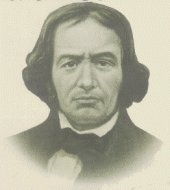
1829
Thimonnier’s machine made straight seams with a chain stitch, similar to the stitch described in Thomas Saint’s earlier model.
1832
Walter Hunt invented the first American lockstitch sewing machine in 1832.
1841
British partners Newton and Archibold introduced the eye-pointed needle and two pressing surfaces to hold fabric in position in 1841.
1844
English inventors John Fisher and James Gibbons produced a machine using an eye-pointed needle carrying one thread and a shuttle carrying the other to make a double-loop chain stitch.
1830
In 1830, Thimonnier and his partners opened the world’s first machine-based clothing manufacturing company to produce army uniforms for the French Army.
1857
Willcox & Gibbs commercial sewing machines continued to be used into the 21st century, with spare parts available.
1859
William Jones started making sewing machines in 1859.
1860 - 1863
As Chadwick & Jones, the partners manufactured sewing machines at Ashton-under-Lyne, England, until 1863.
1860
William Jones formed a partnership with Thomas Chadwick in 1860.
1869
William Jones opened a sewing-machine factory in Guide Bridge, Manchester, in 1869.
1877
Joseph M. Merrow, president of a company that had begun in the 1840s as a machine shop for specialized knitting machinery, invented and patented the world’s first crochet machine in 1877.
Image source: Merrow Sewing Machine Company
1877
The Merrow Machine Company became one of the largest American manufacturers of overlock sewing machines and remained, into the 21st century, the last American overlock sewing-machine manufacturer.
1885
Singer patented the Singer Vibrating Shuttle sewing machine in 1885, using Allen B. Wilson’s idea for a vibrating shuttle.
Image source: Singer Corporation
1885 - 1900
Millions of Singer Vibrating Shuttle machines were produced. They were described as perhaps the first genuinely practical sewing machines for domestic use before rotary-shuttle machines superseded them in the twentieth century.
1893
A Jones advertising sheet from 1893 claimed that the Guide Bridge factory was the largest factory in England devoted exclusively to making first-class sewing machines.
1830
In 1830, Thimonnier signed a contract with Auguste Ferrand, a mining engineer who prepared the requisite drawings and submitted a patent application.
Jul 17, 1830
A patent for Thimonnier’s sewing machine was issued on 17 July 1830.
1832 - 1854
Walter Hunt eventually lost interest in his machine and sold individual machines without promptly patenting the invention. He obtained a patent only at a late date, in 1854.
1842
John Greenough patented the first sewing machine in the United States in 1842.
Image source: Noble and Greenough School
1845
Elias Howe, born in Spencer, Massachusetts, created a sewing machine in 1845 using a method similar to Fisher’s. His machine held the fabric vertically.
Image source: Elias Howe
1845
The Fisher and Gibbons machine, together with John Duncan’s machine, was adapted into a form that became part of a court case challenging Elias Howe’s 1845 patent.
1851
Isaac Merritt Singer was granted an American patent for a sewing machine in 1851.
1854
Elias Howe won a patent-infringement case in 1854 and received the right to claim royalties from manufacturers using ideas covered by his patent, including Singer.
1854
Walter Hunt patented his earlier lockstitch invention in 1854, after having sold individual machines without initially patenting it.
1856 - 1877
The Sewing Machine Combination was formed in 1856 by Singer, Howe, Wheeler, Wilson, and Grover and Baker. It lasted until 1877, when the last patent expired.
Jun 2, 1857
James Edward Allen Gibbs, a farmer from Raphine in Rockbridge County, Virginia, patented the first chain-stitch single-thread sewing machine on 2 June 1857.
Image source: James Edward Allen Gibbs
1845 - 1900
Works including Benjamin Disraeli’s Sybil, Honoré de Balzac’s Splendeurs et misères des courtisanes, Emile Zola’s Au Bonheur des Dames, and Theodore Dreiser’s Sister Carrie explored related social and economic themes.
1848
Elizabeth Gaskell’s Mary Barton, published in 1848 and set in Manchester, exemplified literary themes associated with industrial work, women’s labor, and clothing manufacture.
Image source: Mary Barton
1850 - 1870
Mid-nineteenth-century laws sought to regulate child labor and prioritize education, but these initiatives often conflicted with the realities faced by rural families.
Image source: Child labour
1850 - 1860
Helen Rogers observed that by mid-century the needlewoman had become an iconic figure in the Victorian imagination.
1851 - 1860
Pam Inder highlighted concerns that helped fuel demands for higher wages for men, allowing women to remain at home and reinforcing the Victorian belief that women should not work for pay outside the domestic sphere.
1851
Louise Tilly and Joan Scott noted that nearly half of women workers in England held manufacturing jobs in 1851.
1864 - 1866
Public debates surrounding the Contagious Disease Acts of 1864 and 1866 highlighted opposing views about gender, work, morality, and social regulation.
Image source: Contagious Diseases Acts
Or browse the full history timeline directory, with more than 2,500 topics.
This History of the Sewing Machine timeline was generated with the help of AI, using information found on the internet.
We work hard to keep these timelines accurate, but mistakes do get through. If you spot one, email us at [email protected] and we'll fix it for future visitors.
Generate yours with AI or build it from scratch, for free.
Export your timeline, add your own events, edit or remove AI-generated events, and much more
No credit card required.
Cancel anytime.
Cancel anytime.
You can create an unlimited number of timelines with up to 10 events on each one, customize how they look, export them to PDF, PNG, PowerPoint, CSV, and Excel, and share them with a link. Paid plans raise the event limit and add features like spreadsheet imports and collaborators.
Yes. You can cancel your subscription from your account page at any time, and you will not be charged again. Your subscription stays active for the rest of the period you already paid for.
Yes. We will email you a reminder before the annual renewal, and we will also email you a receipt.
Yes. You can email us within 15 days of any payment, and we will issue you a full refund.
Check out our pricing docs or send us an email anytime: [email protected].