-
Use Cases
-
Resources
-
Pricing
Sep 17, 1787
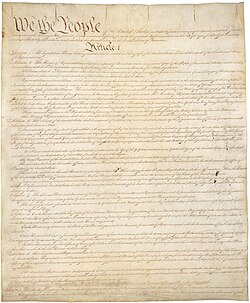
The United States Constitution was adopted on September 17, 1787. Its allocation of authority over naturalization and immigration later provided the constitutional foundation for federal regulation of citizenship and admission.
Image source: Constitution of the United States
1790
Congress passed the first federal naturalization law in 1790. It limited naturalization to free white persons of good moral character who had resided in the United States for two years.
Image source: Naturalization Act of 1790
1795
The Naturalization Act of 1795 increased the residency requirement for citizenship to five years and required applicants to give three years’ notice of their intention to naturalize.
1798 - 1802
The Naturalization Act of 1798 increased the required period of residence to fourteen years and required five years’ notice of intent to seek citizenship.
Jun 1798 - Jul 1798
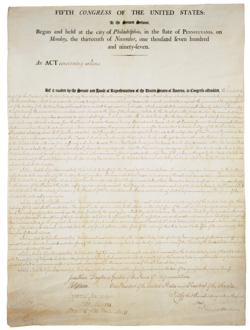
The Fifth Congress passed and President John Adams signed the Alien and Sedition Acts in June and July 1798. The measures expanded federal power over aliens and included laws concerning alien enemies, immigration, and political dissent.
Image source: Alien and Sedition Acts
1802
The Naturalization Law of 1802 repealed and replaced the 1798 naturalization law. It restored a five-year residency requirement and helped establish the basic federal naturalization framework that remained influential for decades.
1802
By 1802, the Alien Enemies Act was the only one of the four Alien and Sedition Acts still in force. It authorized measures against nationals of hostile foreign states during declared war.
1819
The Steerage Act of 1819 became the first United States law regulating conditions of transportation for people arriving and departing by sea. It required ship manifests and helped create the basis for federal immigration statistics.
1857
In Dred Scott v. Sandford, the Supreme Court ruled that people of African descent were not included among constitutional citizens. The decision deepened racial divisions and was later effectively nullified by constitutional amendments.
Image source: Dred Scott v. Sandford
1866
The Civil Rights Act of 1866 declared people born in the United States, with specified exceptions, to be citizens regardless of race or previous condition of slavery. It established an important statutory basis for birthright citizenship.
1868
Ratified in 1868, the Fourteenth Amendment provided that all persons born or naturalized in the United States and subject to its jurisdiction were citizens of the United States and the state where they resided.
Image source: Fourteenth Amendment to the United States Constitution
1870
In 1870, federal naturalization law was broadened to allow African Americans to become naturalized citizens. The change expanded eligibility while retaining racial restrictions affecting other groups.
1898
In United States v. Wong Kim Ark, the Supreme Court applied the Fourteenth Amendment to the child of Chinese citizens legally resident in the United States. The decision affirmed birthright citizenship, subject to limited exceptions such as children of diplomats.
1923
The Supreme Court’s 1923 decision in United States v. Bhagat Singh Thind classified South Asian Indians as non-white for naturalization purposes. Some previously naturalized Indians consequently faced efforts to revoke their citizenship.
1946
The Luce–Celler Act of 1946 ended discrimination against Filipino and Indian Americans in naturalization. It also created a quota of one hundred immigrants per year for each group.
1875
The Page Act of 1875 became the first federal statute restricting immigration. It particularly targeted the entry of Chinese women and people suspected of entering for contract labor or immoral purposes.
1882
After large-scale Chinese immigration, Congress passed the Chinese Exclusion Act in 1882. It limited further Chinese labor immigration and marked a major expansion of race-based federal exclusion.
Aug 1882
Beginning in August 1882, shipping companies landing non-U.S. citizens were required to pay a federal head tax of fifty cents per passenger. The tax was subsequently increased several times.
1884
Amendments made in 1884 tightened the rules governing Chinese immigrants’ departure and return and clarified that the restrictions applied to ethnic Chinese regardless of their country of origin.
1885
Congress passed the Alien Contract Labor Law in 1885 to restrict the importation of workers under prearranged labor contracts. It reflected growing concern about employers using foreign labor to undermine domestic wages and conditions.
1891
The Immigration Act of 1891 assumed federal control over immigration regulation from the states. It excluded people with contagious diseases and required excluded immigrants to be returned at shipping companies’ expense.
1892
The Geary Act renewed Chinese exclusion for another ten years in 1892 and added enforcement provisions. The exclusion system was extended again in 1902 without a terminal date.
1902
In 1902, Chinese exclusion was renewed without a terminal date. The exclusion laws remained in place until their repeal in 1943, although large-scale Chinese immigration did not resume until 1965.
1903
After President William McKinley was assassinated by an anarchist of immigrant parentage, Congress enacted the Anarchist Exclusion Act in 1903. It excluded known anarchist agitators and expanded ideological grounds for exclusion.
1907
Under the Gentlemen’s Agreement, Japan agreed to stop issuing passports to citizens seeking to emigrate to the United States. The arrangement restricted Japanese labor immigration without taking the form of a conventional exclusion statute.
1913
California’s 1913 Alien Land Law restricted land ownership by aliens ineligible for citizenship. The state measure reflected the intersection of immigration status, racial classification, and property rights.
1917
The Immigration Act of 1917 added a literacy test to federal immigration law. Congress overrode President Woodrow Wilson’s veto after earlier literacy bills had been vetoed by Presidents Cleveland, Taft, and Wilson.
1943
The Chinese exclusion laws were repealed in 1943. The repeal ended formal exclusion but initially preserved a small quota for Chinese immigration.
1891
Federal control under the 1891 legislation led to the establishment of the Federal Bureau of Immigration. The bureau became the central federal institution responsible for administering immigration inspection and exclusion.
Jan 1, 1892
The federal immigration inspection station at Ellis Island opened in 1892. It became the best-known gateway for inspection of immigrants arriving in the United States.
Image source: Ellis Island
Dec 1900
The original Ellis Island immigration facility burned in 1897. A replacement facility reopened in December 1900 and continued federal inspection operations.
1906
The Naturalization Act of 1906 created the Bureau of Immigration and Naturalization, centralized naturalization records, and imposed uniform nationwide procedures, forms, and certificates. Courts were required to follow bureau procedures before naturalizing applicants.
1921
The Emergency Quota Act of 1921 established national immigration quotas for the Eastern Hemisphere. Each country’s quota was based on three percent of the foreign-born population of that nationality recorded in the 1910 census.
1924
The Immigration Act of 1924 replaced the emergency quota system with the National Origins Formula. It set quotas based on the national origins of the white American population and left Western Hemisphere immigration unrestricted.
Mar 4, 1929
The Sabath Act of March 4, 1929, addressed declarations of intention in naturalization proceedings. It formed part of the period’s broader effort to regulate and standardize citizenship procedures.
1932 - 1933
During the Great Depression, President Hoover and the State Department effectively shut down much immigration. Annual immigration fell from 236,000 in 1929 to 23,000 in 1933.
Image source: Great Depression
1952
The McCarran–Walter Act revised the National Origins Formula and created a four-class preference system for immigration. For the first time, racial distinctions were omitted from the United States Code, although the quota structure remained.
1965
The Hart–Celler Act abolished the national-origins quota system. It reorganized immigration around family reunification and employment preferences and became the foundation of the modern visa system.
1980
The Refugee Act of 1980 established comprehensive refugee policies and redefined “refugee” in accordance with United Nations norms. It created a more systematic process for refugee admissions and asylum policy.
1986
The Immigration Reform and Control Act created penalties for employers who knowingly hired undocumented immigrants. It also granted amnesty to millions of undocumented immigrants who met specified requirements.
1990
The Immigration Act of 1990 expanded the 1965 system, increased the total immigration limit to 700,000, and increased available visas by forty percent. It also changed responsibility for naturalization.
Oct 1, 1991
Effective October 1, 1991, authority to naturalize people moved from courts to the United States Attorney General, who delegated it to the Commissioner of the Immigration and Naturalization Service.
1996
Several laws signed in 1996 marked a turn toward harsher policies for legal and undocumented immigrants. The resulting enforcement framework contributed to the deportation of well over two million people since 1996.
2001
The DREAM Act was initially introduced in 2001 to provide certain undocumented immigrants brought to the United States as children with a possible path to legal status. It was later incorporated into broader proposals and reintroduced separately in 2009 and 2010.
Sep 11, 2001
The terrorist attacks of September 11, 2001, changed American perspectives on immigration and national security. Immigration enforcement, screening, and border security subsequently received increased policy attention.
Image source: September 11 attacks
2003
After 2003, the Immigration and Naturalization Service was divided among agencies in the newly created Department of Homeland Security. USCIS handles naturalization and immigration services, ICE handles enforcement, and CBP handles border inspections.
Image source: United States Department of Homeland Security
2005
The REAL ID Act of 2005 changed some visa limits, tightened asylum restrictions, made it easier to exclude suspected terrorists, and removed restrictions on constructing border fences.
2005 - 2007
From 2005 through 2007, Congress debated comprehensive immigration reform proposals involving legalization, guest-worker programs, and enhanced border security. Senate and House bills conflicted, and the 2007 proposal did not become law.
2010
Arizona SB 1070, passed in 2010, made failure to carry immigration documents a state misdemeanor. It also authorized immigration-status verification for people stopped or arrested by state police, subject to subsequent legal challenges.
Image source: Arizona SB 1070
Apr 17, 2013
On April 17, 2013, the Senate’s Gang of Eight introduced S.744, a major immigration reform bill. The proposal included legalization, changes to legal immigration, and border-security measures.
Jun 27, 2013
The Senate passed S.744 on June 27, 2013, by a vote of 68–32. The bill did not become law after failing to advance through the House of Representatives.
Nov 21, 2014
On November 21, 2014, President Barack Obama signed two executive actions that had the effect of delaying deportation for millions of undocumented immigrants. The actions became the subject of extensive political and legal disputes.
Image source: Deferred Action for Childhood Arrivals
Mar 2020 - May 11, 2023
In March 2020, the Trump administration launched the Title 42 immigration policy, using public-health authority to expel many people encountered at the border. The policy terminated on May 11, 2023, when the COVID-19 public health emergency was lifted.
2021
In 2021, the Biden administration introduced the U.S. Citizenship Act in the House of Representatives. The proposal addressed legal status, citizenship, family immigration, employment immigration, and border administration.
Or browse the full history timeline directory, with more than 2,500 topics.
This History of US Immigration Law timeline was generated with the help of AI, using information found on the internet.
We work hard to keep these timelines accurate, but mistakes do get through. If you spot one, email us at [email protected] and we'll fix it for future visitors.
Generate yours with AI or build it from scratch, for free.
Export your timeline, add your own events, edit or remove AI-generated events, and much more
No credit card required.
Cancel anytime.
Cancel anytime.
You can create an unlimited number of timelines with up to 10 events on each one, customize how they look, export them to PDF, PNG, PowerPoint, CSV, and Excel, and share them with a link. Paid plans raise the event limit and add features like spreadsheet imports and collaborators.
Yes. You can cancel your subscription from your account page at any time, and you will not be charged again. Your subscription stays active for the rest of the period you already paid for.
Yes. We will email you a reminder before the annual renewal, and we will also email you a receipt.
Yes. You can email us within 15 days of any payment, and we will issue you a full refund.
Check out our pricing docs or send us an email anytime: [email protected].