-
Use Cases
-
Resources
-
Pricing
Volkswagen (meaning 'people's car' in German) was founded in 1937 and grew from a state-sponsored project to produce an affordable automobile into one of the world's largest car manufacturers. Its iconic Beetle became a global symbol of affordable mobility, followed by successful models like the Golf and Passat. The company's history also includes major challenges, such as its wartime role and the 2015 Dieselgate emissions scandal. More Less
May 28, 1933
% complete
At the Berlin Motor Show, Adolf Hitler called for the development of an affordable car for ordinary Germans, capable of carrying two adults and three children at 100 km/h. This vision led to the creation of the Volkswagen project, with Ferdinand Porsche commissioned to design the vehicle.
Image source: Volkswagen
Jun 22, 1934
% complete
The German government signed a contract with Ferdinand Porsche's design firm to develop the KdF-Wagen, the car that would become the Beetle. Porsche's engineering team created a rear-engine, air-cooled design that proved remarkably durable and influential.
Image source: Ferdinand Porsche
May 28, 1937
% complete
The state-owned Gesellschaft zur Vorbereitung des Deutschen Volkswagens was established, later renamed Volkswagenwerk GmbH. A massive factory was built near Fallersleben in Lower Saxony, in a new town that became known as Wolfsburg.
May 26, 1938
% complete
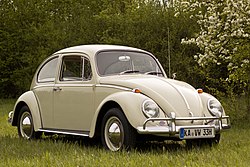
The cornerstone of the new Wolfsburg factory was laid and the KdF-Wagen ('Strength Through Joy car') was presented. Germans could save toward purchasing one through a savings plan, though few buyers ever received their cars due to the outbreak of war.
Image source: Volkswagen Beetle
Sep 1, 1939 - Apr 1945
% complete
With World War II underway, the Wolfsburg plant shifted to producing military vehicles such as the Kübelwagen and Schwimmwagen, along with munitions. The factory relied heavily on forced labor from prisoners of war and concentration camp inmates.
Jun 1945
% complete
After the war, British occupation forces took control of the heavily damaged Wolfsburg plant under Major Ivan Hirst. Rather than dismantling it as reparations, the British ordered production of the Beetle for occupation forces, reviving the company.
Jan 1, 1948
% complete
Former Opel executive Heinrich Nordhoff took charge of Volkswagen, transforming it into one of the world's most successful automakers. He focused on quality improvement, dealer networks, exports, and continuous refinement of the Beetle.
Image source: Heinrich Nordhoff
Jan 1949
% complete
Two Beetles were shipped to New York by Dutch importer Ben Pon, marking the beginning of Volkswagen's export business. The Beetle would go on to achieve extraordinary popularity in America during the 1950s and 1960s.
Aug 5, 1955
% complete
Volkswagen celebrated the production of its one millionth Beetle at the Wolfsburg plant, cementing its status as Germany's leading automaker and demonstrating the remarkable success of Nordhoff's postwar strategy.
May 1960
% complete
Volkswagen was converted into a joint-stock company, with the German federal government and the state of Lower Saxony each holding 20 percent of shares, while the rest was sold to the public. This structure remains largely intact today.
Image source: Volkswagen Group
Jul 1961
% complete
The Type 3, including the Notchback and Squareback variants, expanded Volkswagen's lineup with a more conventional sedan body on the Beetle's mechanical platform, offering customers greater comfort and luggage space.
Image source: Volkswagen Type 3
Jan 1, 1965
% complete
Volkswagen acquired Auto Union GmbH from Daimler-Benz, gaining the Audi brand and front-wheel-drive technology. The Ingolstadt-based manufacturer became the foundation for VW's move into larger, more modern vehicles beyond the rear-engined Beetle.
Image source: Audi
Feb 17, 1972
% complete
The 15,007,034th Beetle rolled off the line, surpassing the Ford Model T as the world's most-produced single automobile model, a testament to the enduring appeal of Porsche's original design.
May 1973
% complete
The first-generation Passat, based on the Audi 80, marked Volkswagen's transition to modern front-wheel-drive, water-cooled vehicles. It became a mainstay of the mid-size segment and one of VW's best-selling models worldwide.
Image source: Volkswagen Passat
May 1974
% complete
Designed by Giorgetto Giugiaro, the front-wheel-drive Golf replaced the Beetle as Volkswagen's core product. Its hatchback format defined the compact class and became one of the best-selling cars in history, with over 35 million units sold across generations.
Image source: Volkswagen Golf
Jan 19, 1978
% complete
Production of the Beetle ended at the Wolfsburg plant after nearly four decades, as Volkswagen fully committed to its new water-cooled model range. Beetle production continued abroad, notably in Mexico and Brazil.
Apr 10, 1978
% complete
Volkswagen opened its first American manufacturing facility in Westmoreland County, Pennsylvania, becoming the first foreign automaker since World War II to build cars in the United States. The plant built Rabbits until closing in 1988.
Image source: Volkswagen Westmoreland Assembly
Jan 1, 1982
% complete
Carl Hahn returned from leading Volkswagen of America to become chairman, launching an aggressive internationalization strategy that included joint ventures in China and Spain and a focus on making Volkswagen a truly global automaker.
Image source: Carl Hahn
Oct 1984
% complete
Volkswagen formed Shanghai Volkswagen Automotive, one of the earliest Western auto joint ventures in China. The partnership proved enormously successful, making China Volkswagen's largest single market within two decades.
Image source: SAIC Volkswagen
Jun 1986
% complete
Volkswagen acquired a majority stake in Spanish automaker SEAT, adding a third brand to the group. SEAT provided access to the Spanish market and became a key volume brand within the expanding Volkswagen Group.
Image source: SEAT
Apr 16, 1991
% complete
Following the fall of communism, Volkswagen acquired a stake in Czech automaker Škoda, revitalizing the historic brand. Škoda grew into one of the group's fastest-growing and most profitable marques.
Image source: Škoda Auto
Jan 1, 1993
% complete
Ferdinand Piëch, grandson of Ferdinand Porsche, took over leadership of Volkswagen. His tenure brought ambitious engineering projects, dramatic cost cutting, platform sharing, and the acquisition of luxury brands that transformed the group.
Image source: Ferdinand Piëch
Mar 1998
% complete
Volkswagen introduced the retro-styled New Beetle, based on the Golf platform, which revived nostalgia for the original and boosted sales significantly, particularly among younger American buyers.
Image source: Volkswagen New Beetle
Jul 1998
% complete
Under Piëch, Volkswagen purchased Rolls-Royce and Bentley from Vickers, acquiring Bentley outright while ceding Rolls-Royce to BMW, and also gained control of Italian supercar maker Lamborghini and French hypercar marque Bugatti.
Nov 2008
% complete
Porsche SE, controlled by the Porsche and Piëch families, dramatically increased its stake in Volkswagen amid a failed takeover attempt of VW by Porsche. The ensuing squeeze on short sellers briefly made Volkswagen the world's most valuable company.
Image source: Porsche SE
Dec 2009
% complete
After financial difficulties forced Porsche to abandon its takeover bid, the two companies agreed to create an integrated automotive group, with Volkswagen acquiring a controlling interest in Porsche AG, completing a remarkable reversal of roles.
Jan 2010
% complete
Volkswagen Group surpassed Toyota in some quarterly sales figures and solidified its position as one of the world's largest automakers, driven by strong growth in China and an expanding multi-brand portfolio.
Sep 18, 2015
% complete
The US EPA accused Volkswagen of installing defeat devices in diesel vehicles to cheat emissions tests. The scandal affected about 11 million vehicles worldwide, cost the company tens of billions of dollars in fines and settlements, and led to CEO Martin Winterkorn's resignation.
Image source: Volkswagen emissions scandal
Jun 2016
% complete
New CEO Matthias Müller announced a sweeping strategic overhaul emphasizing electric vehicles, digitalization, and autonomous driving, pledging to make Volkswagen a leader in sustainable mobility following the emissions crisis.
Apr 13, 2018
% complete
Herbert Diess took charge of the Volkswagen Group, committing billions to electrification, launching the ID series of electric vehicles, and positioning the group to compete directly with Tesla in the emerging EV market.
Image source: Herbert Diess
Jul 10, 2019
% complete
The last of more than 21.5 million modern-era Beetles was produced at the Puebla, Mexico plant, ending 81 years of Beetle production and closing a defining chapter in automotive history.
Sep 1, 2022
% complete
Oliver Blume, previously head of Porsche, replaced Herbert Diess as Volkswagen Group CEO, tasked with steering the company through the challenging transition to electric mobility amid supply chain disruptions and intensifying competition.
Image source: Oliver Blume
Or browse the full history timeline directory, with more than 2,000 topics.
This History of Volkswagen timeline was generated with the help of AI, using information found on the internet.
We work hard to keep these timelines accurate, but mistakes do get through. If you spot one, email us at [email protected] and we'll fix it for future visitors.
Generate yours with AI or build it from scratch, for free.
Export your timeline, add your own events, edit or remove AI-generated events, and much more
No credit card required.
Cancel anytime.
Cancel anytime.
You can create an unlimited number of timelines with up to 10 events on each one, customize how they look, export them to PDF, PNG, PowerPoint, CSV, and Excel, and share them with a link. Paid plans raise the event limit and add features like spreadsheet imports and collaborators.
Yes. You can cancel your subscription from your account page at any time, and you will not be charged again. Your subscription stays active for the rest of the period you already paid for.
Yes. We will email you a reminder before the annual renewal, and we will also email you a receipt.
Yes. You can email us within 15 days of any payment, and we will issue you a full refund.
Check out our pricing docs or send us an email anytime: [email protected].