-
Use Cases
-
Resources
-
Pricing
Zeppelins are rigid airships manufactured by the Zeppelin company, pioneered by Count Ferdinand von Zeppelin in Germany. These massive lighter-than-air vessels dominated long-distance air travel in the early 20th century, used for passenger transport, military bombing raids in World War I, and transatlantic flights, until the 1937 Hindenburg disaster and the rise of airplanes ended their golden age. More Less
Jul 8, 1838
% complete
Ferdinand von Zeppelin, the German army officer and inventor who would go on to found the airship industry bearing his name, was born in Konstanz, Grand Duchy of Baden. His experiences observing military balloon use during the American Civil War inspired his later pursuit of rigid airship development.
Image source: Ferdinand von Zeppelin
Aug 31, 1895
% complete
Count Ferdinand von Zeppelin received a patent for his design of a navigable rigid airship in Germany. The design featured a rigid aluminum framework containing multiple gas bags, a radical departure from earlier non-rigid balloons and airships.
Image source: Zeppelin
1898
% complete
Zeppelin founded a joint stock company to raise funds for building his airships, attracting initial investments from industrialists. This organization financed the construction of LZ 1 and early experimental flights on Lake Constance.
Jul 2, 1900
% complete
The LZ 1, Count Zeppelin's first rigid airship, made its maiden flight over Lake Constance near Friedrichshafen, Germany. The 420-foot-long craft remained aloft for about 18 minutes and carried five passengers, proving the feasibility of the rigid airship concept despite limited performance.
Image source: Zeppelin LZ 1
Jan 17, 1906
% complete
LZ 2, the successor to LZ 1, suffered engine failure during its only flight and crash-landed near Kisslegg. The wreck was later destroyed by a storm, but lessons learned from the failure informed subsequent designs.
Image source: LZ 2
Oct 9, 1906
% complete
LZ 3 completed successful flights demonstrating improved reliability and control, including flights lasting several hours. These successes convinced the German government of the military potential of rigid airships.
Image source: LZ 3
Mar 1908
% complete
Following trials of LZ 4, the German Army expressed serious interest in purchasing Zeppelin airships, marking official state recognition of their military value and providing crucial funding for continued development.
Image source: LZ 4
Aug 5, 1908
% complete
LZ 4 caught fire and was destroyed at Echterdingen after being torn from its moorings by a storm. Remarkably, the disaster triggered an outpouring of public sympathy and donations exceeding six million marks, securing the future of the Zeppelin enterprise.
Nov 7, 1908
% complete
Using funds raised after the Echterdingen disaster, Luftschiffbau Zeppelin was formally established as a company dedicated to airship construction. It would become the leading manufacturer of rigid airships in the world.
Nov 16, 1909
% complete
Deutsche Luftschiffahrts-Aktiengesellschaft (DELAG) was established as the world's first commercial airline, using Zeppelin airships to carry passengers between German cities. By 1914 it had transported tens of thousands of passengers without a single fatality.
Image source: DELAG
1918
% complete
Following Count Zeppelin's death in 1917, Hugo Eckener assumed leadership of Luftschiffbau Zeppelin. An accomplished pilot and publicist, Eckener championed civilian airship travel and guided the company through the postwar period under Allied restrictions.
Image source: Hugo Eckener
1920
% complete
As part of war reparations, Germany delivered several airships to the Allies, including the LZ 126 which became USS Los Angeles for the United States Navy. The transfers spread Zeppelin technology abroad and kept German shipyards active during the Versailles-imposed restrictions.
Image source: USS Los Angeles (ZR-3)
Sep 18, 1928
% complete
The LZ 127 Graf Zeppelin, the most successful rigid airship ever built, made its maiden flight from Friedrichshafen. Over nearly a decade of service it flew over a million miles, carrying passengers across oceans and continents with an unmatched safety record.
Oct 11, 1928 - Oct 15, 1928
% complete
The Graf Zeppelin crossed the Atlantic from Friedrichshafen to Lakehurst, New Jersey, carrying 20 passengers and completing the first scheduled transatlantic passenger air service by airship. Commander Hugo Eckener became an international celebrity.
Aug 8, 1929 - Aug 29, 1929
% complete
Sponsored partly by American newspaper magnate William Randolph Hearst, the Graf Zeppelin circumnavigated the globe in 21 days, covering roughly 21,000 miles via Tokyo, San Francisco, Los Angeles, and New York. The feat electrified the world press.
Jul 24, 1931 - Jul 31, 1931
% complete
The Graf Zeppelin undertook an Arctic scientific expedition, flying from Berlin over the Barents Sea and Franz Josef Land to meet the Soviet icebreaker Malygin. The mission gathered valuable meteorological and magnetic data.
May 1932
% complete
The Graf Zeppelin commenced scheduled service between Germany and Brazil, cutting the journey to Rio de Janeiro to days rather than weeks. Regular mail and passenger flights across the South Atlantic proved commercially viable.
Mar 4, 1936
% complete
The Hindenburg, the largest aircraft ever built at 804 feet in length, made its maiden flight from Friedrichshafen. Designed for transatlantic service, it offered luxurious passenger accommodations including dining rooms, lounges, and private cabins.
Image source: LZ 129 Hindenburg
May 6, 1936 - Oct 9, 1936
% complete
The Hindenburg completed ten round trips between Europe and North America in its inaugural season, carrying over a thousand passengers at speeds far faster than ocean liners. It also flew a propaganda tour over Nuremberg rallies and the Rhineland.
May 6, 1937
% complete
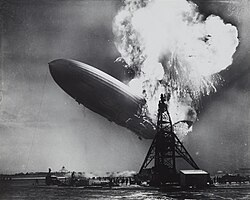
While landing at Naval Air Station Lakehurst, New Jersey, the hydrogen-filled Hindenburg burst into flames and was destroyed in seconds. Thirty-five people aboard and one crewman on the ground died. Herbert Morrison's anguished radio broadcast ('Oh, the humanity!') shocked the world and effectively ended the era of passenger airship travel.
Image source: Hindenburg disaster
Jun 30, 1937
% complete
In the wake of the Hindenburg disaster, the Graf Zeppelin was withdrawn from passenger service and housed alongside the unfinished LZ 130 in a hangar at Frankfurt. Public confidence in hydrogen-filled airships had collapsed irreversibly.
Jan 19, 1915
% complete
German Navy Zeppelins conducted the first air raid on Great Britain, bombing Great Yarmouth and King's Lynn. The raids inaugurated strategic bombing from the air and terrorized British civilians throughout the war.
Image source: Strategic bombing during World War I
Sep 3, 1916
% complete
Lieutenant William Leefe Robinson shot down the German Army airship SL 11 over Cuffley, England, using incendiary ammunition. The burning airship fell spectacularly before crowds, marking a turning point as improved British defenses began inflicting heavy losses on Zeppelins.
Image source: Leefe Robinson
1917
% complete
Mounting losses from British fighters, incendiary bullets, and adverse weather forced Germany to largely abandon Zeppelin raids on Britain in favor of long-range bombers like the Gotha G.IV. Around 80 airships were lost during the war overall.
1928 - 1940
% complete
The Goodyear-Zeppelin Corporation in Akron, Ohio, built the USS Akron (1931) and USS Macon (1933), the largest rigid airships ever flown by the United States. Both were lost in accidents by 1935, ending American interest in rigid airships, though Goodyear continued building non-rigid blimps.
Image source: Goodyear Aerospace
Mar 1940
% complete
Air Marshal Hermann Göring ordered both the Graf Zeppelin and LZ 130 broken up for scrap to provide aluminum for the German war effort. Their giant hangars at Frankfurt were demolished, closing the chapter on German rigid airships.
1942 - 1945
% complete
Although not true Zeppelins, American non-rigid airships (blimps) escorted convoys and hunted U-boats throughout World War II, flying millions of miles and escorting thousands of ships without a single convoy loss under their protection.
Image source: Blimp
1988
% complete
Engineers at Zeppelin Luftschifftechnik began developing the Zeppelin NT (New Technology), a modern semi-rigid airship using helium, composite structures, and vectored thrust engines. It revived the Zeppelin name for the twenty-first century.
Image source: Zeppelin NT
Sep 18, 1997
% complete
The first Zeppelin NT took to the skies over Friedrichshafen, exactly 97 years after the original LZ 1. The 75-meter craft demonstrated modern safety, maneuverability, and efficiency, and soon entered tourist and research service.
2008 - 2012
% complete
California-based Airship Ventures operated a Zeppelin NT named Eureka for sightseeing flights over San Francisco Bay and other locations, bringing the Zeppelin experience to American skies before ceasing operations in 2012.
Image source: Airship Ventures
Jul 2020
% complete
A Zeppelin NT operated by Deutsche Zeppelin-Reederei set endurance records with multi-day flights over Germany conducting atmospheric research, showcasing the enduring utility of airships for surveillance, science, and tourism more than a century after LZ 1.
Or browse the full history timeline directory, with more than 2,000 topics.
This Zeppelins timeline was generated with the help of AI, using information found on the internet.
We work hard to keep these timelines accurate, but mistakes do get through. If you spot one, email us at [email protected] and we'll fix it for future visitors.
Generate yours with AI or build it from scratch, for free.
Export your timeline, add your own events, edit or remove AI-generated events, and much more
No credit card required.
Cancel anytime.
Cancel anytime.
You can create an unlimited number of timelines with up to 10 events on each one, customize how they look, export them to PDF, PNG, PowerPoint, CSV, and Excel, and share them with a link. Paid plans raise the event limit and add features like spreadsheet imports and collaborators.
Yes. You can cancel your subscription from your account page at any time, and you will not be charged again. Your subscription stays active for the rest of the period you already paid for.
Yes. We will email you a reminder before the annual renewal, and we will also email you a receipt.
Yes. You can email us within 15 days of any payment, and we will issue you a full refund.
Check out our pricing docs or send us an email anytime: [email protected].