-
Use Cases
-
Resources
-
Pricing
The history of electric cars spans nearly two centuries, beginning with early battery-powered vehicles in the 1830s and peaking in popularity around 1900 before gasoline cars took over. After decades of decline, concerns over pollution and oil dependence sparked a revival in the late 20th century, leading to today's rapidly growing electric vehicle market led by companies like Tesla, Nissan, and BYD. More Less
1832 - 1839
% complete
Robert Anderson is often credited with inventing the first electric car some time between 1832 and 1839, a crude early vehicle that demonstrated the potential of electric propulsion long before practical automobiles existed.
Image source: History of the electric vehicle
1881
% complete
In 1881, Gustave Trouvé presented an electric car driven by an improved Siemens motor at the Exposition internationale d'Électricité de Paris, an early milestone in demonstrating electric vehicle technology to the public.
Image source: Gustave Trouvé
1882
% complete
In 1882, Werner von Siemens presented the Electromote in Berlin, the world's first trolleybus, showcasing early applications of electric traction for road transport.
Image source: Electromote
1884
% complete
In 1884, Thomas Parker built an electric car in Wolverhampton, England using his own specially designed high-capacity rechargeable batteries, although the only documentation is a photograph from 1895.
Image source: Thomas Parker (inventor)
1888
% complete
In 1888, the German Andreas Flocken designed the Flocken Elektrowagen, which is regarded as the first 'real' electric car, a four-wheeled vehicle suitable for use on roads.
Image source: Flocken Elektrowagen
1890
% complete
In 1890, Andrew Morrison introduced the first electric car to the United States, helping spark American interest in electric automobile propulsion.
1897
% complete
In 1897, electric cars found commercial use as taxis in Britain and in the United States, marking their entry into everyday urban transportation.
1897
% complete
In 1897, New York City had a fleet of twelve hansom cabs and one brougham based on the Electrobat II, introduced as part of a project partly funded by the Philadelphia Electric Storage Battery Company.
Image source: Electrobat
1899
% complete
The rocket-shaped La Jamais Contente, driven by Camille Jenatzy, broke the 100 km/h speed barrier by reaching a top speed of 105.88 km/h (65.79 mph) in 1899. It was the last of six electric cars to hold the land speed record in the 19th century.
Image source: La Jamais Contente
1900 - 1939
% complete
During the 20th century, the main US manufacturers of electric vehicles included Anthony Electric, Baker, Columbia, Anderson, Edison, Riker, Milburn Wagon Company (Milburn Light Electric), Bailey Electric, and Detroit Electric.
1912
% complete
A decisive moment came with the 1912 introduction of the electric starter motor, which replaced laborious and dangerous methods such as hand-cranking and helped internal combustion cars overtake electrics in popularity.
Image source: Starter (engine)
2004
% complete
California electric-automaker Tesla Motors began development in 2004 of what became the Tesla Roadster, a lithium-ion battery sports car that would help reignite global interest in electric vehicles.
Image source: Tesla Roadster (first generation)
2008
% complete
The Tesla Roadster was first delivered to customers in 2008, proving that electric cars could offer high performance and long range. Advances in batteries, along with the desire to reduce greenhouse-gas emissions and improve urban air quality, increased interest in EVs in 2008.
2009
% complete
The 2009 Mitsubishi i-MiEV was the first highway-legal series production electric car, and the first to sell more than 10,000 units, paving the way for mass-market electric vehicles.
Image source: Mitsubishi i-MiEV
2010
% complete
The Nissan Leaf, launched in 2010, quickly surpassed the Mitsubishi i-MiEV as the best-selling all-electric car, bringing affordable electric mobility to mainstream consumers worldwide.
Image source: Nissan Leaf
2013
% complete
Better Place developed battery charging and battery swapping services for electric vehicles, but went bankrupt in 2013, illustrating the challenges of building EV infrastructure businesses.
Image source: Better Place (company)
Jul 2019
% complete
In July 2019 Motor Trend awarded the Tesla Model S the title 'ultimate car of the year', recognizing its transformative impact on the automotive industry.
Image source: Tesla Model S
2010 - 2019
% complete
Battery prices decreased from €605 per kWh in 2010, to €170 in 2017, to €100 in 2019, making electric vehicles increasingly affordable and competitive with combustion cars.
Image source: Electric battery
2012
% complete
All-electric cars have outsold plug-in hybrids since 2012, reflecting growing consumer preference for fully battery-powered vehicles.
Image source: Electric car
2015 - 2016
% complete
The Tesla Model S was the world's top selling plug-in electric car in 2015 and 2016, establishing Tesla as a leader in premium electric vehicles.
Dec 2019
% complete
Tesla became the world's leading electric vehicle manufacturer in December 2019, cementing its position at the forefront of the industry.
Image source: Tesla, Inc.
Dec 31, 2019
% complete
China has the largest all-electric car fleet in use, with 2.58 million at the end of 2019, more than half (53.9%) of the world's electric car stock.
Image source: Electric car use by country
Mar 2020
% complete
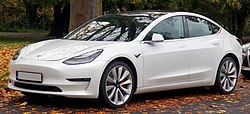
In March 2020 the Tesla Model 3 passed the Nissan Leaf to become the best-selling electric car, with more than 500,000 units delivered; it reached 1 million units in June 2021, becoming the first electric car to pass 1 million global sales.
Image source: Tesla Model 3
Mar 2020
% complete
Tesla produced its 1 millionth electric car in March 2020, becoming the first auto manufacturer to do so, a landmark in the mass production of electric vehicles.
2021
% complete
In the year 2021, the total number of electric cars on the world's roads was about 16.5 million, showing rapid adoption worldwide. Sales of electric cars in the first quarter of 2022 alone increased to 2 million.
2023
% complete
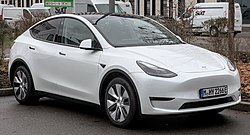
In 2023, the Tesla Model Y became the world's best selling car of any type, a historic first for an electric vehicle. The Model Y had also been the top selling plug-in car in 2022.
Image source: Tesla Model Y
Oct 2023 - Dec 2023
% complete
In the fourth quarter of 2023, BYD surpassed Tesla as the top-selling electric vehicle manufacturer by selling 526,409 battery electric cars, while Tesla delivered 484,507 vehicles. From 2018 to 2023, BYD produced nearly 3.18 million purely plug-in electric cars.
Image source: BYD Auto
2024
% complete
Electric SUVs became cheaper than petrol ones for the first time in 2024 in China, a major price parity milestone, even though electric cars were typically still somewhat more expensive to purchase than ICE cars globally.
Oct 4, 2024 - Oct 30, 2024
% complete
The European Commission, following a vote by EU member states on 4 October 2024, moved to impose definitive countervailing duties on imports of Chinese-manufactured battery electric vehicles, with the duties set to apply by 30 October 2024.
2025
% complete
Worldwide, 21 million plug-in electric cars were sold in 2025, over a quarter of new car sales and up 20% from 2024, demonstrating accelerating global adoption.
Image source: Plug-in electric vehicles in the United States
2025
% complete
For example, Norway set a national goal that by 2025 all new car sales should be ZEVs (battery electric or hydrogen), exemplifying ambitious government policy driving electrification.
Image source: Plug-in electric vehicles in Norway
2026
% complete
In 2026, EVs in the UK had become cheaper to buy than petrol cars, marking a significant affordability breakthrough for British consumers.
Or browse the full history timeline directory, with more than 2,000 topics.
This History of Electric Cars timeline was generated with the help of AI, using information found on the internet.
We work hard to keep these timelines accurate, but mistakes do get through. If you spot one, email us at [email protected] and we'll fix it for future visitors.
Generate yours with AI or build it from scratch, for free.
Export your timeline, add your own events, edit or remove AI-generated events, and much more
No credit card required.
Cancel anytime.
Cancel anytime.
You can create an unlimited number of timelines with up to 10 events on each one, customize how they look, export them to PDF, PNG, PowerPoint, CSV, and Excel, and share them with a link. Paid plans raise the event limit and add features like spreadsheet imports and collaborators.
Yes. You can cancel your subscription from your account page at any time, and you will not be charged again. Your subscription stays active for the rest of the period you already paid for.
Yes. We will email you a reminder before the annual renewal, and we will also email you a receipt.
Yes. You can email us within 15 days of any payment, and we will issue you a full refund.
Check out our pricing docs or send us an email anytime: [email protected].