-
Use Cases
-
Resources
-
Pricing
Tesla, Inc. is an American electric vehicle and clean energy company founded in 2003 by Martin Eberhard and Marc Tarpenning, later shaped by Elon Musk. It revolutionized the automotive industry by proving that electric cars could be desirable, high-performance products, expanding from the original Roadster through mass-market models like the Model 3 while also developing battery storage, solar energy, and autonomous driving technologies. More Less
Jul 1, 2003
% complete
Tesla Motors was founded by engineers Martin Eberhard and Marc Tarpenning with the goal of proving that electric vehicles could be better than gasoline-powered cars. The company was named after inventor Nikola Tesla and set out to accelerate the world's transition to sustainable energy.
Image source: Tesla, Inc.
Jan 1, 2004
% complete
Battery expert JB Straubel joined Tesla as its chief technology officer, playing a crucial role in developing the company's battery systems and powertrain technology. He is widely considered a co-founder alongside Eberhard, Tarpenning, and Musk.
Image source: J. B. Straubel
Oct 1, 2008
% complete
Following a leadership dispute and the departure of founder Martin Eberhard, Elon Musk assumed the role of chief executive officer of Tesla, consolidating his control over the company's direction and operations.
Image source: Elon Musk
Feb 1, 2004
% complete
Elon Musk invested $6.5 million to lead Tesla's Series A funding round, becoming the company's chairman of the board. His involvement brought significant capital and vision that would shape Tesla's long-term strategy of moving from expensive sports cars to affordable mass-market electric vehicles.
Aug 2, 2006
% complete
Elon Musk published Tesla's master plan, outlining the strategy of building an expensive sports car, using those profits to build a more affordable car, and then using those profits to build an even more affordable mass-market car while providing zero-emission electric power generation options.
Dec 1, 2008
% complete
Amid the global financial crisis and costly Roadster production delays, Tesla nearly ran out of money. Elon Musk invested his remaining personal fortune to keep the company alive, closing a financing round on Christmas Eve 2008 that saved Tesla from bankruptcy.
May 19, 2009
% complete
German automaker Daimler AG acquired an equity stake in Tesla for $50 million, validating Tesla's technology and providing critical capital. Daimler also contracted Tesla to supply battery packs for its Smart Fortwo electric drive vehicles.
Jun 29, 2009
% complete
Tesla secured a $465 million loan guarantee from the U.S. Department of Energy to develop the Model S sedan and build manufacturing facilities. The loan was repaid in full nine years early, in May 2013.
May 20, 2010
% complete
Toyota announced a partnership with Tesla, purchasing a $50 million equity stake. Toyota also sold Tesla its former NUMMI factory in Fremont, California, which became Tesla's primary vehicle manufacturing plant.
Jun 29, 2010
% complete
Tesla became the first American automaker to go public since Ford in 1956, raising approximately $226 million by selling shares at $17 each on the Nasdaq exchange. The IPO provided crucial capital for Model S development.
May 22, 2013
% complete
Tesla paid off its $465 million Department of Energy loan nine years ahead of schedule, becoming the only American automaker at the time to have fully repaid such government support, bolstering confidence in the company's financial health.
Nov 21, 2016
% complete
Tesla completed its controversial $2.6 billion all-stock acquisition of SolarCity, the solar panel company founded by Musk's cousins. The deal created a vertically integrated sustainable energy company offering solar generation, storage, and electric vehicles.
Image source: SolarCity
Apr 10, 2017
% complete
Tesla's market capitalization surpassed General Motors', making it the most valuable American automaker despite producing far fewer vehicles. This milestone reflected investor belief in Tesla's growth potential and its position as a technology company rather than a traditional carmaker.
Jul 1, 2017 - Jun 30, 2018
% complete
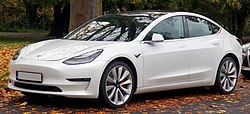
Tesla struggled to scale Model 3 production, with severe bottlenecks particularly in battery module assembly at Gigafactory 1. Musk described the period as 'production hell' and famously slept at the factory while implementing fixes that eventually enabled volume production.
Image source: Tesla Model 3
Dec 21, 2020
% complete
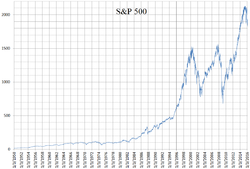
Tesla was added to the S&P 500 index in the largest addition ever at the time, following a year in which its stock surged over 700%. The inclusion forced index funds to purchase billions of dollars of Tesla shares and cemented its status among America's most valuable companies.
Image source: S&P 500
Jan 27, 2021
% complete
Tesla reported its first full calendar year of GAAP profitability, earning $721 million in net income for 2020 after years of losses. The milestone validated the company's business model and marked its transition from speculative startup to established automaker.
Jul 19, 2006
% complete
Tesla publicly unveiled the Roadster prototype at an event in Santa Monica, California. Based on the Lotus Elise chassis, the Roadster promised over 200 miles of range on a single charge, demonstrating that electric cars could be both high-performance and practical.
Image source: Tesla Roadster (first generation)
Feb 1, 2008
% complete
Tesla began delivering production Roadsters to customers, marking the first highway-legal lithium-ion battery electric vehicle produced in series. The Roadster could accelerate from 0 to 60 mph in under four seconds and had a range of about 245 miles.
Jun 22, 2012
% complete
Tesla began delivering the Model S, a full-size luxury electric sedan built at the Fremont factory. The Model S received widespread acclaim, winning Motor Trend's 2013 Car of the Year award and becoming the first electric vehicle to top monthly sales rankings in several countries.
Image source: Tesla Model S
Sep 29, 2015
% complete
Tesla delivered its first Model X electric SUVs, featuring distinctive falcon-wing doors and advanced safety features. The complex vehicle proved challenging to manufacture, causing production delays but showcasing Tesla's engineering ambitions.
Image source: Tesla Model X
Mar 31, 2016
% complete
Tesla unveiled the Model 3, its first mass-market sedan priced around $35,000. Hundreds of thousands of customers placed refundable deposits within days, representing one of the largest product launch responses in automotive history.
Nov 16, 2017
% complete
Tesla revealed the second-generation Roadster concept alongside the Semi truck, claiming extraordinary performance figures including 0-60 mph in under two seconds. The vehicle was positioned as a demonstration of Tesla's ultimate capability, though its release has been repeatedly delayed.
Image source: Tesla Roadster (second generation)
Nov 16, 2017
% complete
Tesla unveiled its Class 8 electric semi-truck, promising ranges up to 500 miles and lower operating costs than diesel trucks. Major companies like Walmart, UPS, and PepsiCo placed reservations, signaling interest in electrifying freight transport.
Image source: Tesla Semi
Mar 14, 2019
% complete
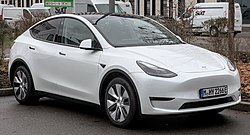
Tesla unveiled the Model Y, a compact crossover SUV sharing much of its platform with the Model 3. Positioned in the fastest-growing segment of the auto market, the Model Y went on to become one of the best-selling vehicles in the world.
Image source: Tesla Model Y
Nov 21, 2019
% complete
Tesla unveiled the radically angular Cybertruck pickup at an event in Los Angeles, where a demonstration of 'shatterproof' windows famously cracked on camera. Despite the mishap, the unconventional design generated enormous public attention and hundreds of thousands of reservations.
Image source: Tesla Cybertruck
Sep 24, 2012
% complete
Tesla unveiled its Supercharger network, a system of fast-charging stations enabling long-distance travel for Model S owners. The network expanded rapidly across North America, Europe, and Asia, addressing one of the biggest barriers to electric vehicle adoption.
Image source: Tesla Supercharger
Jun 12, 2014
% complete
Elon Musk announced that Tesla would not initiate patent lawsuits against anyone using its technology in good faith, opening its patent portfolio to accelerate the adoption of sustainable transport across the automotive industry.
Jul 31, 2014
% complete
Tesla announced plans for Gigafactory 1 near Reno, Nevada, a massive battery factory developed with Panasonic to dramatically reduce lithium-ion cell costs through economies of scale. The factory was essential to producing affordable batteries for the Model 3 and energy products.
Image source: Gigafactory Nevada
Apr 30, 2015
% complete
Tesla unveiled the Powerwall, a rechargeable lithium-ion home battery designed to store solar energy for residential use. Alongside the larger Powerpack for utilities, it marked Tesla's expansion into stationary energy storage.
Image source: Tesla Powerwall
Oct 14, 2015
% complete
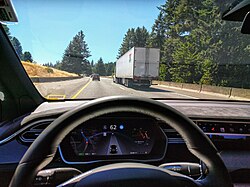
Tesla released Autopilot via an over-the-air software update, bringing semi-autonomous driving capabilities including lane keeping, adaptive cruise control, and automatic steering to Model S and Model X vehicles equipped with the necessary hardware.
Image source: Tesla Autopilot
Oct 1, 2019
% complete
Tesla's first overseas factory in Shanghai began producing Model 3 vehicles remarkably quickly, breaking ground in January 2019 and delivering cars by year's end. The plant gave Tesla access to the world's largest EV market and reduced costs significantly.
Image source: Gigafactory Shanghai
Or browse the full history timeline directory, with more than 2,000 topics.
This History of Tesla timeline was generated with the help of AI, using information found on the internet.
We work hard to keep these timelines accurate, but mistakes do get through. If you spot one, email us at [email protected] and we'll fix it for future visitors.
Generate yours with AI or build it from scratch, for free.
Export your timeline, add your own events, edit or remove AI-generated events, and much more
No credit card required.
Cancel anytime.
Cancel anytime.
You can create an unlimited number of timelines with up to 10 events on each one, customize how they look, export them to PDF, PNG, PowerPoint, CSV, and Excel, and share them with a link. Paid plans raise the event limit and add features like spreadsheet imports and collaborators.
Yes. You can cancel your subscription from your account page at any time, and you will not be charged again. Your subscription stays active for the rest of the period you already paid for.
Yes. We will email you a reminder before the annual renewal, and we will also email you a receipt.
Yes. You can email us within 15 days of any payment, and we will issue you a full refund.
Check out our pricing docs or send us an email anytime: [email protected].