
-
Use Cases
-
Resources
-
Pricing
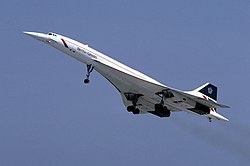
Concorde was a Franco-British supersonic passenger airliner jointly developed by Aérospatiale and the British Aircraft Corporation. Flying at twice the speed of sound, it offered transatlantic travel in under four hours, becoming an icon of aviation luxury and engineering before being retired in 2003. More Less
Feb 1954 - Apr 1955
% complete
Studies into a supersonic transport began in 1954. The group met in February 1954 and delivered its first report in April 1955, laying early groundwork for what would eventually become Concorde.
Image source: Concorde
Oct 1, 1956
% complete
On 1 October 1956, the Ministry of Supply asked Morgan to form the Supersonic Transport Aircraft Committee (STAC) to develop a practical supersonic transport design and find industry partners to build it.
Image source: Bristol Type 223
Nov 5, 1956
% complete
At STAC's first meeting on 5 November 1956, it was decided to fund a test-bed aircraft to examine the low-speed performance of the slender delta wing, a contract that eventually produced the Handley Page HP.115.
Image source: Handley Page HP.115
Jan 1, 1957
% complete
Morgan suggested that a 150-passenger transatlantic supersonic transport would cost about £75–90 million to develop and be in service in 1970, while a smaller 100-passenger short-range version would cost £50–80 million and be ready in 1968. To meet this schedule, development would need to begin in 1960 with production contracts let in 1962.
Jan 1, 1959
% complete
In 1959, a study contract was awarded to Hawker Siddeley and Bristol for preliminary designs based on the slender delta wing, which developed as the HSA.1000 and Bristol 198.
Apr 1960
% complete
As soon as the design was complete, in April 1960, Pierre Satre, Sud Aviation's technical director, was sent to Bristol to discuss a partnership. Talks continued through 1961, and it became clear the two aircraft would be very similar despite different ranges and seating arrangements.
Dec 8, 1960
% complete
A symposium titled 'Supersonic-Transport Implications' was hosted by the Royal Aeronautical Society on 8 December 1960, reflecting growing interest in civil supersonic flight.
Nov 29, 1962
% complete
The UK–France treaty establishing the joint Concorde programme was signed on 29 November 1962, following an independent review of the project by the Committee on Civil Scientific Research and Development between July and September 1962. The programme cost was estimated at £70 million.
Jan 25, 1963
% complete
At Charles de Gaulle's January 1963 press conference — the same speech in which he vetoed the UK's entry into the European Community — the aircraft was first called 'Concorde'.
Dec 14, 1967
% complete
At the French roll-out in Toulouse in late 1967, the British Minister of Technology, Tony Benn, announced that he would change the spelling back to Concorde, resolving a dispute over the aircraft's name.
Jan 1, 1965 - Dec 31, 1965
% complete
In 1965, NASA test aircraft successfully tested Concorde's wing design and found that it reduced landing speeds noticeably over the standard delta wing.
Feb 1965
% complete
Construction of six prototypes began in February 1965, including two full prototypes: 001, built by Aérospatiale at Toulouse, and 002, built by BAC at Filton, Bristol.
Mar 2, 1969
% complete
Concorde 001 made its first test flight from Toulouse on 2 March 1969, piloted by André Turcat, marking the debut of the world's first Anglo-French supersonic airliner prototype.
Apr 9, 1969
% complete
The first UK-built Concorde flew from Filton to RAF Fairford on 9 April 1969, piloted by Brian Trubshaw.
Jun 7, 1969 - Jun 8, 1969
% complete
Both Concorde prototypes were presented to the public on 7–8 June 1969 at the Paris Air Show, giving the world its first close look at the supersonic airliner.
Oct 1, 1969
% complete
On 1 October 1969, Concorde 001 first went supersonic, demonstrating the aircraft's ability to fly faster than the speed of sound during its test programme.
Sep 4, 1971
% complete
As the flight programme progressed, Concorde 001 embarked on a sales and demonstration tour on 4 September 1971, which also marked the aircraft's first transatlantic crossing.
Jun 2, 1972
% complete
Concorde 002 followed the demonstration tour with one of the Middle and Far East beginning on 2 June 1972, promoting sales of the aircraft abroad.
Mar 26, 1974
% complete
During a test flight on 26 March 1974, a Concorde reached its maximum speed of 2,370 km/h (Mach 2.23) at an altitude of 19,415 metres (63,700 feet).
Jan 1, 1971
% complete
The US government cut federal funding for the Boeing 2707, its supersonic transport programme, in 1971 after spending more than $1 billion; Boeing never completed its two 2707 prototypes, leaving Concorde without an American competitor.
Image source: Boeing 2707
Nov 1, 1977
% complete
The Tupolev Tu-144, Concorde's only competitor, began carrying passengers in November 1977. After a crash during a pre-delivery test flight in May 1978, it was withdrawn from passenger service after only 55 flights averaging 58 passengers each.
Image source: Tupolev Tu-144
Jun 30, 1973
% complete
Concorde was used for observing solar eclipses, including the solar eclipse of 30 June 1973 and again for the total solar eclipse on 11 August 1999, chasing the moon's shadow at supersonic speeds.
May 1989
% complete
Pope John Paul II flew on Concorde in May 1989, one of many notable passengers carried by the supersonic airliner over its operational life.
Oct 9, 1975
% complete
On 9 October 1975, Concorde received its French certificate of airworthiness, clearing it for commercial passenger service.
Dec 5, 1975
% complete
Concorde was certified by the UK Civil Aviation Authority on 5 December 1975, completing the certification process required for British commercial operations.
Jan 21, 1976
% complete
Concorde entered service on 21 January 1976, with Air France flying from Paris-Roissy and British Airways from London Heathrow, beginning scheduled supersonic passenger flights.
May 24, 1976
% complete
Transatlantic flights became Concorde's main market, with services to Washington Dulles beginning on 24 May 1976.
Jan 1, 1977
% complete
Elizabeth II and Prime Ministers Edward Heath, Jim Callaghan, Margaret Thatcher, John Major and Tony Blair took Concorde on charter flights, including the Queen's trips to Barbados for her Silver Jubilee in 1977, again in 1987 and 2003, to the Middle East in 1984 and to the US in 1991.
Oct 17, 1977
% complete
Concorde services to New York JFK began on 17 October 1977, completing the lucrative transatlantic routes that became the aircraft's principal market.
Jan 1979 - May 1980
% complete
Braniff International Airways operated Concordes at subsonic speed between Dulles International Airport and Dallas Fort Worth International Airport from January 1979 until May 1980, using its own flight and cabin crew, insurance and operator's licence. An earlier arrangement ran three flights between 9–13 December 1977 before resuming on 24 January 1979 and operating until 1 November 1980.
Jul 17, 2001
% complete
The first flight with the safety modifications departed from London Heathrow on 17 July 2001, piloted by Bannister, testing changes made in response to the Flight 4590 crash.
Nov 7, 2001
% complete
Normal commercial operations resumed on 7 November 2001 with BA and AF aircraft G-BOAE and F-BTSD, with service to New York JFK, where Mayor Rudy Giuliani greeted the passengers.
Feb 13, 1985
% complete
On 13 February 1985, a Concorde charter flight flew from London Heathrow to Sydney in a time of 17 hours, 3 minutes and 45 seconds, including refuelling stops.
Oct 12, 1992 - Oct 13, 1992
% complete
On 12–13 October 1992, commemorating the 500th anniversary of Columbus' first voyage, Concorde Spirit Tours chartered Air France Concorde F-BTSD and circumnavigated the world in 32 hours 49 minutes and 3 seconds from Lisbon, with six refuelling stops. The same aircraft set an eastbound record on 15–16 August 1995.
Feb 7, 1996
% complete
The fastest transatlantic airliner flight was achieved on 7 February 1996 from New York JFK to London Heathrow by British Airways G-BOAD, aided by a 175 mph tailwind, in 2 hours, 52 minutes and 59 seconds from take-off to touchdown.
Apr 12, 1989
% complete
On 12 April 1989, Concorde G-BOAF, on a chartered flight from Christchurch, New Zealand, to Sydney, Australia, suffered a structural failure at supersonic speed. A similar failure occurred on G-BOAB on 21 March 1992, and four incidents of partial rudder separation occurred in 1991, 1998, 2002 and 2003.
Jul 25, 2000
% complete
On 25 July 2000, Air France Flight 4590, registration F-BTSC, crashed shortly after take-off from Charles de Gaulle Airport en route to New York JFK, killing all 109 occupants and four people on the ground. It remains the only fatal incident involving Concorde. Before the accident, Concorde had been arguably the safest operational passenger airliner in the world.
Image source: Air France Flight 4590
Jul 25, 2000 - Nov 2001
% complete
Following the Flight 4590 crash, all commercial Concorde service was suspended until November 2001 while modifications were developed and implemented.
Jan 1, 2010 - Jan 1, 2012
% complete
Although a French court initially found Continental Airlines criminally liable for the Flight 4590 crash in 2010, an appeals court overturned the criminal convictions in 2012, while maintaining civil responsibility for the company and the aircraft's manufacturer.
Jan 1, 2003
% complete
In 2003, Air France and British Airways announced the retirement of Concorde, owing to rising maintenance costs, low passenger numbers following the 25 July 2000 crash, and the slump in air travel following the September 11 attacks.
May 30, 2003
% complete
Air France flew its last commercial Concorde flight on 30 May 2003, ending the airline's 27 years of supersonic passenger operations.
Oct 24, 2003
% complete
British Airways retired its Concorde fleet on 24 October 2003, marking the end of commercial supersonic passenger air travel, 27 years after operations had begun.
Nov 1, 2003
% complete
On its way to the Museum of Flight in November 2003, G-BOAG set a New York City-to-Seattle speed record of 3 hours, 55 minutes and 12 seconds.
Jan 1, 2006
% complete
In 2006, 37 years after its first test flight, Concorde was announced the winner of the Great British Design Quest organised by the BBC and the Design Museum, cementing its status as a design icon.
Or browse the full history timeline directory, with more than 2,000 topics.
This Concorde timeline was generated with the help of AI, using information found on the internet.
We work hard to keep these timelines accurate, but mistakes do get through. If you spot one, email us at [email protected] and we'll fix it for future visitors.
Generate yours with AI or build it from scratch, for free.

Export your timeline, add your own events, edit or remove AI-generated events, and much more
No credit card required.
Cancel anytime.
Cancel anytime.
You can create an unlimited number of timelines with up to 10 events on each one, customize how they look, export them to PDF, PNG, PowerPoint, CSV, and Excel, and share them with a link. Paid plans raise the event limit and add features like spreadsheet imports and collaborators.
Yes. You can cancel your subscription from your account page at any time, and you will not be charged again. Your subscription stays active for the rest of the period you already paid for.
Yes. We will email you a reminder before the annual renewal, and we will also email you a receipt.
Yes. You can email us within 15 days of any payment, and we will issue you a full refund.
Check out our pricing docs or send us an email anytime: [email protected].