
-
Use Cases
-
Resources
-
Pricing
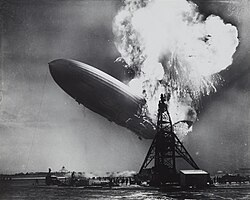
The Hindenburg disaster occurred on May 6, 1937, when the German passenger airship LZ 129 Hindenburg caught fire and was destroyed during its attempt to dock at Naval Air Station Lakehurst in New Jersey. The tragedy killed 36 people, effectively ended the era of passenger airship travel, and became one of the most infamous disasters in aviation history. More Less
Jan 5, 1918
% complete
In the Ahlhorn disaster, explosions of airships in one hangar caused the explosions of others in three adjoining hangars, wiping out all five Zeppelins at the base. The event became a notable precedent in airship accident history.
Sep 18, 1928
% complete
The Graf Zeppelin (LZ 127) was launched in 1928, becoming a pioneering rigid airship for long-distance passenger service. It served as the predecessor to the Hindenburg, which was built as its successor.
Image source: LZ 127 Graf Zeppelin
Apr 4, 1933
% complete
The Navy scout airship USS Akron crashed at sea off the New Jersey coast on April 4, 1933, four years before the Hindenburg disaster, underscoring the dangers of rigid airship operations.
Image source: USS Akron
Feb 12, 1935
% complete
A US Navy rigid airship was lost off the coast of California in February 1935, further demonstrating the risks faced by large airships during this era of aviation.
Image source: USS Macon (ZRS-5)
Mar 1936
% complete
In March 1936, the Hindenburg and the Graf Zeppelin made three-day flights to drop leaflets and broadcast speeches via loudspeaker in support of the Nazi regime's campaign efforts.
Mar 4, 1936
% complete
The Hindenburg made its maiden flight on March 4, 1936. After this first flight, the airship went on to make ten trips to the United States without any incidents during its first season of service.
Mar 4, 1936
% complete
Captain Max Pruss flew on nearly every flight of the Graf Zeppelin since 1928 until the Hindenburg was launched in 1936, making him one of the most experienced Zeppelin commanders of his time.
Image source: Max Pruss
Mar 12, 1936
% complete
Investigators later noted a previous incident on March 12, 1936, during which the Hindenburg's lower fin was damaged, an event that would be considered when examining possible structural weaknesses.
Mar 26, 1936
% complete
Before the airship's takeoff on March 26, 1936, Ernst Lehmann chose to launch the Hindenburg with the wind blowing from behind the airship, instead of into the wind as per standard procedure, risking damage to the ship.
Image source: Ernst A. Lehmann
May 6, 1936 - Oct 1936
% complete
Although the high landing was a common procedure for American airships, the Hindenburg had performed this maneuver only a few times in 1936 while landing at Lakehurst, New Jersey.
Image source: Hindenburg disaster
May 6, 1936 - Oct 1936
% complete
After her maiden flight on March 4, 1936, the Hindenburg had made ten trips to the United States without any incidents, establishing a strong safety record for transatlantic passenger service.
Image source: LZ 129 Hindenburg
Mar 1937
% complete
Although the Hindenburg had been recertified for passenger service in 1937, it had completed a full year of operations totalling around 170,000 miles, during which undetected lateral or torsional stress may have accumulated in its structure.
1937 - 1940
% complete
Some of the duralumin framework of the airship was salvaged and shipped back to Germany, where it was recycled and used in the construction of military aircraft for the Luftwaffe, as were the frames of the LZ 127 Graf Zeppelin and LZ 130 Graf Zeppelin II, when both were scrapped in 1940.
May 6, 1937
% complete
German victims were memorialized similarly to fallen war heroes, and grassroots movements to fund zeppelin construction, as happened after the 1908 crash of the LZ 4, were expressly forbidden by the Nazi government.
May 10, 1937
% complete
The short film Hindenburg Explodes (1937) documented the disaster and is available for free viewing and download at the Internet Archive, preserving footage of the catastrophic event.
Image source: Hindenburg disaster
May 10, 1937
% complete
A special report on the Hindenburg disaster aired on May 10, 1937, and the short film Universal Newsreel Special Release – Zeppelin Explodes Scores Dead is available for free viewing and download at the Internet Archive.
1968
% complete
The site of the Hindenburg disaster at Lakehurst was designated a National Historic Landmark in 1968, recognizing its significance in aviation history.
1975
% complete
Mooney's book was made into the film The Hindenburg (1975), a mostly fictionalized account of the Zeppelin's final flight, and it has been suggested that the plot was created for the then-upcoming film.
Image source: The Hindenburg (film)
May 6, 1987
% complete
A memorial to the victims of the Hindenburg disaster was dedicated on May 6, 1987, the 50th anniversary of the disaster, honoring those who lost their lives at Lakehurst.
Nov 8, 2019
% complete
Werner Doehner, a survivor of the Hindenburg disaster who escaped without injury, died on November 8, 2019. He was the last surviving crew member of the ill-fated airship.
Mar 1937 - Mar 31, 1937
% complete
After opening its 1937 season by completing a single round-trip passage to Rio de Janeiro, Brazil, in late March, the Hindenburg prepared for its scheduled transatlantic service between Europe and North America.
May 3, 1937
% complete
On the evening of May 3, 1937, the Hindenburg departed from Frankfurt, Germany, on the first of ten round trips between Europe and the United States that were scheduled for its second year of commercial service.
May 6, 1937
% complete
At 7:18 p.m., as the final turn progressed, Captain Pruss ordered 300, 300, and 500 kg of water ballast released in successive drops because the airship was stern-heavy, moments before the disaster.
May 6, 1937
% complete
The Hindenburg disaster was an airship accident that occurred on May 6, 1937, in Manchester Township, New Jersey, United States, destroying the LZ 129 Hindenburg as it attempted to dock at Naval Air Station Lakehurst.
May 1937 - Aug 1938
% complete
An official investigation into the accident took place in 1937, with witnesses testifying about what they saw. Notably, no static discharge was seen by any of the witnesses who testified at the official investigation.
1938
% complete
Hoehling laid out a general case for sabotage in his book What About the Airship? (1938), which was as much an extended argument for the further development of the rigid airship as it was a historical overview of the airship concept.
Aug 1938
% complete
The Board of Commerce report, published in August 1938, stated that the possibility of a major structural failure in the stern of the ship causing hydrogen to be liberated and producing a spark was considered plausible.
1960
% complete
In a 1960 interview conducted by Kenneth Leish for Columbia University's Oral History Research Office, Pruss said early dirigible travel was safe, and therefore he strongly believed that sabotage was to blame for the disaster.
1964
% complete
In his book LZ-129 Hindenburg (1964), Zeppelin historian Douglas Robinson commented that although ignition of free hydrogen by static discharge had become a favored hypothesis, no such discharge was seen by any of the witnesses who testified at the official investigation into the accident in 1937.
1972
% complete
Ten years after Hoehling's work, Michael MacDonald Mooney's book The Hindenburg, which was based heavily on Hoehling's sabotage hypothesis, also identified Erich Spehl as a possible saboteur. Mooney's book has been criticized as having numerous fictional elements and factual errors.
1996
% complete
The incendiary paint theory (IPT) was proposed in 1996 by retired NASA scientist Addison Bain, stating that the doping compound of the airship was the cause of the fire, and that the Hindenburg would have burned even if it were filled with helium.
2001
% complete
The 2001 documentary Hindenburg Disaster: Probable Cause suggested that 16-year-old Bobby Rutan, who claimed that he had smelled gasoline when standing below the Hindenburg's aft port engine, had detected a diesel fuel leak.
Dec 2012
% complete
An episode of the Discovery Channel series Curiosity titled 'What Destroyed the Hindenburg?', which first aired in December 2012, investigated both the static spark theory and other hypotheses about the cause of the fire.
Apr 2021
% complete
An episode of the PBS series Nova titled Hindenburg: The New Evidence, which first aired in April 2021 on SBS in Australia, focuses on the static electricity hypothesis as a possible cause of the disaster.
2025
% complete
While no photographs are known to capture the exact moment of ignition, a study published in 2025 by digital imaging historian Phil Lloyd proposed that a photograph taken by 16-year-old amateur photographer Foo Chu may show the onset of structural failure in the aft upper hull, in the vicinity of gas cells 4 and 5.
Or browse the full history timeline directory, with more than 2,000 topics.
This Hindenburg Disaster timeline was generated with the help of AI, using information found on the internet.
We work hard to keep these timelines accurate, but mistakes do get through. If you spot one, email us at [email protected] and we'll fix it for future visitors.
Generate yours with AI or build it from scratch, for free.
Export your timeline, add your own events, edit or remove AI-generated events, and much more
No credit card required.
Cancel anytime.
Cancel anytime.
You can create an unlimited number of timelines with up to 10 events on each one, customize how they look, export them to PDF, PNG, PowerPoint, CSV, and Excel, and share them with a link. Paid plans raise the event limit and add features like spreadsheet imports and collaborators.
Yes. You can cancel your subscription from your account page at any time, and you will not be charged again. Your subscription stays active for the rest of the period you already paid for.
Yes. We will email you a reminder before the annual renewal, and we will also email you a receipt.
Yes. You can email us within 15 days of any payment, and we will issue you a full refund.
Check out our pricing docs or send us an email anytime: [email protected].