-
Use Cases
-
Resources
-
Pricing
The Chernobyl Disaster was the worst nuclear accident in history, occurring on April 26, 1986, when Reactor No. 4 at the Chernobyl Nuclear Power Plant in Ukraine (then part of the Soviet Union) exploded during a safety test. The explosion released massive amounts of radioactive material into the atmosphere, forcing the evacuation of thousands of residents, contaminating vast areas of Europe, and prompting long-term health, environmental, and political consequences that reshaped nuclear energy policy worldwide. More Less
1982 - 1985
% complete
An initial test in 1982 indicated that the excitation voltage of the turbine-generator was insufficient. The electrical system was modified and the test was repeated in 1984, but again proved unsuccessful. In 1985, a third attempt yielded no results due to a problem with the recording equipment.
1983
% complete
In 1983, the insertion of control rods in a similar RBMK reactor at the Ignalina Nuclear Power Plant induced a power spike, revealing dangerous behaviour under certain operating conditions. The authors of the 1986 test procedure were not aware of this unusual RBMK-1000 reactor behaviour.
Image source: RBMK
1986 - 1992
% complete
INSAG produced two significant reports on Chernobyl: INSAG-1 in 1986, and a revised report, INSAG-7, in 1992, refining the understanding of the accident's causes and the role of reactor design flaws versus operator error.
1998 - 2017
% complete
Konstantin Checherov hypothesized in 1998 that the second explosion was a thermal explosion caused by complete water loss in the reactor core. Dubasov theorized in 2009 that it could have been an extremely fast nuclear power transient. In 2017, Lars-Erik De Geer, Christer Persson and Henning Rodhe examined the nuclear fizzle hypothesis, considering it the more probable cause of the first explosion.
Image source: Chernobyl disaster
1985
% complete
The International Atomic Energy Agency (IAEA) created the International Nuclear Safety Advisory Group (INSAG) in 1985. INSAG would later produce two significant reports on Chernobyl: INSAG-1 in 1986 and a revised report, INSAG-7, in 1992.
1991
% complete
The Chernobyl Trust Fund was created in 1991 by the United Nations to help victims of the Chernobyl accident. Beginning in 2002, under the United Nations Development Programme, the fund shifted its focus from emergency assistance to long-term development.
1997
% complete
The Chernobyl Shelter Fund was established in 1997 at the G8 summit in Denver to finance the Shelter Implementation Plan (SIP). While the original cost estimate for the SIP was US$768 million, the 2006 estimate was $1.2 billion.
Feb 2002
% complete
The programme was initiated in February 2002 based on the recommendations in the report on Human Consequences of the Chernobyl Nuclear Accident. In 2003, the United Nations Development Programme launched the Chernobyl Recovery and Development Programme (CRDP) for the recovery of affected areas.
Image source: Chernobyl Recovery and Development Programme
1986
% complete
The Exclusion Zone was originally an area with a radius of 30 km in all directions from the plant, but was subsequently greatly enlarged to include an area measuring approximately 2600 square km, officially called the 'zone of alienation'.
Image source: Chernobyl exclusion zone
1986 - 2000
% complete
The years between 1986 and 2000 saw the near tripling in the total number of permanently resettled persons from the most severely contaminated areas to approximately 350,000.
1990
% complete
More than 18,000 Ukrainian children affected by the disaster have been treated in the resort town of Tarará, Cuba, since 1990, receiving medical care and respite from contaminated environments.
Apr 2020
% complete
In April 2020, forest fires spread through 20,000 ha of the exclusion zone, causing increased radiation from the release of caesium-137 and strontium-90 from the ground and biomass.
Image source: 2020 Chernobyl exclusion zone wildfires
Apr 25, 1986
% complete
As planned, a gradual reduction in the output of power unit 4 began at 01:06 on 25 April 1986 as part of a scheduled reactor shutdown preparatory to a maintenance outage. By the beginning of the day shift, the power level had reached 1600 MW of its nominal 3200 MW thermal level.
Apr 26, 1986
% complete
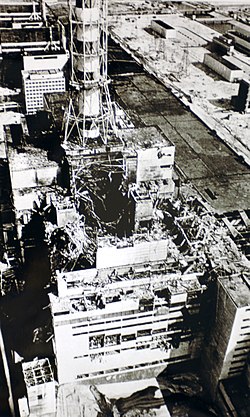
On 26 April 1986, reactor 4 of the Chernobyl Nuclear Power Plant, located near Pripyat, Ukraine, exploded during the safety test. With dozens of direct casualties and thousands of health complications stemming from the disaster, it is one of only two nuclear accidents rated at the maximum severity on the International Nuclear Event Scale, the other being the 2011 Fukushima nuclear accident.
Apr 26, 1986 - May 10, 1986
% complete
The fire in reactor no. 4 continued to burn until 10 May 1986; it is possible that well over half of the graphite ultimately burned out, releasing radioactive material into the atmosphere.
Apr 26, 1986
% complete
The test plan called for a gradual decrease in reactor power to a thermal level of 700–1000 MW, and an output of 720 MW was reached at 00:05 on 26 April 1986. The test procedure was to be run during this controlled power-down of reactor no. 4.
Apr 27, 1986
% complete
Starting from 27 April 1986 at 14:00, each apartment block in Pripyat was provided with a bus, supervised by police and city officials, to evacuate residents from the contaminated city following the explosion.
Oct 1991
% complete
In October 1991, a fire occurred in the turbine building of reactor no. 2, contributing to decisions about the plant's future operations.
Image source: Chernobyl Nuclear Power Plant
2008
% complete
Anatoli Zakharov, a fireman stationed in Chernobyl, offered a different description in 2008: 'I remember joking to the others, There must be an incredible amount of radiation here.' His recollections provided a personal perspective on the immediate response.
May 20, 1986 - Nov 30, 1986
% complete
The design of the sarcophagus started on 20 May 1986, just 24 days after the disaster, with construction running from June to late November. From May 5, 1986, workers from NIKIET and other institutes contributed to decontamination and construction efforts.
Nov 1986
% complete
Work began once again in late November 1986, as the Complex Expedition began work to assess the damage, while members of the Khoplin Radium Institute collected any fuel rods they found and took them back to their laboratory.
Dec 1986
% complete
The Chernobyl Nuclear Power Plant sarcophagus, completed in December 1986, reduced the spread of radioactive contamination and provided radiological protection for the crews of the undamaged reactors.
Dec 1986
% complete
In December 1986, after months of investigation, Vasya Koryagin accidentally found a large object that appeared to be molten lead that had dropped into the reactor core and melted, providing insight into conditions inside the destroyed reactor.
1987
% complete
In 1987, Valery Legasov, first deputy director of the Kurchatov Institute of Atomic Energy in Moscow, said: 'We learned that robots are not the great remedy for everything,' reflecting the limits of robotic technology in the highly radioactive cleanup.
Image source: Valery Legasov
Nov 1996
% complete
Reactor no. 1 was decommissioned in November 1996 as part of a deal between the Ukrainian government and international organizations such as the IAEA to end operations at the plant.
1999 - 2007
% complete
A contract was signed in 1999 with Areva NP (Framatome) for construction of ISF-2, an interim spent fuel storage facility. In 2003, technical deficiencies became apparent, and in 2007 Areva withdrew and Holtec International was contracted for a new design and construction.
Dec 15, 2000
% complete
On 15 December 2000, then-President Leonid Kuchma personally turned off reactor no. 3, ending nuclear power generation at the Chernobyl plant permanently.
Feb 12, 2013
% complete
On 12 February 2013, a 600 square metre section of the roof of the turbine-building collapsed, adjacent to the sarcophagus, causing a new release of radioactivity.
Image source: Chernobyl Nuclear Power Plant sarcophagus
Nov 29, 2016 - 2018
% complete
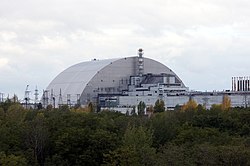
The shelter was completed in 2016 and was moved into place over the sarcophagus on 29 November. It received €864 million from international donors in 2011 and was managed by the European Bank for Reconstruction and Development. In 2016–2018, the NSC was constructed around the old sarcophagus to enable removal of reactor debris, with clean-up scheduled for completion by 2065.
Image source: Chernobyl New Safe Confinement
2017 - 2021
% complete
While neutron activity has declined across most of the destroyed fuel, from 2017 until late 2020 a doubling in neutron density was recorded in the sub-reactor space, before levelling off in early 2021. As of 2021, some fuel had already degraded significantly.
Aug 2017
% complete
The new ISF-2 design was approved in 2010, work started in 2011, and construction was completed in August 2017. Fuel transfers to ISF-1 were completed in June 2016.
2018
% complete
Although a number of radioactive emergency vehicles were buried in trenches, many of the vehicles used by the liquidators still remained, as of 2018, parked in a field in the Chernobyl area.
Feb 2025 - Dec 2025
% complete
In February 2025, a Russian drone struck the shelter causing a fire, damaging the outer and inner protective covering of the NSC and insulating layers inside. In December 2025, the IAEA said that the drone strike meant the structure could no longer perform its main safety function.
2002 - 2011
% complete
The first limited guided tours began in 2002. In 2011, Ukraine opened the sealed zone around the Chernobyl reactor to tourists, allowing wider public access to the site.
2007
% complete
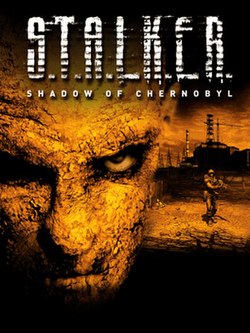
The video game S.T.A.L.K.E.R.: Shadow of Chernobyl, developed by GSC Game World and released by THQ in 2007, is a first-person shooter set in the Exclusion Zone. Its release increased the site's popularity, and tour operators estimated that 40,000 tourists visited between 2007 and 2017. A prequel, Clear Sky, followed in 2008 and a sequel, Call of Pripyat, in 2010.
Image source: S.T.A.L.K.E.R.: Shadow of Chernobyl
Jul 2019
% complete
After its release in July 2019, the critically acclaimed historical drama television miniseries Chernobyl boosted interest in the disaster. Ukrainian president Volodymyr Zelenskyy announced that the Chernobyl site would become an official tourist attraction. Between 2017 and 2022, over 350,000 tourists visited the site, peaking at almost 125,000 visitors in 2019.
Image source: Chernobyl (miniseries)
Feb 2022 - Apr 2026
% complete
Tourism rebounded after COVID in 2021, but the Russian invasion of Ukraine in early 2022 and fighting in the surrounding area forced the zone to be closed to all visitors. The zone remains closed to tourists as of April 2026.
Or browse the full history timeline directory, with more than 2,000 topics.
This Chernobyl Disaster timeline was generated with the help of AI, using information found on the internet.
We work hard to keep these timelines accurate, but mistakes do get through. If you spot one, email us at [email protected] and we'll fix it for future visitors.
Generate yours with AI or build it from scratch, for free.
Export your timeline, add your own events, edit or remove AI-generated events, and much more
No credit card required.
Cancel anytime.
Cancel anytime.
You can create an unlimited number of timelines with up to 10 events on each one, customize how they look, export them to PDF, PNG, PowerPoint, CSV, and Excel, and share them with a link. Paid plans raise the event limit and add features like spreadsheet imports and collaborators.
Yes. You can cancel your subscription from your account page at any time, and you will not be charged again. Your subscription stays active for the rest of the period you already paid for.
Yes. We will email you a reminder before the annual renewal, and we will also email you a receipt.
Yes. You can email us within 15 days of any payment, and we will issue you a full refund.
Check out our pricing docs or send us an email anytime: [email protected].