
-
Use Cases
-
Resources
-
Pricing
2011
% complete
In the aftermath of the accident, Germany accelerated plans to close its nuclear power reactors and decided to phase out the rest by 2022.
Image source: Fukushima nuclear accident
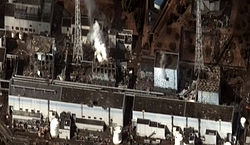
May 2011
% complete
In May 2011, Prime Minister Kan ordered the aging Hamaoka Nuclear Power Plant closed over earthquake and tsunami concerns, and said he would freeze building plans for new reactors.
May 2011
% complete
In May 2011, UK chief inspector of nuclear installations Mike Weightman traveled to Japan as the lead of an International Atomic Energy Agency (IAEA) expert mission to assess the accident.
Jul 2011
% complete
In July 2011, Prime Minister Naoto Kan said, 'Japan should reduce and eventually eliminate its dependence on nuclear energy,' marking a major shift in national energy policy.
Sep 2011
% complete
In September 2011, IAEA Director General Yukiya Amano said the Japanese nuclear disaster 'caused deep public anxiety throughout the world and damaged confidence in nuclear power.'
Dec 16, 2012
% complete
On 16 December 2012, Japan held a general election that shaped the country's post-disaster political landscape and energy policy direction.
2013
% complete
The contribution of nuclear energy dropped to less than one percent following the accident, and all nuclear reactors in Japan were shut down by 2013, increasing reliance on fossil fuel imports and producing a trade deficit for the first time in decades.
Apr 2023
% complete
In April 2023, fishers and activists held protests in front of the Japanese embassy in the Philippines in opposition to the planned release of 1.3 million tons of treated water into the Pacific Ocean.
Mar 11, 2011
% complete
The 9.0 magnitude earthquake occurred at 14:46 on Friday, 11 March 2011, with its epicenter off the east coast of the Tōhoku region. At the time, units 1–3 of the Fukushima Daiichi Nuclear Power Plant were operating. The resulting tsunami overwhelmed the plant's defenses and triggered a major nuclear accident.
Image source: 2011 Tōhoku earthquake and tsunami
Mar 11, 2011
% complete
On 11 March 2011, a major nuclear accident started at the Fukushima Daiichi Nuclear Power Plant in Ōkuma, Fukushima, Japan, after the earthquake and tsunami knocked out cooling systems, leading to meltdowns in three reactors.
Image source: Fukushima nuclear accident
Mar 14, 2011
% complete
Gotō had a series of press briefings at the Foreign Correspondents' Club of Japan starting from 14 March 2011, providing information about the unfolding crisis.
Nov 2011
% complete
Subsequent analysis in November 2011 suggested that an extended period without cooling resulted in the melting of the fuel in unit 1, most of which would have escaped the reactor pressure vessel and embedded itself into the concrete at the base of the primary containment vessel.
Mar 20, 2011
% complete
On 20 March 2011, the radioactivity of vegetables produced in six prefectures in the Kanto and Tohoku regions exceeded provisional regulation values, prompting concerns about food safety.
Mar 21, 2011
% complete
On 21 March 2011, the first restrictions were placed on the distribution and consumption of contaminated items in areas affected by radioactive releases from the plant.
Oct 2011
% complete
As of late 2011, measurements of both the seawater and the coastal sediments suggested that the consequences of the accident for marine life would be minor, despite caesium concentrations being 10 to 1000 times above pre-accident levels.
Jun 2012
% complete
The number of residents displaced due to the accident peaked at 164,000 in June 2012, and stood at around 119,000 in January 2015.
Apr 2014
% complete
In April 2014, studies confirmed the presence of radioactive tuna off the coasts of the Pacific U.S., after researchers tested albacore tuna caught before and after the 2011 accident.
Jun 2016
% complete
In June 2016, the advocacy group International Physicians for the Prevention of Nuclear War asserted that 174,000 people had been unable to return to their homes, and reported ecological damage including malformations in trees, birds, and mammals.
Feb 2018
% complete
In February 2018, Japan renewed the export of fish caught off Fukushima's nearshore zone. According to prefecture officials, no seafood had been found with radiation levels exceeding Japan safety standards since April 2015, and Thailand became the first country to receive fresh fish from Fukushima prefecture in 2018.
Jan 2022
% complete
In January 2022, six patients who were kids at the time of the accident sued TEPCO for 616 million yen after developing thyroid cancer.
Aug 2011
% complete
In August 2011, several top energy officials were fired by the Japanese government, including the Vice-minister for Economy, Trade and Industry; the head of the Nuclear and Industrial Safety Agency; and the head of the Agency for Natural Resources and Energy.
Jul 5, 2012
% complete
On 5 July 2012, the NAIIC found that the causes of the accident had been foreseeable, and that TEPCO had failed to meet basic safety requirements such as risk assessment, preparing for containing collateral damage, and developing evacuation plans.
Image source: National Diet of Japan Fukushima Nuclear Accident Independent Investigation Commission
Jul 23, 2012
% complete
The investigation committee, supported by public prosecutors and government experts, released its final 448-page investigation report on 23 July 2012.
Oct 12, 2012
% complete
On 12 October 2012, TEPCO admitted that it had failed to take necessary measures for fear of inviting lawsuits or protests against its nuclear plants.
2016
% complete
In 2016, three former TEPCO executives — chairman Tsunehisa Katsumata and two vice presidents — were indicted for negligence resulting in death and injury. They pleaded not guilty, and in September 2019, the court agreed they should not be convicted.
Dec 2016
% complete
In December 2016, the government estimated decontamination, compensation, decommissioning, and radioactive waste storage costs at ¥21.5 trillion ($220 billion inflation adjusted), nearly double the 2013 estimate. By 2022, ¥12.1 trillion had already been spent.
Mar 2017
% complete
In March 2017, a Japanese court ruled that negligence by the Japanese government had led to the Fukushima accident by failing to use its regulatory powers to force TEPCO to take preventive measures.
Sep 30, 2020
% complete
On 30 September 2020, the Sendai High Court ruled that the Japanese government and TEPCO are responsible for the accident, ordering them to pay $9.5 million in damages to residents for their lost livelihoods.
Mar 2022
% complete
In March 2022, Japan's Supreme Court rejected an appeal from TEPCO and upheld the order for it to pay damages of ¥1.4 billion ($12 million) to about 3,700 people whose lives were harmed by the accident.
Jun 17, 2022
% complete
On 17 June 2022, the Supreme Court acquitted the government of any wrongdoing regarding potential compensation to over 3,700 people affected by the accident.
Jul 13, 2022
% complete
On 13 July 2022, four former TEPCO executives were ordered to pay ¥13 trillion ($95 billion) in damages to the operator of the power plant, in the civil case brought by TEPCO shareholders.
2013
% complete
In 2013, TEPCO installed additional filters, vents, and other safety systems at Kashiwazaki-Kariwa Nuclear Power Plant in response to lessons learned from the Fukushima accident.
Image source: Kashiwazaki-Kariwa Nuclear Power Plant
Dec 2014
% complete
TEPCO completed the removal of 1535 fuel assemblies from the Unit 4 spent fuel pool in December 2014, a major milestone in the decommissioning effort.
Sep 10, 2015
% complete
On 10 September 2015, floodwaters driven by Typhoon Etau prompted mass evacuations in Japan and overwhelmed the drainage pumps at the stricken power plant.
2018
% complete
In 2018, tours to visit the accident area began, allowing visitors to see the effects of the disaster firsthand.
Sep 2020
% complete
In September 2020, The Great East Japan Earthquake and Nuclear Disaster Memorial Museum was opened in the town of Futaba, near the power plant, preserving the memory and lessons of the disaster.
Feb 2021
% complete
TEPCO completed the removal of 566 fuel assemblies from the Unit 3 spent fuel pool in February 2021. It plans to remove all fuel rods from Units 1, 2, 5, and 6 pools by 2037 and molten fuel debris from Units 1–3 by about 2050.
Jul 2022
% complete
In July 2022, Japan's Nuclear Regulation Authority approved discharging the treated water into the sea, following a 2020 government committee conclusion that the purified water should be released to the sea or evaporated. Tanks used to store the water were expected to be filled in 2023.
Or browse the full history timeline directory, with more than 2,000 topics.
This Fukushima Disaster timeline was generated with the help of AI, using information found on the internet.
We work hard to keep these timelines accurate, but mistakes do get through. If you spot one, email us at [email protected] and we'll fix it for future visitors.
Generate yours with AI or build it from scratch, for free.
Export your timeline, add your own events, edit or remove AI-generated events, and much more
No credit card required.
Cancel anytime.
Cancel anytime.
You can create an unlimited number of timelines with up to 10 events on each one, customize how they look, export them to PDF, PNG, PowerPoint, CSV, and Excel, and share them with a link. Paid plans raise the event limit and add features like spreadsheet imports and collaborators.
Yes. You can cancel your subscription from your account page at any time, and you will not be charged again. Your subscription stays active for the rest of the period you already paid for.
Yes. We will email you a reminder before the annual renewal, and we will also email you a receipt.
Yes. You can email us within 15 days of any payment, and we will issue you a full refund.
Check out our pricing docs or send us an email anytime: [email protected].