-
Use Cases
-
Resources
-
Pricing
The Meiji Restoration was a political revolution in Japan beginning in 1868, which restored imperial rule under Emperor Meiji and ended over two centuries of Tokugawa shogunate rule. It launched rapid modernization, industrialization, and Westernization, transforming Japan into a major world power by the early 20th century. More Less
1775
% complete
Beginning especially in the last quarter of the 18th century, a kind of Shintō revival was occurring alongside a growing interest in Dutch studies, laying intellectual groundwork for later loyalist movements that emphasised loyalty to the Emperor.
Image source: Kokugaku
1800 - 1837
% complete
The bakufu started to show a small annual gold deficit by 1800, which had grown to over half a million ryō by 1837, reflecting deepening financial troubles within the Tokugawa government.
Image source: Tokugawa shogunate
1825
% complete
From the Mito School, Fujita Yūkoku's disciple Aizawa Seishisai extended his teacher's ideas, writing the Shinron ("New Theses") in 1825, which influenced later loyalist ideology.
Image source: Aizawa Seishisai
1841 - 1843
% complete
The Tenpō Reforms (1841–1843) were a series of readjustments to government policy designed to reform issues in political and economic organisation, the result of which was to reveal a deep divide between the shogunate and the daimyō.
Aug 1853
% complete
Beginning in August 1853, senior Rōjū Abe Masahiro took the unprecedented step of seeking a mandate from the daimyō on how to respond to Perry's arrival, weakening the bakufu's traditional authority over decision-making.
Image source: Abe Masahiro
1855
% complete
In 1855, the Nagasaki Naval Training Centre was founded with Katsu Kaishū serving in an important administrative function, and the individual domains were encouraged to build their own shipyards as Japan began modernising its navy.
Image source: Nagasaki Naval Training Center
Jun 4, 1858
% complete
Although Hotta was forced from office, bakufu policy remained the same, and on 4 June 1858, Ii Naosuke was appointed tairō, assuming sweeping authority over the shogunate during a period of intense crisis.
Image source: Ii Naosuke
1804
% complete
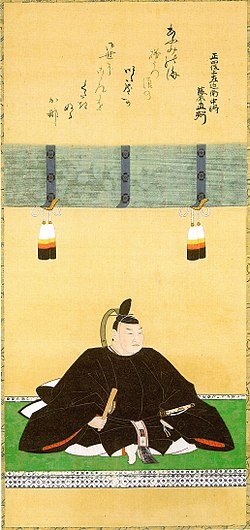
In 1804, Nikolai Rezanov entered Nagasaki bay with a letter from Tsar Alexander I requesting trade. After being refused this request, he staged a series of raids on Japanese settlements in Sakhalin and the Kuril Islands in 1806–1807.
Image source: Nikolai Rezanov
1808
% complete
In 1808, a British frigate entered Nagasaki harbour demanding supplies from the Dutch, demonstrating the vulnerability of Japan's isolation policy to foreign naval power.
Image source: HMS Phaeton (1782)
1811
% complete
The 1811 Golovnin Incident inflamed Japanese mistrust of Russian expeditions, until Golovnin explained that the earlier raids by Rezanov had not been sanctioned by the Tsar.
Image source: Golovnin Incident
1837 - 1839
% complete
By the time of the Morrison Incident (1837) and subsequent suppression of Western scholarship in 1839, the bakufu signalled a reverse course against foreign contact and outside learning.
Image source: Morrison incident
1842
% complete
The Nanking Treaty (1842) specified the transfer of Hong Kong to British control and detailed the opening of treaty ports, alarming Japanese officials about the fate of nations that resisted foreign powers.
Image source: Treaty of Nanking
1844
% complete
From 1843 reports started to circulate of British and French interests in the Ryukyu Islands, then in 1844 the Dutch King William II sent a letter to Japanese officials advising them to take the initiative in their interactions with foreign powers.
Image source: William II of the Netherlands
1845
% complete
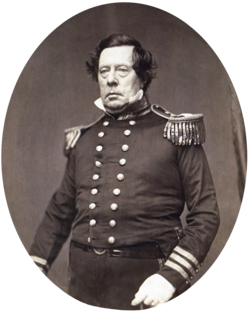
A planned British expedition approved in 1845 failed to materialise when, conscious of the infamy incurred by forcing China to buy British opium, Britain decided to support and capitalise on the success of a planned American expedition to open Japan's ports.
Image source: Matthew C. Perry
1852
% complete
Appointed to command the American expedition in 1852, Commodore Matthew C. Perry would lead the mission that ultimately forced Japan to end its policy of isolation.
1854
% complete
In 1854, the Convention of Kanagawa was signed, opening Japanese ports to American ships and marking the effective end of sakoku after more than two centuries of isolation.
Image source: Convention of Kanagawa
1856 - 1857
% complete
Negotiating treaties with Dutch Commissioner Donker Curtius in 1856 and 1857, a trade agreement was reached that opened Nagasaki and Hakodate to free trade open to all merchants; import duties of 35% were levied on private goods, but it marked a considerable change from the prior Dutch enclave on Dejima.
Image source: Janus Henricus Donker Curtius
1858
% complete
Leveraging his position by instilling a fear of British and French imperialism, Townsend Harris pursued negotiations with Hotta, and in 1858 the Treaty of Amity and Commerce was confirmed, with provisions allowing for ambassadorial residence in Edo, extraterritoriality, the toleration of Christianity, and the opening of five ports for free trade between 1859 and 1863.
Image source: Treaty of Amity and Commerce (United States–Japan)
1860
% complete
In 1860, the Treaty of Amity and Commerce was ratified during the Japanese Embassy to the United States, formalising Japan's new diplomatic relationship with America.
Image source: Japanese Embassy to the United States
Oct 1864
% complete
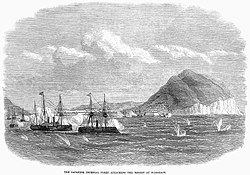
The Shimonoseki agreement to end the foreign attacks signed by the bakufu in October 1864 signalled a shift in policy that prioritised dealing with the foreign powers in a nonantagonistic manner.
Image source: Shimonoseki campaign
1859
% complete
The crisis of 1858 had changed Yoshida Shōin's perspective, where before he had been open to conciliation between the Court and bakufu, he now believed the shishi should take direct action. He was executed in 1859 for planning the assassination of Manabe Akikatsu.
Image source: Yoshida Shōin
1860
% complete
The culmination of unrest among lower-samurai in response to the heavy-handed exercise of authority by the bakufu occurred when Ii Naosuke was assassinated in 1860, shocking the nation and emboldening anti-bakufu forces.
Image source: Sakuradamon Incident (1860)
Oct 1861
% complete
Formalising his leadership over a group of local shishi in October 1861, the loyalist party (among whom was counted Sakamoto Ryōma, although he left in 1862) did not view their loyalty to the Emperor as contradictory to their traditional feudal loyalties.
Image source: Takechi Hanpeita
1862
% complete
In Satsuma Domain, a loyalist group under Ōkubo Toshimichi moved towards conciliation with the domain officials, concerning themselves with persuading the daimyō to break with the bakufu cause; Saigō Takamori would join this group upon return from his exile in 1862.
Image source: Saigō Takamori
1863
% complete
Just prior to this time, Sakamoto Ryōma met Katsu Kaishū intending to assassinate him for his perceived pro-foreign beliefs; what occurred instead was a conversation wherein Ryōma became convinced by Kaishū's plan for rearmament, following Kaishū when he later established the Kobe Naval Training Centre in 1863.
Image source: Sakamoto Ryōma
Mar 1863
% complete
Subsequent British threats for satisfaction drew Shimazu's attention away from Court politics, and thus in March 1863, the Imperial Court issued the order to expel barbarians, escalating tensions with foreign powers.
Image source: Sonnō jōi
May 1864
% complete
With news of uprisings in Yamato and Tajima, in May 1864 pro-sonnō jōi loyalists declared the Mito Rebellion in defiance of the bakufu, part of widespread unrest among lower-ranking samurai.
Image source: Mito Rebellion
Jan 1, 1865 - Mar 31, 1865
% complete
Then, in early 1865 Takasugi launched an attack on the domain government, seizing control of Chōshū and preparing it militarily for confrontation with the bakufu.
Image source: Takasugi Shinsaku
1866
% complete
When hostilities became inevitable by the summer of 1866, Chōshū moved quickly to repulse or forestall any bakufu operations, exposing the military weakness of the Tokugawa regime.
Image source: Second Chōshū expedition
Mar 7, 1866
% complete
On 7 March 1866, Sakamoto successfully brought together Kido Takayoshi and Saigō Takamori to formalise an alliance between Satsuma and Chōshū, creating the coalition that would drive the Restoration.
Image source: Satchō Alliance
1867
% complete
These serious efforts at reform sparked worries among some in the anti-Tokugawa alliance, and in 1867, Saigō and Ōkubo Toshimichi both wrote to Shimazu to indicate their support for returning the country's administration to the power of the Emperor.
Image source: Ōkubo Toshimichi
Feb 1867
% complete
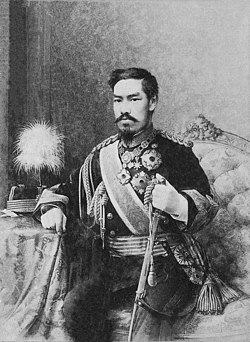
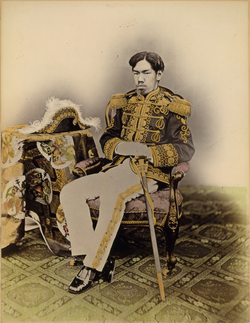
Emperor Kōmei died in February 1867, leaving the teenager Mutsuhito to ascend to the throne as Emperor Meiji, under whose reign imperial rule would be restored and Japan westernised.
Image source: Emperor Meiji
Nov 8, 1867
% complete
Seeking to maintain his title and influence, on 8 November 1867, Tokugawa Yoshinobu, the 15th Tokugawa shōgun, decided to renounce the administrative functions of his office and returned the power to the Imperial Court.
Image source: Tokugawa Yoshinobu
Jan 3, 1868
% complete
On 3 January 1868, Emperor Meiji declared political power to be restored to the Imperial House. In the early hours of that day, domain troops seized control of the Imperial Palace from the bakufu while Iwakura simultaneously received official approval from the Emperor for these actions.
Image source: Meiji Restoration
May 1869
% complete
Forces loyal to the Emperor ended the last attempt at resistance in May 1869 with the Battle of Hakodate, defeating the remnants of Tokugawa loyalists led by Enomoto Takeaki.
Image source: Battle of Hakodate
Nov 1, 1869
% complete
Seeking to end further hostilities and unify the country, Tokugawa Yoshinobu was pardoned on 1 November 1869, after which many of the Tokugawa loyalists (including Enomoto and Nagai Naoyuki) were also pardoned.
Apr 6, 1868
% complete
Drawn up by figures largely from the southwestern domains, the Charter Oath of 1868 was intended as a document to reassure non-Restorationist domains that they would be consulted about decisions concerning objectives of the government. The Oath was issued on 6 April 1868.
Image source: Charter Oath
Sep 3, 1868
% complete
The capital of Edo was renamed Tōkyō on 3 September 1868, symbolising the new era under imperial rule. The Emperor took up residence in the city in 1869.
Image source: Tokyo
Mar 5, 1869
% complete
The document submitted to the Imperial Court on 5 March 1869 put the lands of Satsuma, Chōshū, Tosa, and Hizen at the disposal of the Emperor, beginning the process of abolishing the feudal domains.
Jul 1869
% complete
Iwakura drafted a compromise proposal in July 1869, in it the daimyō were to retain their land under the title of governor or vice-governor, an interim step toward full abolition of the domains.
Image source: Iwakura Tomomi
1870 - 1871
% complete
Over the course of 1870 and 1871, reformers conducted missions to various daimyō of the former anti-bakufu alliance, and reached a collective decision that it was necessary to abolish the domains.
1870
% complete
From 1870, several samurai among the western domains (chiefly Chōshū, Satsuma, and Kagoshima) began to voice their discontent with traditional organisational structures being folded into the new modernising administration; political violence erupted and several modernisers were assassinated—including Ōmura Masujirō.
Image source: Ōmura Masujirō
1871
% complete
With the Dampatsurei Edict of 1871 issued by Emperor Meiji during the early Meiji Era, men of the samurai classes were forced to cut their hair short, effectively abandoning the chonmage hairstyle, as part of edicts intended to modernise the appearance of upper class Japanese men.
Image source: Chonmage
Aug 1871
% complete
Through the promotion of Ōkuma Shigenobu and Itō Hirobumi to ensure the support of their respective domains, the daimyō in Tōkyō were summoned in August 1871, whereupon they were informed of the decision taken to abolish the domains without consultation.
Jan 1872
% complete
These new aristocrats were ordered to move to Tōkyō, separated from their former domains, in January 1872, the 302 domains were formally reorganised into 72 prefectures, completing the centralisation of the Japanese state.
1873
% complete
To reform the military, the government instituted nationwide conscription in 1873, mandating that every male would serve for four years in the armed forces upon turning 21 years old, followed by three more years in the reserves, ending the samurai monopoly on military service.
Image source: Conscription in Taiwan
1874
% complete
Later, in 1874, the samurai were given the option to convert their stipends into government bonds, beginning the dismantling of the hereditary privileges of the warrior class.
May 1875
% complete
The Japanese government reversed its ban on cremation and pro-cremation Japanese adopted western European arguments on how cremation was good for limiting disease spread, so the Japanese government lifted their attempted ban in May 1875 and promoted cremation for diseased people in 1897.
Image source: Cremation in Japan
1876
% complete
Finally, in 1876, this commutation was made compulsory, formally ending the economic basis of the samurai class and accelerating the displacement of the old feudal order.
1889 - 1945
% complete
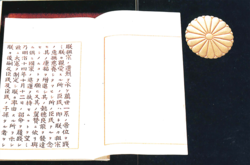
The Meiji Constitution of 1889 would remain in place until the Allied occupation of Japan after the end of World War II, providing the legal framework of the modern Japanese state created by the Restoration.
Image source: Meiji Constitution
1895
% complete
The Meiji Restoration accelerated the industrialisation process in Japan, which led to its rise as a military power by the year 1895, under the slogan of "Enrich the country, strengthen the military" (fukoku kyōhei).
Or browse the full history timeline directory, with more than 2,000 topics.
This Meiji Restoration timeline was generated with the help of AI, using information found on the internet.
We work hard to keep these timelines accurate, but mistakes do get through. If you spot one, email us at [email protected] and we'll fix it for future visitors.
Generate yours with AI or build it from scratch, for free.
Export your timeline, add your own events, edit or remove AI-generated events, and much more
No credit card required.
Cancel anytime.
Cancel anytime.
You can create an unlimited number of timelines with up to 10 events on each one, customize how they look, export them to PDF, PNG, PowerPoint, CSV, and Excel, and share them with a link. Paid plans raise the event limit and add features like spreadsheet imports and collaborators.
Yes. You can cancel your subscription from your account page at any time, and you will not be charged again. Your subscription stays active for the rest of the period you already paid for.
Yes. We will email you a reminder before the annual renewal, and we will also email you a receipt.
Yes. You can email us within 15 days of any payment, and we will issue you a full refund.
Check out our pricing docs or send us an email anytime: [email protected].