-
Use Cases
-
Resources
-
Pricing
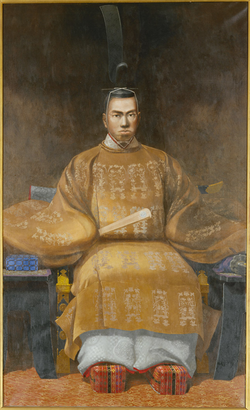
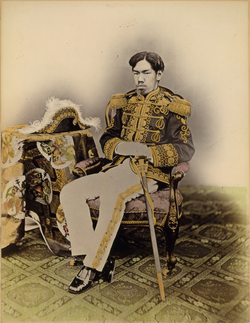
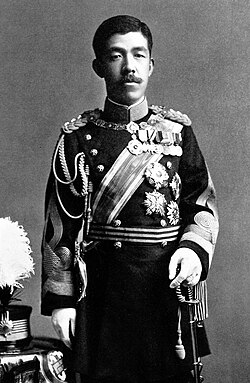
Emperor Meiji (1852–1912), born Mutsuhito, was the 122nd Emperor of Japan. His reign, known as the Meiji Era (1868–1912), marked one of the most transformative periods in Japanese history, during which Japan rapidly modernized its government, economy, military, and society, emerging as a major world power. More Less
1635
% complete
Soon after taking control in the early seventeenth century, shogunate officials (known generically as bakufu) ended almost all Western trade with Japan, and barred Christian missionaries from the islands under the Sakoku Edict of 1635.
Image source: Sakoku
1800
% complete
By the early 19th century, European and American vessels appeared in the waters around Japan with increasing frequency, putting growing pressure on the policy of national seclusion.
Nov 3, 1852
% complete
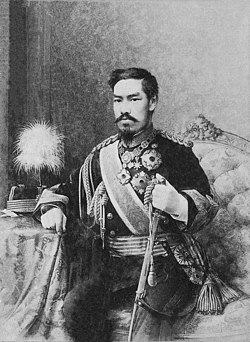
Prince Mutsuhito was born on 3 November 1852 in a small house on his maternal grandfather's property at the north end of the Gosho, to the imperial concubine Nakayama Yoshiko and Emperor Kōmei.
Image source: Emperor Meiji
Jul 8, 1853
% complete
A fleet of ships headed by Commodore Matthew C. Perry arrived in Japan on 8 July 1853. The American naval squadron, dubbed "the Black Ships", sailed into the harbor at Edo, dramatically symbolizing the pressure on Japan to open to the West.
Image source: Perry Expedition
1854 - 1855
% complete
Treaties were signed with the United States by the shogunate between 1854 and 1855, ending Japan's long isolation and fueling domestic demands for modernization.
Image source: Convention of Kanagawa
1858
% complete
In 1858, the shogunate signed treaties with the Netherlands, Imperial Russia, and Great Britain. Word of one treaty arrived with a letter stating that due to shortness of time, it had not been possible to consult with the Court.
Image source: Treaty of Amity and Commerce (United States–Japan)
Mar 1860
% complete
The Tairō, Ii Naosuke, was assassinated in the Sakuradamon incident in March 1860, reflecting rising political violence against the shogunate's leadership.
Image source: Sakuradamon Incident (1860)
Aug 16, 1860
% complete
On 16 August 1860, Sachinomiya (Meiji's childhood name) was proclaimed prince of the blood and heir to the throne and was formally adopted by his father's consort.
1862
% complete
The Namamugi Incident of 1862, an attack on British subjects by Satsuma samurai, heightened tensions between Japan and Western powers and within Japan itself.
Image source: Namamugi Incident
1863
% complete
In 1863, radical samurai known as shishi persuaded Emperor Kōmei to issue an "Order to expel barbarians". Bakufu forces later drove most of the shishi out of Kyoto, and an attempt by them to return in 1864 was driven back.
Image source: Order to expel barbarians
1864 - 1865
% complete
British, American, French, and Dutch ships bombarded Shimonoseki; fighting also ensued between the shogunate and Chōshū during 1864–65.
Image source: Shimonoseki campaign
1866
% complete
After the death of the shōgun Tokugawa Iemochi, Tokugawa Yoshinobu took office as the new shōgun in 1866, while the prince continued his classical education. In mid-1866, a bakufu army set forth to punish rebels in southern Japan.
Image source: Tokugawa Yoshinobu
Jan 31, 1867 - Feb 13, 1867
% complete
Emperor Kōmei fell seriously ill at the age of 36 and died on 30 January 1867 from hemorrhagic smallpox. In a brief ceremony in Kyoto, the crown prince formally ascended to the throne on 13 February 1867.
Image source: Emperor Kōmei
Nov 9, 1867
% complete
The political struggle reached its climax in late 1867. After an agreement fell apart, Yoshinobu officially tendered his resignation to the emperor on 9 November 1867 and formally stepped down ten days later.
Image source: Meiji Restoration
1868 - 1869
% complete
In the Boshin War, Yoshinobu's followers briefly resisted, and bakufu holdouts were finally defeated in late 1869. Samurai mostly from the Chōshū and Satsuma Domains defeated the shogunate and restored power in the emperor's name.
Image source: Boshin War
Jan 4, 1868
% complete
On 4 January 1868, imperial rule was formally restored, ending 265 years of rule by the Tokugawa shogunate and proclaiming the Empire of Japan, which began the Meiji era.
Apr 7, 1868
% complete
On 7 April 1868, the emperor was presented with the Charter Oath, a five-point statement of the nature of the new government outlining goals such as seeking knowledge throughout the world.
Image source: Charter Oath
Sep 19, 1868
% complete
On 19 September 1868, Mutsuhito changed the name of the city of Edo to Tokyo, meaning "eastern capital". A final decision to move the capital to Tokyo was not made until 1889.
Image source: Tokyo
Oct 23, 1868
% complete
On 23 October 1868 the era was changed from Keiō to Meiji ('enlightened rule'), which was later used for the emperor's posthumous name.
Image source: Japanese era name
1869
% complete
In 1869, several of the daimyōs who had supported the revolution gave their land property to the emperor and were reappointed as governors, with considerable salaries.
Image source: Chōshū Domain
Jan 11, 1869
% complete
The emperor married Ichijo Haruko on 11 January 1869. Known posthumously as Empress Dowager Shōken, she was the first Imperial Consort in several centuries to receive the title of kōgō (Empress Consort).
Image source: Empress Shōken
1871
% complete
In 1871, as Japan was organized into 72 prefectures, the emperor abolished domains entirely. From this year onward, his studies also began to include materials on contemporary affairs.
1873
% complete
Edo Castle was destroyed in a conflagration in 1873, and the emperor moved to the Akasaka Palace.
Image source: Imperial Palace, Tokyo
1877
% complete
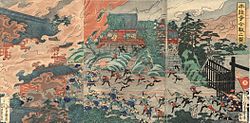
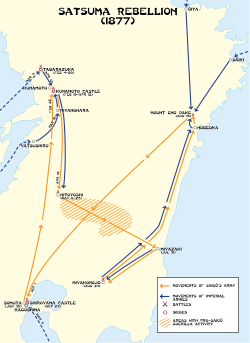
The Satsuma Rebellion of 1877, led by disgruntled former samurai, was a major uprising against the new imperial government and marked the end of the period of rebellion and assassination that had begun in the late 1860s.
Image source: Satsuma Rebellion
1878
% complete
Ōkubo Toshimichi, one of the leading statesmen of the Meiji Restoration, was assassinated in 1878 amid the turbulence of the era.
Image source: Ōkubo Toshimichi
Aug 31, 1879
% complete
Prince Yoshihito, the future Emperor Taishō and the emperor's only surviving son, was born on 31 August 1879. Only five of Meiji's fifteen children lived to adulthood.
Image source: Emperor Taishō
1882
% complete
The Imperial Rescript to Soldiers and Sailors of 1882 was issued to the armed forces, emphasizing loyalty to the emperor, and was one of the key documents of the reign alongside the Charter Oath and the Meiji Constitution.
Image source: Imperial Rescript to Soldiers and Sailors
1885
% complete
In 1885, a prime minister leading a cabinet in a western fashion was established, replacing the previous governmental structure. Itō Hirobumi became the first Prime Minister of Japan.
Image source: Prime Minister of Japan
1888
% complete
The Privy Council was established in 1888 to advise the emperor, part of the institutional modernization guided by the oligarchs known as the genrō.
Image source: Privy Council of Japan
1889
% complete
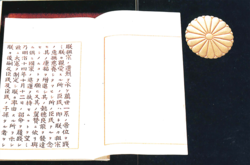
The Meiji Constitution of 1889 created a new parliament, although it had no real power. That year also saw the final decision made to move the capital to Tokyo.
Image source: Meiji Constitution
1890
% complete
The Imperial Diet was established in 1890, the same year the emperor issued the Imperial Rescript on Education, another key document advising moral instruction in schools.
Image source: National Diet
Nov 5, 1872
% complete
On 5 November 1872, the emperor received Grand Duke Alexei Alexandrovich of Russia at court.
Image source: Grand Duke Alexei Alexandrovich of Russia
1881
% complete
In 1881, the emperor received King Kalākaua of Hawaii, the first state visit of a foreign monarch to Japan.
Image source: Kalākaua
1894 - 1895
% complete
The Sino-Japanese War of 1894 ended in Japanese victory, establishing Japan as a regional power. Taiwan was annexed in 1895 as a result of the war.
Image source: First Sino-Japanese War
1904 - 1905
% complete
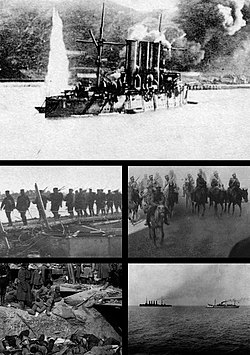
Japan's victory over Russia in the Russo-Japanese War of 1904–1905 earned Japan the status of a great power.
Image source: Russo-Japanese War
1910 - 1945
% complete
Korea was annexed by the Empire of Japan in 1910, beginning the period of Korea under Japanese rule that lasted until 1945.
Image source: Korea under Japanese rule
Mar 19, 1905
% complete
The Illustrated London News published an article with a cover illustration of Emperor Meiji in the New-York Tribune on 19 March 1905, bringing his image to Western audiences.
1910 - 1911
% complete
Near the end of his life, several leftists including Shūsui Kōtoku were executed in 1911 on charges of having conspired to murder the sovereign, in what became known as the High Treason Incident of 1910.
1912
% complete
By 1912, Japan had gone through a political, economic, and social revolution and emerged as one of the great powers in the world. The New York Times noted the striking contrast at the emperor's funeral between that which preceded it and that which followed.
Jul 29, 1912
% complete
Emperor Meiji, suffering from diabetes, nephritis, and gastroenteritis, died of uremia at 10:40 pm on 29 July 1912, aged 59.
1924
% complete
Although Meiji was the last emperor to have concubines, the function was not officially abolished until 1924.
Sep 1941
% complete
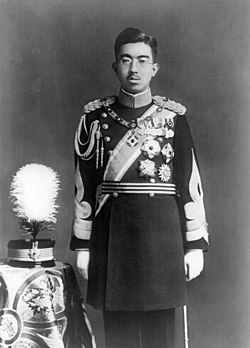
A poem of Emperor Meiji's was later recited by his grandson, Emperor Shōwa, in an Imperial Conference in September 1941 before the attack on Pearl Harbor, to signal that he wanted to avoid the war.
Image source: Hirohito
Or browse the full history timeline directory, with more than 2,000 topics.
This Emperor Meiji timeline was generated with the help of AI, using information found on the internet.
We work hard to keep these timelines accurate, but mistakes do get through. If you spot one, email us at [email protected] and we'll fix it for future visitors.
Generate yours with AI or build it from scratch, for free.
Export your timeline, add your own events, edit or remove AI-generated events, and much more
No credit card required.
Cancel anytime.
Cancel anytime.
You can create an unlimited number of timelines with up to 10 events on each one, customize how they look, export them to PDF, PNG, PowerPoint, CSV, and Excel, and share them with a link. Paid plans raise the event limit and add features like spreadsheet imports and collaborators.
Yes. You can cancel your subscription from your account page at any time, and you will not be charged again. Your subscription stays active for the rest of the period you already paid for.
Yes. We will email you a reminder before the annual renewal, and we will also email you a receipt.
Yes. You can email us within 15 days of any payment, and we will issue you a full refund.
Check out our pricing docs or send us an email anytime: [email protected].