-
Use Cases
-
Resources
-
Pricing
Charles V (1500–1558) was Holy Roman Emperor from 1519 to 1556 and one of the most powerful rulers in European history. As heir to the Habsburg, Burgundian, and Spanish thrones, he ruled a vast empire spanning Europe and the Americas, contending with the Protestant Reformation, wars with France and the Ottoman Empire, before abdicating and retiring to a monastery in Spain. More Less
Feb 24, 1500
% complete
Charles of Habsburg was born on February 24, 1500 in Ghent, in the Low Countries. Son of Philip the Handsome and Joanna of Castile, he would inherit an unprecedented collection of territories across Europe and the Americas.
Image source: Charles V, Holy Roman Emperor
Nov 26, 1504
% complete
Queen Isabella I of Castile died in November 1504, passing the crown of Castile to her daughter Joanna, Charles's mother. Through this line, Charles would eventually claim Spain and its growing American empire.
Image source: Isabella I of Castile
Sep 25, 1506
% complete
The death of Charles's father, Philip the Handsome, made the six-year-old Charles heir to the Burgundian Netherlands, placing him under guardianship and beginning his path toward vast dynastic power.
Image source: Philip I of Castile
Jan 23, 1516
% complete
The death of Ferdinand II of Aragon left Charles, at age 16, as king of a unified Spain (Castile and Aragon), ruling initially as Charles I while his mother Joanna remained nominally queen.
Image source: Ferdinand II of Aragon
Jan 12, 1519 - Jun 28, 1519
% complete
Emperor Maximilian I, Charles's grandfather, died in January 1519. That June, Charles defeated rivals including Francis I of France in the imperial election, becoming King of the Romans and heir apparent to the imperial throne.
Oct 31, 1517
% complete
Luther's challenge to indulgences sparked the Protestant Reformation, creating the central religious crisis that would dominate much of Charles V's reign across his German lands.
Image source: Martin Luther
Jan 28, 1521 - May 25, 1521
% complete
At the Diet of Worms, Luther famously refused to recant before the young emperor, declaring 'Here I stand.' Charles issued the Edict of Worms declaring Luther an outlaw, but the Reformation continued to spread.
Image source: Diet of Worms
Feb 27, 1531
% complete
Protestant princes and cities within the Empire formed a defensive alliance to resist Catholic reconquest, presenting Charles V with a formidable internal religious-political opposition.
Image source: Schmalkaldic League
Apr 24, 1547
% complete
Charles achieved his greatest military victory, routing the Protestant Schmalkaldic forces and capturing John Frederick of Saxony and Philip of Hesse, seemingly restoring Catholic unity to Germany.
Image source: Battle of Mühlberg
1552 - 1555
% complete
Maurice of Saxony and other former allies turned against Charles in league with Henry II of France, forcing him to flee toward Innsbruck and abandon hopes of imposing religious uniformity.
Sep 25, 1555
% complete
After decades of religious conflict, the Peace of Augsburg established the principle 'cuius regio, eius religio', allowing rulers to choose Lutheranism or Catholicism for their lands — though Calvinism was excluded.
Image source: Peace of Augsburg
1519 - Aug 13, 1521
% complete
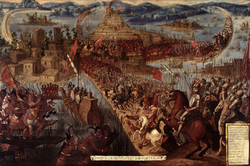
During Charles's early reign, Hernán Cortés conquered the Aztec Empire, adding Mexico to the Spanish crown and beginning massive flows of American silver and gold that financed Charles's European wars.
Image source: Fall of Tenochtitlan
Sep 6, 1522
% complete
Sponsored by Charles I of Spain, the expedition begun by Magellan returned with Juan Sebastián Elcano commanding, completing the first circumnavigation of the globe and expanding Spanish global claims.
Image source: Magellan expedition
Mar 10, 1526
% complete
Charles married Isabella of Portugal in Seville, securing a valuable Iberian alliance and a loving partnership. Their son Philip would succeed him as king of Spain after Isabella's death in 1539.
Image source: Isabella of Portugal
Feb 24, 1530
% complete
Charles was crowned Emperor by Pope Clement VII in Bologna on his thirtieth birthday, February 24, 1530 — the last emperor ever to be crowned by a pope.
Image source: Coronation of Charles V
1532 - 1572
% complete
Pizarro captured the Inca ruler Atahualpa in 1532 and toppled the Inca state, extending Charles's dominion over Peru and vastly increasing New World wealth flowing to Spain.
Image source: Spanish conquest of the Inca Empire
1519 - 1523
% complete
Artisan guilds in Valencia and Majorca rose against noble privilege and royal taxation between 1519 and 1523. The uprising, known as the Revolt of the Germanies, was ultimately suppressed with harsh reprisals.
Image source: Revolt of the Brotherhoods
Apr 16, 1520 - 1521
% complete
Castilian towns rebelled against Charles's rule, angered by foreign advisers and heavy taxation. The revolt was crushed at the Battle of Villalar in April 1521, consolidating royal authority over Spain.
Image source: Revolt of the Comuneros
1521 - 1526
% complete
Charles and Francis I of France began their first open war for control of Italy. Charles's forces won victories at Bicocca (1522) and Pavia, establishing Habsburg dominance on the peninsula.
Image source: Italian War of 1521–1526
Feb 24, 1525
% complete
Imperial forces decisively defeated the French army at Pavia, capturing King Francis I himself. The battle marked the ascendancy of Spanish infantry and Habsburg power in Italy.
Image source: Battle of Pavia
May 6, 1527 - Jun 6, 1527
% complete
Mutinous unpaid Imperial soldiers under Charles de Bourbon stormed and brutally sacked Rome, forcing Pope Clement VII into hiding. Though not ordered by Charles, it cemented his dominance over the papacy.
Image source: Sack of Rome (1527)
Aug 3, 1529
% complete
Known as the 'Ladies' Peace' because it was negotiated by Louise of Savoy and Margaret of Austria, the treaty ended the second Habsburg-Valois war, with Francis renouncing claims in Italy and Flanders.
Image source: Treaty of Cambrai
Sep 27, 1529 - Oct 15, 1529
% complete
Suleiman the Magnificent led the Ottoman army to the walls of Vienna, held by Charles's brother Ferdinand. The siege failed, marking the high-water mark of Ottoman expansion into Central Europe for decades.
Image source: Siege of Vienna (1529)
Jun 1, 1535 - Jul 21, 1535
% complete
Charles personally led a successful campaign against Hayreddin Barbarossa, capturing Tunis and freeing thousands of Christian slaves, a celebrated triumph of his crusading image.
Image source: Conquest of Tunis (1535)
1539 - 1540
% complete
Charles returned to his native city of Ghent to crush a rebellion against new taxation, humiliating the city and stripping it of privileges — a demonstration of his authority in the Netherlands.
Image source: Ghent
Oct 1541 - Nov 1541
% complete
Charles led a major amphibious assault on Algiers that ended disastrously when storms wrecked much of his fleet, damaging his reputation as a champion of Christendom against the Ottomans.
Image source: Battle of Algiers (1541)
Jan 16, 1556
% complete
Weary and ill, Charles formally transferred the Spanish crowns and their colonies to his son Philip II, who became one of history's most powerful monarchs.
Image source: Henry II of France
Sep 12, 1556 - 1558
% complete
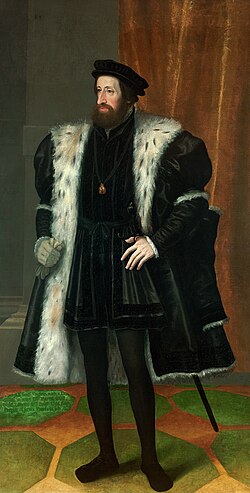
Charles resigned the imperial dignity to his brother Ferdinand I, dividing the Habsburg domains into a Spanish and an Austrian branch, a division that shaped European politics for centuries.
Image source: Ferdinand I, Holy Roman Emperor
Feb 1557
% complete
Charles withdrew to the Hieronymite monastery of Yuste in Extremadura, where he lived out his final months surrounded by relics, clocks (famously set to different hours), and memories of empire.
Image source: Monastery of Yuste
Sep 21, 1558
% complete
Charles V died at the Monastery of Yuste on September 21, 1558, aged 58. He had ruled the largest empire since Rome, spanning Spain, the Netherlands, Italy, Central Europe, and the Americas.
Or browse the full history timeline directory, with more than 2,000 topics.
This Charles V Holy Roman Emperor timeline was generated with the help of AI, using information found on the internet.
We work hard to keep these timelines accurate, but mistakes do get through. If you spot one, email us at [email protected] and we'll fix it for future visitors.
Generate yours with AI or build it from scratch, for free.
Export your timeline, add your own events, edit or remove AI-generated events, and much more
No credit card required.
Cancel anytime.
Cancel anytime.
You can create an unlimited number of timelines with up to 10 events on each one, customize how they look, export them to PDF, PNG, PowerPoint, CSV, and Excel, and share them with a link. Paid plans raise the event limit and add features like spreadsheet imports and collaborators.
Yes. You can cancel your subscription from your account page at any time, and you will not be charged again. Your subscription stays active for the rest of the period you already paid for.
Yes. We will email you a reminder before the annual renewal, and we will also email you a receipt.
Yes. You can email us within 15 days of any payment, and we will issue you a full refund.
Check out our pricing docs or send us an email anytime: [email protected].