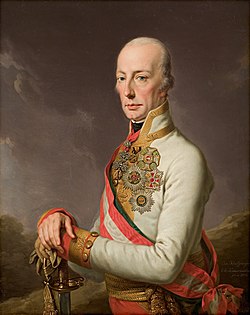
-
Use Cases
-
Resources
-
Pricing
The Holy Roman Empire was a complex multi-ethnic political entity in Central Europe that existed from 800, when Charlemagne was crowned Emperor by Pope Leo III, until its dissolution in 1806 under pressure from Napoleon. Though it claimed continuity with the ancient Roman Empire, it was largely a loose confederation of hundreds of kingdoms, duchies, free cities, and ecclesiastical territories centered on Germany, with the Habsburg dynasty dominating its later centuries. More Less
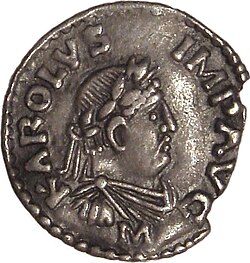
Dec 25, 800
% complete
On Christmas Day in 800, Pope Leo III crowned Charlemagne as Emperor of the Romans in St. Peter's Basilica, reviving the imperial title in the West for the first time since the fall of Rome. This coronation laid the foundation for what would later be called the Holy Roman Empire and established a lasting connection between Germanic kingship and papal authority.
Image source: Charlemagne
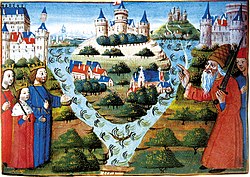
843
% complete
The Treaty of Verdun partitioned the Carolingian Empire among the three grandsons of Charlemagne: Louis the German received East Francia, Charles the Bald received West Francia, and Lothair received Middle Francia along with the imperial title. East Francia would eventually evolve into the Kingdom of Germany, the core of the Holy Roman Empire.
Image source: Treaty of Verdun
936
% complete
Otto I, son of Henry the Fowler, was crowned King of Germany at Aachen in 936. He consolidated royal power over the powerful duchies, defeated the Magyars at the Battle of Lechfeld in 955, and strengthened the German kingdom, setting the stage for the empire's revival.
Image source: Otto the Great
962 - 1024
% complete
Under the Ottonian and early Salian emperors, the empire experienced a cultural and artistic revival centered on court culture, illuminated manuscripts, and church reform. Monasteries such as Reichenau became centers of learning, and imperial ideology emphasized the emperor's sacred role as protector of the Church.
Image source: Ottonian Renaissance
Feb 2, 962
% complete
Pope John XII crowned Otto I as emperor at Old St. Peter's Basilica on February 2, 962. This event is traditionally regarded as the founding of the Holy Roman Empire, establishing a new imperial line that combined German kingship with the Roman imperial tradition.
Image source: Holy Roman Emperor
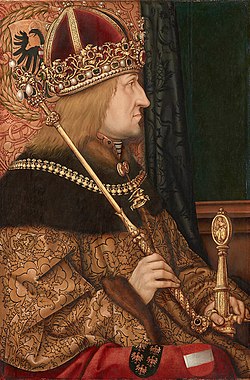
1024
% complete
Conrad II was elected king of Germany in 1024, beginning the Salian dynasty. He expanded imperial authority into Burgundy and strengthened the administration of the empire, laying groundwork for the Salian emperors' ambitious efforts to control both secular and ecclesiastical affairs.
Image source: Conrad II, Holy Roman Emperor
1495
% complete
At the Diet of Worms in 1495, Maximilian I agreed to sweeping reforms including the Eternal Peace banning private warfare and the creation of the Imperial Chamber Court. These institutions gave the empire a more durable legal and governmental framework, balancing imperial and princely interests.
Image source: Maximilian I, Holy Roman Emperor
1075 - 1122
% complete
The Investiture Controversy was a major conflict between Pope Gregory VII and Emperor Henry IV over who had the authority to appoint bishops. Gregory excommunicated Henry in 1076, forcing the emperor to do penance at Canossa in 1077. The struggle fundamentally reshaped the relationship between Church and Empire.
Image source: Investiture Controversy
Jan 28, 1077
% complete
After his excommunication, Henry IV stood barefoot in the snow outside the castle of Canossa for three days seeking absolution from Pope Gregory VII. Although the pope lifted the ban, the episode symbolized papal supremacy over secular rulers and became a legendary moment in medieval history.
Image source: Road to Canossa
1096 - 1099
% complete
Spurred by Pope Urban II's call at Clermont in 1095, armies from across Europe, including many from imperial territories, marched east to capture Jerusalem. The crusade succeeded in taking the city in 1099, but also deepened tensions between emperors and popes, as rival claimants backed competing antipopes during the era.
Image source: First Crusade
Sep 23, 1122
% complete
The Concordat of Worms, signed between Pope Callixtus II and Emperor Henry V, ended the Investiture Controversy. Bishops would be elected by the Church but the emperor could be present at elections and invest them with secular authority. The compromise defined Church-state relations in the empire for centuries.
Image source: Concordat of Worms
1152
% complete
Frederick I, known as Barbarossa, was elected king in 1152 and crowned emperor in 1155. He sought to restore imperial control over northern Italy, fought a series of campaigns against the Lombard League, and drowned in 1190 while leading the Third Crusade, becoming a legendary figure in German mythology.
Image source: Frederick Barbarossa
May 29, 1176
% complete
At Legnano, the Lombard League of northern Italian cities decisively defeated Frederick Barbarossa's forces. The victory secured the cities' autonomy and forced the emperor to accept their self-government, marking a major limit on imperial power south of the Alps.
Image source: Battle of Legnano
1183
% complete
The Peace of Constance between Frederick Barbarossa and the Lombard League confirmed the Italian communes' rights to elect their own officials, administer justice, and govern themselves while nominally recognizing imperial overlordship. It formalized the practical independence of northern Italy from direct imperial rule.
Image source: Peace of Constance
1212
% complete
Emperor Frederick II issued the Golden Bull of Sicily, confirming Ottokar I of Bohemia and his heirs as kings and making Bohemia an autonomous constituent part of the empire. This elevated Bohemia's status and gave its rulers a privileged electoral role in later centuries.
Image source: Golden Bull of Sicily
1254 - 1273
% complete
Following the death of Frederick II and the end of Hohenstaufen rule, no king could establish universal recognition for nearly two decades. Princes and cities gained substantial autonomy during this period, permanently weakening central imperial authority and strengthening particularism within the empire.
Image source: Interregnum (Holy Roman Empire)
1273
% complete
Rudolf of Habsburg was elected king, ending the Great Interregnum. He defeated Otakar II of Bohemia and secured Austria for his family, founding Habsburg power that would dominate the empire until its dissolution more than five centuries later.
Image source: Rudolf I of Germany
Nov 15, 1315
% complete
Swiss Confederates ambushed and defeated a much larger Habsburg army at Morgarten. The victory protected the young Swiss Confederacy's autonomy and began the long process by which Switzerland gradually detached itself from imperial control.
Image source: Battle of Morgarten
1356
% complete
Issued by Emperor Charles IV, the Golden Bull codified the election of the king by seven prince-electors: three ecclesiastical and four secular. It established constitutional procedures for imperial succession, prohibited papal confirmation requirements, and shaped the empire's federal structure until 1806.
Image source: Golden Bull of 1356
1419 - 1434
% complete
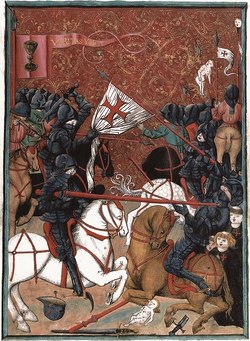
Inspired by the reformer Jan Hus, executed at Constance in 1415, Bohemian Hussites rebelled against Sigismund's rule and Catholic authorities. Their innovative military tactics repeatedly defeated crusading armies before internal divisions led to compromise, foreshadowing the religious upheavals of the next century.
Image source: Hussite Wars
1440
% complete
Frederick III of Habsburg was elected king of Germany, beginning nearly four centuries of continuous Habsburg occupation of the imperial throne. Through strategic marriages, notably that of his son Maximilian to Mary of Burgundy, the dynasty accumulated vast territories across Europe.
Oct 31, 1517
% complete
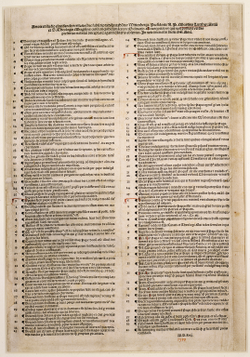
Martin Luther's critique of indulgences sparked the Protestant Reformation. His ideas spread rapidly through the printing press across imperial territories, dividing the empire along confessional lines and challenging both papal and imperial religious authority.
Image source: Ninety-five Theses
Apr 17, 1521 - Apr 26, 1521
% complete
Emperor Charles V summoned Martin Luther to the Diet of Worms to recant his teachings. Luther famously refused, declaring he could not act against his conscience, and was placed under imperial ban. The confrontation cemented the split between Lutheran reformers and imperial Catholic authority.
Image source: Diet of Worms
1524 - 1525
% complete
Peasant uprisings inspired partly by Reformation ideas swept across Swabia, Franconia, and Thuringia demanding social and economic rights. The revolt was brutally suppressed, with tens of thousands killed, and reinforced princely authority while discrediting radical interpretations of Luther's message.
Image source: German Peasants' War
1546 - 1547
% complete
Charles V waged war against the Schmalkaldic League of Lutheran princes and cities, winning a decisive victory at Mühlberg in 1547. However, his subsequent attempts to impose religious uniformity failed, as Protestant resistance revived under Maurice of Saxony.
Image source: Schmalkaldic War
Sep 25, 1555
% complete
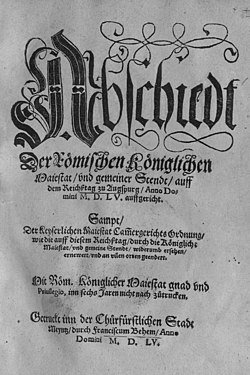
The Peace of Augsburg granted legal recognition to Lutheranism and allowed each imperial prince to determine whether his territory would be Catholic or Lutheran. While it brought temporary stability, it excluded Calvinists and left unresolved conflicts that would later ignite the Thirty Years' War.
Image source: Peace of Augsburg
1618 - 1648
% complete
A complex conflict involving most major European powers, the Thirty Years' War devastated the empire, killing a large proportion of the population in some regions through fighting, famine, and disease. It began as a religious war but evolved into a broader struggle over European political balance.
Image source: Thirty Years' War
May 23, 1618
% complete
Protestant nobles threw two Catholic imperial governors out of a window of Prague Castle, igniting the Bohemian Revolt against Habsburg rule. The rebellion marked the beginning of the Thirty Years' War, one of the most destructive conflicts in European history.
Image source: Defenestrations of Prague
Oct 24, 1648
% complete
The Peace of Westphalia granted full legal equality to Catholics, Lutherans, and Calvinists, recognized the effective sovereignty of imperial states, and established a framework for resolving disputes peacefully within the empire. It is often considered the birth of the modern state system in Europe.
Image source: Peace of Westphalia
Jul 17, 1683 - Sep 12, 1683
% complete
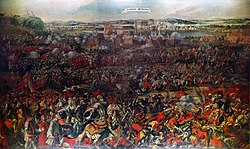
Ottoman forces besieged Vienna, but a relief army led by Polish King John III Sobieski and supported by imperial troops decisively defeated them. The victory marked the high point of Ottoman expansion into Europe and began the Habsburg-led reconquest of Hungary.
Image source: Battle of Vienna
1701 - 1714
% complete
Fought to prevent Bourbon domination of Spain, the war saw Emperor Leopold I and his successors contest French claims. Though the Habsburgs did not win Spain, they gained the Spanish Netherlands and Italian possessions, further expanding their dynastic power beyond the imperial framework.
Image source: War of the Spanish Succession
1740 - 1748
% complete
When Maria Theresa inherited the Habsburg lands, Prussia's Frederick II seized Silesia, sparking a general European war. Despite losing Silesia permanently, she defended her core territories, and her husband Francis I was later elected Holy Roman Emperor, continuing Habsburg influence over the crown.
Image source: War of the Austrian Succession
1756 - 1763
% complete
The Seven Years' War pitted Prussia, allied with Britain, against Austria, France, and Russia. Frederick II narrowly preserved Prussia's gains including Silesia, establishing Prussia as a great power and creating a lasting dualism with Austria that would define German politics for the next century.
Image source: Seven Years' War
1792
% complete
Francis II was elected emperor in 1792, presiding over the empire's final years amid the French Revolutionary and Napoleonic wars. His reign witnessed enormous territorial losses and the reorganization of Germany under French influence, culminating in the empire's dissolution.
Image source: Francis II, Holy Roman Emperor
Aug 6, 1806
% complete
After Napoleon formed the Confederation of the Rhine from German states, Francis II abdicated the imperial crown and dissolved the Holy Roman Empire, which had lasted over eight centuries. He had already declared himself Emperor of Austria in 1804, preserving Habsburg imperial status in a new form.
Image source: Dissolution of the Holy Roman Empire
Or browse the full history timeline directory, with more than 2,000 topics.
This Holy Roman Empire timeline was generated with the help of AI, using information found on the internet.
We work hard to keep these timelines accurate, but mistakes do get through. If you spot one, email us at [email protected] and we'll fix it for future visitors.
Generate yours with AI or build it from scratch, for free.
Export your timeline, add your own events, edit or remove AI-generated events, and much more
No credit card required.
Cancel anytime.
Cancel anytime.
You can create an unlimited number of timelines with up to 10 events on each one, customize how they look, export them to PDF, PNG, PowerPoint, CSV, and Excel, and share them with a link. Paid plans raise the event limit and add features like spreadsheet imports and collaborators.
Yes. You can cancel your subscription from your account page at any time, and you will not be charged again. Your subscription stays active for the rest of the period you already paid for.
Yes. We will email you a reminder before the annual renewal, and we will also email you a receipt.
Yes. You can email us within 15 days of any payment, and we will issue you a full refund.
Check out our pricing docs or send us an email anytime: [email protected].