-
Use Cases
-
Resources
-
Pricing
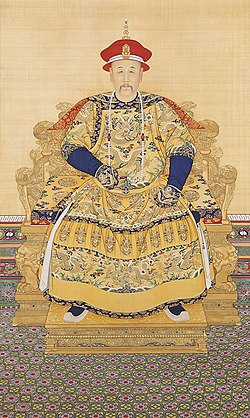
The Kangxi Emperor, born Aisin Gioro Xuanye in 1654, was the fourth emperor of the Qing dynasty and the second to rule over China proper. Ascending the throne at age seven and reigning from 1661 to 1722, he holds the record as one of the longest-reigning monarchs in world history. His reign consolidated Qing control over China after the Manchu conquest, suppressed the Revolt of the Three Feudatories, recovered Taiwan, expanded the empire into Mongolia and Tibet, and fostered cultural achievements including the Kangxi Dictionary. His era is often regarded as the beginning of the High Qing, a period of prosperity and stability. More Less
1634
% complete
The Inner Mongolian Chahar leader Ligdan Khan, a descendant of Genghis Khan, opposed and fought against the Qing until he died of smallpox in 1634.
Image source: Ligdan Khan
1661
% complete
Ejei Khan died in 1661 and was succeeded by his brother Abunai as leader among the Chahar Mongols.
1662
% complete
In the spring of 1662, the regents ordered a Great Clearance in southern China that evacuated the entire population from the seacoast to counter a resistance movement led by Taiwan-based Ming general Zheng Chenggong, also titled Koxinga.
Image source: Great Clearance
1669
% complete
After Abunai showed disaffection with Manchu Qing rule, he was placed under house arrest in 1669 in Shenyang and the Kangxi Emperor gave his title to his son Borni.
1673
% complete
After the Qing takeover of China in 1644, large parts of the south and west were given as fiefs to three Ming generals who aided the Qing; in 1673 the three feudatories were controlled by Wu Sangui, Geng Jingzhong, and Shang Zhixin, who revolted against the Qing.
1675
% complete
Abunai bided his time then, with his brother Lubuzung, revolted against the Qing in 1675 during the Revolt of the Three Feudatories, with 3,000 Chahar Mongol followers joining in on the revolt.
Image source: Chahars
Apr 20, 1675
% complete
The revolt was put down within two months, the Qing defeating the rebels in battle on 20 April 1675, killing Abunai and all his followers.
1681
% complete
The Revolt of the Three Feudatories ended with victory for Qing forces in 1681 after eight years of devastating warfare across southern China.
Image source: Revolt of the Three Feudatories
1683
% complete
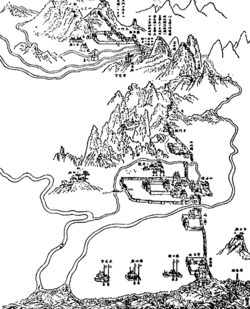
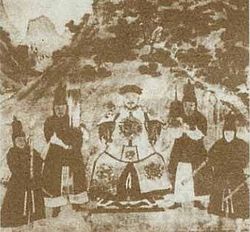
In 1683, the naval forces of the Ming loyalists on Taiwan—organized under the Zheng dynasty as the Kingdom of Tungning—were defeated off Penghu by 300-odd ships under the Qing admiral Shi Lang.
1685
% complete
In 1685, the Qing used former Ming loyalist Han Chinese naval specialists who had served under the Zheng family in Taiwan in the siege of Albazin against Russian forces.
Image source: Sino-Russian border conflicts
1688
% complete
In 1688, the Dzungar chief Galdan Boshugtu Khan attacked the Khalkha from the west and invaded their territory, drawing the Qing into conflict with the Dzungars.
1689
% complete
Negotiations culminated in the Treaty of Nerchinsk of 1689, by which a border was agreed between Russia and China—the first treaty between China and a European power.
Image source: Treaty of Nerchinsk
1690
% complete
In 1690, the Dzungars and Qing forces clashed at the Battle of Ulan Butung in Inner Mongolia, in which the Qing eventually emerged as the victor.
Image source: Battle of Ulan Butung
1696 - 1697
% complete
In 1696 and 1697 the Kangxi Emperor personally led campaigns against the Dzungars in the early Dzungar–Qing War.
Image source: Dzungar–Qing Wars
1697
% complete
This has been linked to the Qing's annihilation of the Manchu clan Hoifan (Hoifa) in 1697 after they rebelled against the Qing.
Image source: Kangxi Emperor
1700
% complete
In 1700, some 20,000 Qiqihar Xibe were resettled in Guisui, modern Inner Mongolia, and 36,000 Songyuan Xibe were resettled in Shenyang, Liaoning.
Image source: Sibe people
1701
% complete
In 1701, the Kangxi Emperor ordered the reconquest of Kangding and other border towns in western Sichuan that had been taken by the Tibetans.
Image source: Kangding
1703
% complete
The Manchu tribe Ula was wiped out in 1703 after they rebelled against the Qing, alongside the earlier annihilation of the Hoifan clan.
1705
% complete
Eventually Sangye Gyatso was toppled and killed by the Khoshut ruler Lhazang Khan in 1705.
Image source: Lha-bzang Khan
1717
% complete
The Dzungar Khanate, a confederation of Oirat tribes based in parts of what is now Xinjiang, continued to threaten the Qing Empire and invaded Tibet in 1717.
Image source: Dzungar Khanate
1718
% complete
The Dzungars held Lhasa for three years and at the Battle of the Salween River defeated a Qing army sent to the region in 1718.
1720
% complete
The Qing did not take control of Lhasa until 1720, when the Kangxi Emperor sent a larger expedition force there to defeat the Dzungars and expel them from Tibet.
Image source: Chinese expedition to Tibet (1720)
1644
% complete
The transition from the Ming dynasty to the Qing was a cataclysm whose central event was the fall of the capital Beijing to the peasant rebels led by Li Zicheng, then to the Manchus in 1644, with the installation of the five-year-old Shunzhi Emperor on their throne.
Image source: Transition from Ming to Qing
May 4, 1654
% complete
The Kangxi Emperor was born on 4 May 1654 to the Shunzhi Emperor and Empress Xiaokangzhang in Jingren Palace, the Forbidden City, Beijing, and was originally given the Chinese name Xuanye.
Feb 7, 1661
% complete
By 1661, when the Shunzhi Emperor died, the Qing conquest of China proper was almost complete. The seven-year-old (eight by East Asian age reckoning) Kangxi Emperor was enthroned on 7 February 1661.
Feb 18, 1662
% complete
Although enthroned in 1661, the young emperor's era name "Kangxi" only started to be used on 18 February 1662, the first day of the following lunar year.
1669
% complete
In 1669, the Kangxi Emperor had Oboi arrested with the help of his grandmother Grand Empress Dowager Zhaosheng, who had raised him, taking personal control of government.
Image source: Oboi
1683
% complete
Financial and other incentives to new settlers particularly drew the Hakka, who would have continuous low-level conflict with the returning Punti people for the next few centuries.
Image source: Hakka people
1688
% complete
The Grand Empress Dowager influenced him greatly and he took care of her himself in the months leading up to her death in 1688.
Image source: Empress Xiaozhuangwen
1712
% complete
As peace returned and tax revenues grew, the Kangxi Emperor made tax remissions, then in 1712 froze the land tax and corvée altogether without embarrassing the state treasury, though this later hindered fiscal modernization.
1670
% complete
The Kangxi Emperor appealed to Confucian values by issuing the Sacred Edict in 1670, promoting moral instruction among the population.
Image source: Sacred Edict of the Kangxi Emperor
1682 - 1697
% complete
The Tibetan desi (regent) Sangye Gyatso concealed the death of the 5th Dalai Lama in 1682, and only informed the emperor in 1697.
Image source: Dalai Lama
1683
% complete
Their palace was used as Shi Lang's headquarters in 1683, but he memorialized the emperor to convert it into a Mazu temple as a propaganda measure in quieting remaining resistance on Taiwan.
Image source: Shi Lang
1688
% complete
The French Jesuit and mathematician Louis Le Comte painted a portrait of the emperor he met around 1688, describing him as above average height and fatter than ordinary well-built Europeans.
Image source: Louis Le Comte
1692
% complete
In 1692, when Pereira requested tolerance for Christianity, the Kangxi Emperor issued the Edict of Toleration, which recognized Catholicism, barred attacks on their churches, and legalized missions and Christian practice by Chinese people.
Image source: Edict of toleration
1700
% complete
In 1700, on the Kangxi Emperor's order, compilation began of the vast encyclopedia known as the Complete Classics Collection of Ancient China (completed under Yongzheng), along with the Complete Tang Poems.
Image source: Complete Classics Collection of Ancient China
1705
% complete
The Dominican position won the support of Pope Clement XI, who in 1705 sent Charles-Thomas Maillard de Tournon as his representative to the Kangxi Emperor, to communicate the ban on Chinese rites.
Image source: Chinese Rites controversy
1711 - 1723
% complete
From 1711 to 1723, Matteo Ripa, an Italian priest sent to China by the Congregation for the Evangelization of Peoples, worked as a painter and copper-engraver at the Qing court.
Image source: Matteo Ripa
Mar 19, 1715
% complete
On 19 March 1715, Pope Clement XI issued the papal bull Ex illa die, which officially condemned Chinese rites, deepening the Chinese Rites controversy.
1723
% complete
In 1723, Matteo Ripa returned to Naples from China with four young Chinese Christians, in order to groom them to become priests and send them back to China as missionaries.
1674
% complete
In 1674 the Kangxi Emperor's first spouse, Empress Xiaochengren, died while giving birth to his second surviving son Yinreng, who at the age of two was named crown prince—a Han Chinese custom—to ensure stability during a time of chaos in the south.
Image source: Empress Xiaochengren
1707
% complete
In 1707, the emperor decided he could no longer tolerate Yinreng's behavior—"never obeying ancestors' virtues... only doing inhumanity and devilry"—and stripped him of his position as crown prince.
Image source: Yunreng
1709
% complete
Yinzhi's actions caused the Kangxi Emperor to suspect that Yinreng might have been framed, so he restored Yinreng as crown prince in 1709, with the support of the 4th and 13th princes, on the excuse that Yinreng had acted under mental illness.
1712
% complete
In 1712, during the Kangxi Emperor's last inspection tour of the south, Yinreng, put in charge of state affairs during his father's absence, tried to vie for power again with his supporters.
Dec 20, 1722
% complete
According to official records, on the evening of 20 December 1722, just before his death at age 68, the Kangxi Emperor called seven of his sons to assemble at his bedside.
Dec 20, 1722
% complete
He died in 1722 at the age of 68 and was succeeded by his fourth son, who assumed the throne as the Yongzheng Emperor.
Image source: Yongzheng Emperor
Or browse the full history timeline directory, with more than 2,000 topics.
This Kangxi Emperor timeline was generated with the help of AI, using information found on the internet.
We work hard to keep these timelines accurate, but mistakes do get through. If you spot one, email us at [email protected] and we'll fix it for future visitors.
Generate yours with AI or build it from scratch, for free.
Export your timeline, add your own events, edit or remove AI-generated events, and much more
No credit card required.
Cancel anytime.
Cancel anytime.
You can create an unlimited number of timelines with up to 10 events on each one, customize how they look, export them to PDF, PNG, PowerPoint, CSV, and Excel, and share them with a link. Paid plans raise the event limit and add features like spreadsheet imports and collaborators.
Yes. You can cancel your subscription from your account page at any time, and you will not be charged again. Your subscription stays active for the rest of the period you already paid for.
Yes. We will email you a reminder before the annual renewal, and we will also email you a receipt.
Yes. You can email us within 15 days of any payment, and we will issue you a full refund.
Check out our pricing docs or send us an email anytime: [email protected].