-
Resources
-
Pricing
The Sui Dynasty was a short but transformative period in Chinese history that reunified China, strengthened centralized rule, expanded the Grand Canal, and established foundations later developed by the Tang Dynasty. More Less
Build a timeline like this one in minutes, for free. Start Yours →
Part of our collection of Chinese history timelines.
580
Yang Jian became regent for the young Emperor Jing of Northern Zhou, placing the imperial government under his control and creating the political conditions for the Sui takeover.
Image source: Emperor Wen of Sui
581 - 582
After founding the Sui, Emperor Wen eliminated potential rivals from the Northern Zhou imperial house and consolidated authority over the former regime's aristocratic and military networks.
581 - 583
The Sui formalized a centralized bureaucracy based on the Five Departments and Six Boards system, which preceded the Three Departments and Six Ministries system.
Feb 581
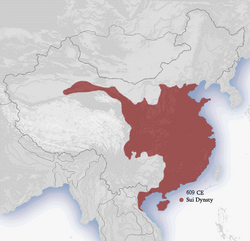
Yang Jian forced Emperor Jing of Northern Zhou to abdicate and established the Sui dynasty, taking the throne as Emperor Wen. The new dynasty initially ruled northern China from its capital at Daxingcheng.
Image source: Sui dynasty
583
The Kaihuang Code was promulgated under Emperor Wen. It organized criminal and administrative law, reduced some earlier harsh penalties, and influenced legal systems in China, Korea, and Japan.
Image source: Kaihuang Code
589 - 590
The Sui government reorganized the empire into prefectures and counties, replacing many local commanderies and reducing the independence of powerful regional authorities.
590 - 591
The state conducted extensive household registration and census efforts to identify taxpayers and laborers. These measures strengthened central control and expanded the fiscal base of the reunified empire.
590 - 600
The Sui continued and expanded the equal-field system, assigning agricultural land to households while reserving some land for state and official use. The policy aimed to stabilize peasant production and taxation.
602
Empress Dugu Qieluo, Emperor Wen's influential consort and political partner, died in 602. Her death removed a major figure from the inner court and altered the balance of power around the emperor.
604
Yang Guang succeeded his father as Emperor Yang of Sui. His reign continued major construction and military projects but placed increasingly severe demands on the population.
Image source: Emperor Yang of Sui
Aug 604
Emperor Wen died in 604 after building a highly centralized and territorially unified empire. He was succeeded by his son Yang Guang, who became Emperor Yang.
582 - 583
Emperor Wen commissioned a new capital at Daxingcheng, later known as Chang'an. Planned by Yuwen Kai, the immense grid-patterned city became the political center of the Sui and later Tang empires.
Image source: Battle of Huoyi
585 - 605
The Sui expanded state granaries to store grain near major population centers and transport routes. These reserves helped the government provision armies and respond to regional shortages.
605 - 606
Emperor Yang established and greatly expanded Luoyang as an eastern capital. Its location connected the political center with the rich agricultural regions of the east and the Grand Canal network.
Image source: Luoyang
605 - 610
Emperor Yang ordered the excavation and connection of major waterways linking the Yellow River basin, the Huai River, the Yangtze, and the region around modern Beijing. The project created the core of China's Grand Canal.
Image source: Grand Canal (China)
605
The Tongji Canal connected the Yellow River system with the Huai River and enabled transport between Luoyang and the lower Yangtze. Its construction required enormous compulsory labor mobilization.
605 - 606
Large palaces and government compounds were built at Luoyang under Emperor Yang. The scale of the works displayed imperial power but consumed vast resources and labor.
608
The Yongji Canal extended the canal system northward from the Yellow River toward Zhuojun. It improved military and logistical access to the northern frontier but intensified the burden on conscripted workers.
583 - 584
The Sui confronted the Eastern Turkic Khaganate after the steppe power threatened the northern frontier. Diplomatic maneuvering and military pressure helped divide Turkic forces and reduce the immediate danger to China.
588 - 589
Emperor Wen launched a massive campaign against the Chen dynasty in southern China. Sui armies advanced across the Yangtze using coordinated land and naval operations.
Image source: Chen dynasty
589
With the annexation of Chen, the Sui united the northern and southern Chinese states. The reunification enabled the central government to standardize institutions, taxation, law, and administration across a vast territory.
Feb 589
Sui forces captured Jiankang and overthrew the Chen dynasty. The victory reunified most of China for the first time since the end of the Western Jin, ending nearly three centuries of division.
612
Emperor Yang launched a huge invasion of Goguryeo, mobilizing hundreds of thousands of soldiers and support personnel. Goguryeo defenses, difficult terrain, and supply problems halted the advance.
Jul 612
Goguryeo forces under Eulji Mundeok destroyed much of a Sui expeditionary army at the Salsu River. The defeat became one of the most damaging reverses in Sui military history.
Image source: Battle of Salsu
613
Emperor Yang resumed the war against Goguryeo in 613 and besieged Liaodong. The campaign was abandoned when rebellion broke out within China, exposing the fragility of Sui rule.
614
A third Sui expedition attacked Goguryeo in 614. The campaign achieved no decisive victory, and Emperor Yang accepted a nominal submission while the costly war continued to undermine domestic stability.
611 - 617
Floods, famine, heavy taxation, conscription, and forced labor contributed to widespread revolts across the empire. Rebel leaders including Dou Jiande, Li Mi, and others established competing power bases.
Image source: Sui dynasty
613
Yang Xuangan, a prominent official and military leader, rebelled near Luoyang during the second Goguryeo campaign. The Sui court suppressed the revolt, but the uprising revealed elite opposition to Emperor Yang.
Image source: Yang Xuangan
Nov 617
Li Yuan, the Duke of Tang, marched into Chang'an and seized the Sui capital. He installed Yang You as a nominal emperor while exercising real power, laying the foundation for the Tang dynasty.
Image source: Emperor Gaozu of Tang
618
Emperor Yang was assassinated in 618 by his Yuwen clan advisors after going south in response to threats from rebel groups.
Jun 618
Yang You abdicated in favor of Li Yuan, who founded the Tang dynasty as Emperor Gaozu. The transfer formally ended the Sui dynasty after less than four decades of rule.
Build a timeline like this one in minutes, for free. Start Yours →
Or browse the full history timeline directory, with more than 2,500 topics.
This Sui Dynasty timeline was generated with the help of AI, using information found on the internet.
We work hard to keep these timelines accurate, but mistakes do get through. If you spot one, email us at [email protected] and we'll fix it for future visitors.
Generate yours with AI or build it from scratch, for free.
Export your timeline, add your own events, edit or remove AI-generated events, and much more
No credit card required.
15-day money-back guarantee.
You can create an unlimited number of timelines with up to 10 events on each one, customize how they look, export them to PDF, PNG, PowerPoint, CSV, and Excel, and share them with a link. Timelines made with Timeline Maker AI keep every event the generator created, and you can add up to 5 events of your own. Paid plans remove the event limit, add spreadsheet imports and hide Preceden's branding, and the higher-priced plan also adds collaborators, a custom logo and a custom domain.
Yes. You can cancel your subscription from your account page at any time, and you will not be charged again. Your subscription stays active for the rest of the period you already paid for.
Yes. We email you a reminder 15 days before your annual renewal, and we email you a receipt after every payment.
Yes. You can email us within 15 days of any payment, and we will issue you a full refund.
Check out our pricing docs or send us an email anytime: [email protected].