-
Use Cases
-
Resources
-
Pricing
1020
The Habsburg family established its dynastic identity around Habsburg Castle in present-day Switzerland. The stronghold became the family's original seat and gave the dynasty its enduring name.
1108
Rudolf I, the earliest securely documented Habsburg ancestor, was recorded as a count. His descendants gradually expanded the family's influence through marriage, inheritance, and imperial service.
Image source: House of Habsburg
1358 - 1359
Rudolf IV of Austria commissioned the Privilegium Maius, a collection of forged documents designed to elevate Austria's status. Although not immediately accepted, it later supported Habsburg claims to special privileges within the Empire.
1365
Duke Rudolf IV founded the University of Vienna, strengthening Vienna as a political, cultural, and intellectual center of the Habsburg lands. It became one of Europe's oldest continuously operating universities.
Image source: University of Vienna
1438 - 1439
Albert II of Habsburg was elected King of the Romans and became Holy Roman Emperor in 1438. His accession began the nearly continuous Habsburg succession to the imperial title until the Empire's dissolution.
Image source: Albert II of Germany
1452 - 1493
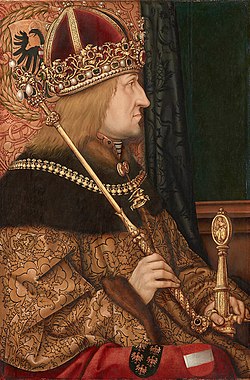
Frederick III was crowned Holy Roman Emperor in Rome and ruled for more than four decades. He consolidated Habsburg dynastic claims and famously used the motto A.E.I.O.U. to symbolize the family's imperial ambitions.
Image source: Frederick III, Holy Roman Emperor
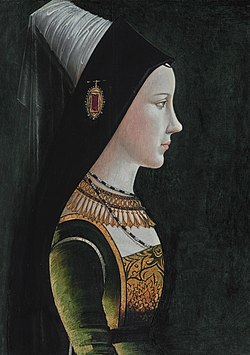
Aug 19, 1477
Maximilian's marriage to Mary of Burgundy brought the Habsburgs control of the Burgundian Netherlands and access to immense commercial and strategic resources. The union demonstrated the dynasty's use of marriage as a tool of territorial expansion.
Image source: Mary of Burgundy
1493 - 1519
Maximilian I succeeded Frederick III and transformed the Habsburg monarchy through administrative reforms, military innovation, and dynastic marriages. His policies laid the foundation for the family's sixteenth-century European ascendancy.
Image source: Maximilian I, Holy Roman Emperor
Oct 20, 1496
Philip the Handsome's marriage to Joanna, heir to the Spanish crowns, connected the Habsburgs to Castile and Aragon. Their son Charles would inherit an unprecedented combination of European and overseas territories.
Image source: Philip the Handsome
1516 - 1556
Charles inherited the crowns of Castile and Aragon, along with Spain's expanding American empire. His accession created the Spanish Habsburg monarchy and made him one of the most powerful rulers of the early modern world.
Image source: Charles V, Holy Roman Emperor
Jun 28, 1519 - 1556
Charles was elected Holy Roman Emperor after a competitive election against Francis I of France. His territories stretched across Europe and the Americas, producing the famous description of an empire on which the sun never set.
Jan 28, 1521 - May 25, 1521
At the Diet of Worms, Charles V confronted Martin Luther and rejected Luther's refusal to recant his writings. The resulting Edict of Worms outlawed Luther and intensified the religious division of the Empire.
Image source: Diet of Worms
Feb 24, 1525
Habsburg forces decisively defeated the French army at Pavia and captured King Francis I. The victory strengthened Charles V's position in the Italian Wars and temporarily confirmed Habsburg dominance in Italy.
Image source: Battle of Pavia
May 6, 1527
Mutinous imperial troops, including German Landsknechte, sacked Rome during Charles V's conflict with Pope Clement VII. The shocking event weakened papal political independence and symbolized the violence of the Italian Wars.
Image source: Sack of Rome (1527)
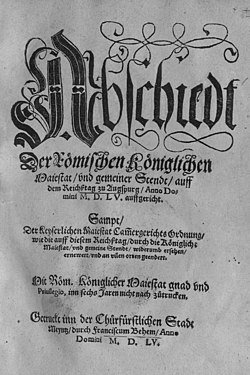
Sep 25, 1555
The Peace of Augsburg temporarily settled religious conflict within the Holy Roman Empire by recognizing Lutheranism and allowing each territorial ruler to determine the confession of his state. It limited, but did not eliminate, Habsburg religious tensions.
Image source: Peace of Augsburg
Oct 7, 1571
The Holy League, dominated by Spain and commanded by Don John of Austria, defeated the Ottoman fleet at Lepanto. The victory halted Ottoman naval expansion in the western Mediterranean and enhanced Habsburg prestige.
Image source: Battle of Lepanto
1580 - 1598
After a succession crisis, Philip II of Spain became Philip I of Portugal. The resulting Iberian Union placed Portugal and its global empire under Spanish Habsburg rule, creating the largest territorial concentration in the dynasty's history.
Image source: Iberian Union
May 1588 - Sep 1588
Philip II sent the Spanish Armada to escort an invasion force against England. The expedition failed because of English resistance, logistical problems, and severe weather, marking a major setback for Spanish Habsburg power.
Image source: Spanish Armada
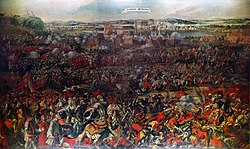
Sep 27, 1529 - Oct 15, 1529
Sultan Suleiman the Magnificent's Ottoman army besieged Vienna, capital of the Habsburg hereditary lands. The siege failed, but the Ottoman threat remained central to Habsburg military and diplomatic policy for generations.
Image source: Siege of Vienna (1529)
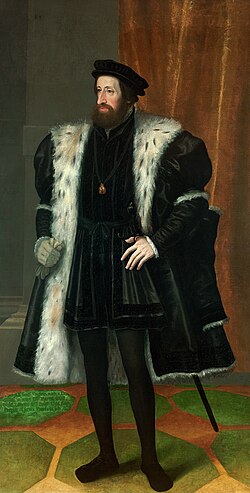
1558 - 1564
After Charles V's abdication, his brother Ferdinand I became Holy Roman Emperor. The succession formalized the division between the Spanish and Austrian Habsburg branches while preserving close dynastic cooperation.
Image source: Ferdinand I, Holy Roman Emperor
May 23, 1618
Bohemian Protestant nobles threw imperial representatives from a Prague castle window in protest against Habsburg religious policies. The incident triggered the Bohemian Revolt and helped ignite the Thirty Years' War.
Image source: Defenestrations of Prague
Nov 8, 1620
Habsburg and Catholic League forces defeated the Bohemian Protestant army near Prague. The victory restored Ferdinand II's authority, accelerated re-Catholicization, and began a long period of stronger Habsburg control over Bohemia.
Image source: Battle of White Mountain
Oct 24, 1648
The Peace of Westphalia ended the Thirty Years' War and recognized important territorial and religious settlements. It curtailed the emperor's ability to impose uniform authority across the Empire and confirmed France and Sweden as major powers.
Image source: Peace of Westphalia
Jul 14, 1683 - Sep 12, 1683
Ottoman forces besieged Vienna under Grand Vizier Kara Mustafa Pasha. An allied relief army led by Jan III Sobieski defeated the besiegers, beginning a major Habsburg counteroffensive in central and southeastern Europe.
Image source: Battle of Vienna
Jan 26, 1699
The Treaty of Karlowitz transferred most of Hungary and Transylvania from Ottoman to Habsburg control. It marked a decisive expansion of the Austrian monarchy and a major reversal of Ottoman power in Europe.
Image source: Treaty of Karlowitz
Apr 19, 1713
Charles VI issued the Pragmatic Sanction to ensure that his hereditary lands could pass to a daughter if he had no male heir. The measure sought European recognition of the indivisibility of Habsburg territories.
Image source: Pragmatic Sanction of 1713
Oct 20, 1740 - Nov 29, 1780
Maria Theresa inherited the Habsburg hereditary lands after Charles VI's death. Several powers challenged her succession, beginning the War of the Austrian Succession, but she preserved most of her inheritance and strengthened the monarchy.
Image source: Maria Theresa
Dec 16, 1740 - Oct 18, 1748
European powers fought over Maria Theresa's inheritance after Prussia invaded Silesia. The war ended with Maria Theresa retaining her main lands, although Austria ceded Silesia to Prussia and emerged determined to reform its institutions.
Image source: War of the Austrian Succession
Mar 18, 1764 - Feb 20, 1790
Joseph II was elected and crowned King of the Romans while co-ruling with his mother, Maria Theresa. After becoming emperor, he pursued sweeping Enlightenment reforms involving religion, administration, education, and serfdom.
Image source: Joseph II, Holy Roman Emperor
Aug 5, 1772
Austria joined Russia and Prussia in partitioning the Polish–Lithuanian Commonwealth. The Habsburg monarchy acquired Galicia and Lodomeria, substantially expanding its population and territory in eastern Europe.
Sep 30, 1790 - Mar 1, 1792
Leopold II succeeded his brother Joseph II and moderated some of Joseph's most disruptive reforms. He stabilized relations with the nobility and helped prepare the monarchy for the revolutionary crisis in France.
Jul 5, 1792 - Aug 6, 1806
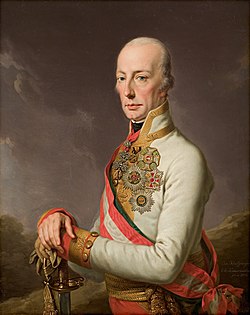
Francis II became the last Holy Roman Emperor. Facing Napoleon's victories and the reorganization of Germany, he later dissolved the Empire and continued as hereditary Emperor of Austria under the title Francis I.
Image source: Francis II, Holy Roman Emperor
Dec 2, 1805
Napoleon defeated the combined Austrian and Russian armies at Austerlitz, one of the most consequential victories of the Napoleonic Wars. Austria was forced into the Treaty of Pressburg and lost significant influence in Germany and Italy.
Image source: Battle of Austerlitz
Aug 6, 1806
Francis II abdicated the imperial crown, formally ending the Holy Roman Empire after more than eight centuries. He retained the title Emperor of Austria, preserving a distinct Habsburg imperial state.
Image source: Dissolution of the Holy Roman Empire
Sep 18, 1814 - Jun 9, 1815
The Congress of Vienna reorganized Europe after Napoleon's defeat. Austria, represented by Klemens von Metternich, regained influence in Italy and Germany and helped establish a conservative diplomatic order.
Image source: Congress of Vienna
Mar 13, 1848 - Oct 31, 1849
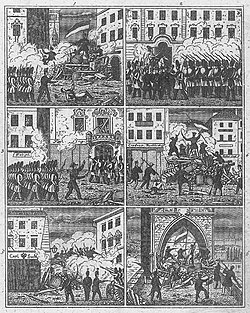
Revolutionary movements challenged Habsburg rule across Vienna, Hungary, Bohemia, and northern Italy. The monarchy suppressed the uprisings with military assistance, but the crisis exposed deep national, social, and constitutional tensions.
Image source: Revolutions of 1848 in the Austrian Empire
Dec 2, 1848 - Nov 21, 1916
Francis Joseph I became emperor during the revolutionary crisis and ruled for nearly 68 years. His long reign brought administrative continuity but also witnessed military defeats, nationalist conflict, and the eventual collapse of the monarchy.
Feb 8, 1867
The Ausgleich created the dual monarchy of Austria-Hungary. Hungary gained extensive domestic autonomy while the emperor retained control of foreign affairs, the army, and certain shared finances.
Jun 13, 1878 - Jul 13, 1878
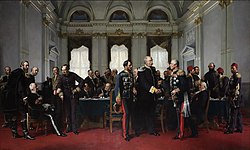
The Congress of Berlin revised the settlement of the Russo-Turkish War. Austria-Hungary received the mandate to occupy and administer Bosnia and Herzegovina, expanding its influence while increasing tensions with Serbia and Russia.
Image source: Congress of Berlin
Oct 6, 1908
Austria-Hungary formally annexed Bosnia and Herzegovina after decades of occupation. The action provoked a major international crisis and intensified Serbian nationalism, contributing to the instability that preceded World War I.
Image source: Bosnian Crisis
Jun 28, 1914
Gavrilo Princip assassinated Archduke Franz Ferdinand and his wife Sophie in Sarajevo. Austria-Hungary's ultimatum to Serbia following the attack set off the diplomatic crisis that escalated into World War I.
Image source: Assassination of Archduke Franz Ferdinand
Jul 28, 1914
Austria-Hungary declared war on Serbia exactly one month after the Sarajevo assassination. The decision activated alliance commitments and began the general European conflict that would destroy the Habsburg monarchy.
Image source: History of Austria-Hungary during World War I
Nov 21, 1916 - Nov 11, 1918
Charles I succeeded Francis Joseph I in the middle of World War I. He attempted to negotiate peace and reform the multinational state, but military defeat and national secession made preservation of the monarchy impossible.
Image source: Charles I of Austria
Oct 31, 1918 - Nov 12, 1918
National councils and successor states dismantled Austria-Hungary as its armies collapsed at the end of World War I. The empire's territories became Austria, Hungary, Czechoslovakia, Yugoslavia, and enlarged neighboring states.
Image source: Dissolution of Austria-Hungary
Nov 11, 1918
Charles I renounced participation in the Austrian government's affairs but did not formally abdicate. The declaration ended effective Habsburg rule in Austria, and the new republic later banished the former imperial family.
Apr 3, 1919
The Austrian parliament deposed the Habsburg-Lorraine dynasty, confiscated much of its property, and expelled members who would not renounce dynastic claims. The law established the legal basis for the family's exclusion from republican Austria.
Image source: Habsburg Law
Apr 1, 1922
Charles I died in exile on Madeira after unsuccessful attempts to restore himself to the Hungarian throne. His death ended the life of the last reigning Habsburg monarch, although the dynasty continued as a prominent historical and political family.
Or browse the full history timeline directory, with more than 2,500 topics.
This Habsburg Dynasty timeline was generated with the help of AI, using information found on the internet.
We work hard to keep these timelines accurate, but mistakes do get through. If you spot one, email us at [email protected] and we'll fix it for future visitors.
Generate yours with AI or build it from scratch, for free.
Export your timeline, add your own events, edit or remove AI-generated events, and much more
No credit card required.
Cancel anytime.
Cancel anytime.
You can create an unlimited number of timelines with up to 10 events on each one, customize how they look, export them to PDF, PNG, PowerPoint, CSV, and Excel, and share them with a link. Paid plans raise the event limit and add features like spreadsheet imports and collaborators.
Yes. You can cancel your subscription from your account page at any time, and you will not be charged again. Your subscription stays active for the rest of the period you already paid for.
Yes. We will email you a reminder before the annual renewal, and we will also email you a receipt.
Yes. You can email us within 15 days of any payment, and we will issue you a full refund.
Check out our pricing docs or send us an email anytime: [email protected].