-
Use Cases
-
Resources
-
Pricing
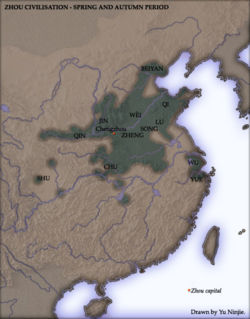
The Zhou Dynasty was the longest-lasting dynasty in Chinese history, ruling from approximately 1046 to 256 BC. It is divided into the Western Zhou (1046–771 BC), when kings ruled from Haojing near modern Xi'an, and the Eastern Zhou (770–256 BC), which encompasses the Spring and Autumn period and the Warring States period. The Zhou introduced the concept of the Mandate of Heaven to legitimize their rule, developed feudal-like systems of land distribution, and presided over a flourishing of philosophy, including the teachings of Confucius, Laozi, and other great thinkers known as the Hundred Schools of Thought. More Less
1046 BC - 256 BC
% complete
Lasting 790 years from c. 1046 BC to 256 BC, the Zhou dynasty holds the record as the longest-spanning dynasty in Chinese history, encompassing both Western and Eastern phases.
Image source: Zhou dynasty
1046 BC
% complete
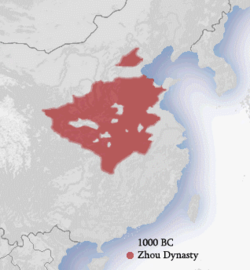
The Zhou dynasty was a royal dynasty of China that existed for 790 years from c. 1046 BC until 256 BC, the longest span of any dynasty in Chinese history.
1046 BC
% complete
A date of 1046 BC for the Zhou's establishment is supported by the Xia–Shang–Zhou Chronology Project and David Pankenier, but David Nivison and Edward L. Shaughnessy date the establishment to 1045 BC.
Image source: Xia–Shang–Zhou Chronology Project
1046 BC
% complete
Wen's son Wu rose to leadership of the Zhou people and, together with his ally Jiang Ziya, prepared to challenge the Shang king Di Xin for supremacy over China.
Image source: King Wu of Zhou
1046 BC
% complete
The Shang king Di Xin was decisively defeated by the Zhou forces at the Battle of Muye, bringing an end to Shang rule and paving the way for the Zhou royal house to take power.
Image source: King Zhou of Shang
1046 BC
% complete
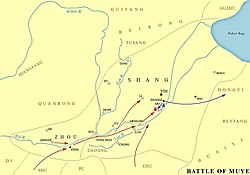
Around 1046 BC, King Wu and his ally Jiang Ziya led an army of 45,000 men and 300 chariots across the Yellow River and defeated Di Xin at the Battle of Muye, marking the beginning of the Zhou dynasty.
Image source: Battle of Muye
1046 BC
% complete
Jiang Ziya served as King Wu's key military strategist and ally during the campaign against the Shang, helping lead the army of 45,000 men and 300 chariots to victory at Muye.
Image source: Jiang Ziya
1046 BC - 771 BC
% complete
Alongside the Wei River valley, the Western Zhou kings extended military authority over the North China Plain, anchoring their power in China's most fertile regions.
Image source: North China Plain
1046 BC - 771 BC
% complete
During the early Zhou, the royal house exercised direct military control over territories centered on the Wei River valley, which formed the heartland of the kingdom.
Image source: Wei River
1046 BC - 256 BC
% complete
The Zhou royal house carried the surname Ji, and under this lineage the dynasty maintained its claim to kingship across both its Western and Eastern periods.
1046 BC - 771 BC
% complete
During the Western Zhou period (c. 1046 – 771 BC), the royal house, surnamed Ji, had military control over territories centered on the Wei River valley and North China Plain.
Image source: Western Zhou
1045 BC - 771 BC
% complete
The new capital of Haojing housed the administration of the Zhou state, where the Ji royal house directed governance of territories across the Wei River valley and North China Plain.
1045 BC
% complete
During the Western Zhou (1045–771 BC), King Wu maintained the old capital for ceremonial purposes while building his new seat of government nearby.
1045 BC - 771 BC
% complete
At Haojing, King Wu established his palace, making the city the administrative heart of the Western Zhou kingdom until its fall in 771 BC.
1045 BC
% complete
King Wu constructed a new capital at Haojing for his palace and administration, near the old ceremonial city, establishing it as the political center of the Western Zhou.
771 BC
% complete
In 771 BC the Western Zhou period came to an end, closing an era in which the Ji royal house had held direct military control over its core territories around the Wei River.
771 BC
% complete
The Eastern Zhou period began in 771 BC and was characterized by an accelerating collapse of royal authority, although the king's ritual importance enabled more than five additional centuries of rule.
Image source: Eastern Zhou
771 BC - 256 BC
% complete
Throughout the Eastern Zhou period, the power of the Zhou kings steadily eroded as regional lords gained autonomy, marking an accelerating collapse of royal authority.
771 BC - 256 BC
% complete
As Eastern Zhou kings lost real military and political control, their suzerainty became increasingly ceremonial, with vassal states treating them mainly as ritual figures.
771 BC - 256 BC
% complete
Despite the loss of practical authority, the king's ritual importance enabled the Zhou royal line to continue ruling for more than five additional centuries after 771 BC.
651 BC
% complete
According to the late 4th-century BC Zuo Zhuan, the baron of Li Rong, after being defeated by Jin, married his daughter Li Ji off, illustrating the political marriage alliances of the era.
651 BC
% complete
The Zuo Zhuan records that the baron of Li Rong suffered defeat at the hands of Jin, after which he gave his daughter Li Ji in marriage, reflecting the shifting balance of power among states.
453 BC - 403 BC
% complete
The partition of Jin during the mid-5th century BC divided one of the major states among rival families, fundamentally reshaping the political map of the Zhou world.
453 BC
% complete
The partition of Jin during the mid-5th century BC is commonly cited as initiating the subsequent Warring States period, an era of intense interstate rivalry within the declining Zhou order.
Image source: Warring States period
256 BC
% complete
Even as Zhou suzerainty became ceremonial, the political system created by the Zhou royal house survived in some form for several additional centuries after the dynasty's fall in 256 BC.
256 BC
% complete
In 256 BC the Zhou dynasty came to an end after 790 years, concluding the longest span of any dynasty in Chinese history.
600 BC
% complete
During the Zhou dynasty, the origins of native Chinese philosophy developed, with its initial stages of development beginning in the 6th century BC.
Image source: Hundred Schools of Thought
600 BC - 500 BC
% complete
The initial stages of development of native Chinese philosophy began in the 6th century BC, during the later years of the Zhou dynasty, laying intellectual foundations for later schools of thought.
Image source: Chinese philosophy
400 BC - 300 BC
% complete
The Zuo Zhuan, a commentary on history compiled in the late 4th century BC, preserved accounts of the Spring and Autumn period, including the story of the baron of Li Rong and his daughter Li Ji.
Image source: Zuo Zhuan
256 BC
% complete
After the dynasty ended in 256 BC, the political system created by the Zhou royal house survived in some form for several additional centuries, testifying to its enduring influence.
Or browse the full history timeline directory, with more than 2,000 topics.
This Zhou Dynasty timeline was generated with the help of AI, using information found on the internet.
We work hard to keep these timelines accurate, but mistakes do get through. If you spot one, email us at [email protected] and we'll fix it for future visitors.
Generate yours with AI or build it from scratch, for free.
Export your timeline, add your own events, edit or remove AI-generated events, and much more
No credit card required.
Cancel anytime.
Cancel anytime.
You can create an unlimited number of timelines with up to 10 events on each one, customize how they look, export them to PDF, PNG, PowerPoint, CSV, and Excel, and share them with a link. Paid plans raise the event limit and add features like spreadsheet imports and collaborators.
Yes. You can cancel your subscription from your account page at any time, and you will not be charged again. Your subscription stays active for the rest of the period you already paid for.
Yes. We will email you a reminder before the annual renewal, and we will also email you a receipt.
Yes. You can email us within 15 days of any payment, and we will issue you a full refund.
Check out our pricing docs or send us an email anytime: [email protected].