-
Use Cases
-
Resources
-
Pricing
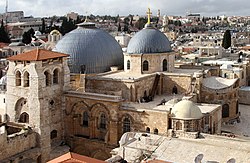
The Church of the Holy Sepulchre in Jerusalem's Christian Quarter is revered as the site of Jesus Christ's crucifixion, burial, and resurrection. First built under Emperor Constantine in the 4th century, it has been destroyed and rebuilt multiple times and is currently shared by six Christian denominations under the historic Status Quo arrangement. More Less
300
% complete
Early in the fourth century, the Church of the Holy Sepulchre site was recognized as the place where Jesus was crucified, buried, and rose from the dead. According to traditional beliefs dating to this period, it contains Calvary, or Golgotha, and Jesus's empty tomb.
Image source: Church of the Holy Sepulchre
300
% complete
The temple built by Hadrian on the site remained standing until the early fourth century, when Constantine's church was constructed over the area.
325
% complete
The church and rotunda were built under Constantine the Great in the fourth century, a fact confirmed by scientific testing. It became an important pilgrimage site for Christians from that time onward.
800
% complete
Early in the ninth century, another earthquake damaged the dome of the Anastasis, the rotunda housing the tomb.
1000 - 1100
% complete
Western pilgrims to Jerusalem during the 11th century found much of the sacred site still in ruins following its destruction by al-Hakim.
Oct 18, 1009
% complete
Fatimid caliph al-Hakim bi-Amr Allah ordered the complete destruction of the church on 18 October 1009 as part of a more general campaign against Christian and Jewish places of worship in Palestine and Egypt.
Image source: Al-Hakim bi-Amr Allah
1027 - 1028
% complete
In wide-ranging negotiations between the Fatimids and the Byzantine Empire in 1027–1028, an agreement was reached whereby the new Caliph Ali az-Zahir (al-Hakim's son) agreed to allow the rebuilding and redecoration of the church.
Image source: Al-Zahir li-I'zaz Din Allah
1048
% complete
The rebuilding was completed during the tenures of Emperor Constantine IX Monomachos and Patriarch Nicephorus of Jerusalem in 1048, during the reign of al-Mustansir Billah, Ali az-Zahir's son.
Image source: Constantine IX Monomachos
1545
% complete
The uppermost level of the 12th-century Crusader bell tower, just south of the Rotunda, was lost in a 1545 collapse. In 1719 another two storeys were lost.
1808
% complete
A fire severely damaged the structure again in 1808, causing the dome of the rotunda to collapse and smashing the Aedicule's exterior decoration. The royal tombs may have been destroyed by this fire or during renovations of 1809–1810.
1809 - 1810
% complete
The rotunda and the Aedicule's exterior were rebuilt in 1809–10 by architect Nikolaos Ch. Komnenos, whose red limestone cladding later deteriorated badly. The present Stone of Anointing was added in this reconstruction.
Image source: Holy Fire
1868
% complete
The dome was restored by Catholics, Greeks, and Turks in 1868, and has been made of iron ever since.
1050
% complete
By the Crusader period, a cistern under the former basilica was rumoured to be where Helena had found the True Cross and began to be venerated as such; there is no evidence of this identification before the 11th century, and archaeology dates the cistern to 11th-century repairs by Monomachos.
Image source: Church of the Holy Sepulchre
1095
% complete
Historians agree that the fate of Jerusalem, and thereby the Church of the Holy Sepulchre, was also of concern, if not the immediate goal of papal policy in 1095, contributing to the launch of the First Crusade.
Image source: First Crusade
Jul 15, 1099
% complete
The rebuilt church site was taken from the Fatimids, who had recently taken it from the Abbasids, by the knights of the First Crusade on 15 July 1099.
1100 - 1200
% complete
Eight 11th- and 12th-century Crusader leaders — Godfrey, Baldwin I, Baldwin II, Fulk, Baldwin III, Amalric, Baldwin IV, and Baldwin V, the first eight rulers of the Kingdom of Jerusalem — were buried in the south transept and inside the Chapel of Adam.
Image source: Kingdom of Jerusalem
1149
% complete
The renovations unified the small chapels on the site and were completed during the reign of Queen Melisende in 1149, placing all the holy places under one roof for the first time.
Image source: Melisende of Jerusalem
1150
% complete
William of Tyre, chronicler of the Crusader Kingdom of Jerusalem, reported on the rebuilding of the church in the mid-12th century, which unified the small chapels on the site.
Image source: William of Tyre
1187 - 1192
% complete
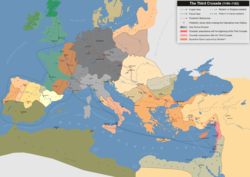
The church was lost to Saladin along with the rest of Jerusalem in 1187, although the treaty established after the Third Crusade allowed Christian pilgrims to continue visiting the site.
Image source: Third Crusade
1220 - 1250
% complete
Frederick II regained the city and the church by treaty in the 13th century while under a ban of excommunication, with the consequence that the holiest church in Christianity was laid under interdict during the last period of Latin control over Jerusalem.
Image source: Frederick II, Holy Roman Emperor
1236
% complete
The tomb of Philip d'Aubigny (died 1236), knight, tutor, and royal councillor to Henry III of England and signer of Magna Carta, is placed in front of the church's two original entrance doors. It is one of the few tombs of crusaders not removed after the Khwarizmian capture of Jerusalem in 1244; a stone marker was placed on it in 1925, sheltered by a wooden trapdoor.
Image source: Philip d'Aubigny
1244
% complete
Both city and church were captured by the Khwarezmians and the Ayyubids in 1244. The royal tombs were looted during the sack but probably remained mostly intact until the fire of 1808; they may have been destroyed then or during renovations of 1809–1810.
Image source: Siege of Jerusalem (1244)
1244
% complete
In the 13th century, the tops of the columns of the church were removed and sent to Mecca by the Khwarezmids.
1288
% complete
The tradition that the Stone of Unction marks where Jesus's body was prepared for burial is only attested since the Crusader era, notably by the Italian Dominican pilgrim Riccoldo da Monte di Croce in 1288. The present stone was added in the 1810 reconstruction.
1187
% complete
After retaking Jerusalem from the Crusaders in 1187, Saladin entrusted the Joudeh family with custody of the keys to the church, an iron key 30 centimetres long; the Nuseibehs either became or remained the doorkeepers.
Image source: Nusaybah family
1192
% complete
In 1192, Saladin assigned door-keeping responsibilities to the Muslim Nusaybah family, who according to their own lore had opened the door since the seventh century, though documents only mention their role since the time of Saladin.
1348 - 1575
% complete
There was certainly a recognisable 'Nestorian' (Church of the East) presence at the Holy Sepulchre from 1348 through 1575, as contemporary Franciscan accounts indicate.
Image source: Church of the East
1555
% complete
The Franciscan friars renovated the church in 1555, as it had been neglected despite increased numbers of pilgrims. Possibly to prevent pilgrims removing bits of rock as souvenirs, marble cladding was placed on the tomb around this time. Afterward, control oscillated between Franciscans and Orthodox depending on who could obtain a favourable firman, often through bribery.
Image source: Custody of the Holy Land
1699
% complete
There was no agreement about control of the church, although the question was discussed at the negotiations for the Treaty of Karlowitz in 1699.
Image source: Treaty of Karlowitz
1757
% complete
During Holy Week of 1757, Orthodox Christians reportedly took over some of the Franciscan-controlled church. An Ottoman decree of 1757 helped establish a status quo upholding the state of affairs at various Holy Land sites, which applies to the Holy Sepulchre to this day.
Image source: Status Quo (Jerusalem and Bethlehem)
1840
% complete
The façade and entrance have undergone significant changes since their construction in the 12th century. For example, when a fire broke out in 1840, dozens of pilgrims were trampled to death.
1853
% complete
Sultan Abdülmecid I's firman solidified the existing territorial division among the communities, requiring consensus to make even minor changes and pinning down permanent statutes of property and custodial roles. In the 19th century the Coptic, Ethiopian, and Syriac Orthodox acquired lesser responsibilities.
1947
% complete
By the British Mandate era, the red limestone cladding applied by Komnenos had deteriorated badly; from 1947 until restoration work in 2016–17, it was held in place with exterior scaffolding of iron girders installed by the British authorities.
1948
% complete
In 1948, Jerusalem was divided between Israel and Jordan, and the Old City, where the church is located, became part of Jordan.
1967
% complete
Israeli forces captured East Jerusalem in the Six-Day War of 1967, and that area, including the church, has remained under Israeli control ever since.
Image source: Six-Day War
1970 - 1978
% complete
During restoration works and excavations inside the building and under the nearby Muristan bazaar, it was found that the area was originally a quarry from which white meleke limestone was struck. East of the Chapel of Saint Helena, excavators found a fourth-century drawing of a Roman pilgrim ship, walls supporting Hadrian's second-century temple, and a higher wall supporting Constantine's basilica.
1994 - 1997
% complete
The dome was restored again in 1994–97 as part of extensive modern renovations ongoing since 1959. Since 1996, the main dome has been topped by the monumental Golgotha Crucifix consecrated by Greek Patriarch Diodoros I of Jerusalem.
Nov 9, 2008
% complete
On Sunday, 9 November 2008, a clash erupted between Armenian and Greek monks during celebrations for the Feast of the Cross, part of recurring disputes despite the Status Quo, including earlier incidents in 1902, 2002, 2004, and Palm Sunday April 2008.
May 2016 - Mar 2017
% complete
A full restoration of the Aedicule was agreed upon and executed from May 2016 to March 2017, an example of concord between the church custodians.
Oct 26, 2016
% complete
For the first time since at least 1555, on 26 October 2016, marble cladding protecting the supposed burial bed of Jesus was removed, revealing an older, partially broken slab with a Crusader-style cross carved into it. Mortar from just above the burial bed was dated to the mid-fourth century.
Feb 2018
% complete
In February 2018, the church was closed in protest following a tax dispute over €152,000,000 of uncollected taxes on church properties, and against a legislative proposal to expropriate church lands sold to private companies since 2010. The affair did not cover church buildings or religious facilities, which are exempt by law.
2022
% complete
During church renovations in 2022, a stone slab covered in modern graffiti was moved from a wall, revealing Cosmatesque-style decoration on one face.
Jun 2022
% complete
After Christian denominations protested a 2019 Supreme Court decision upholding the sale of three properties by the Greek Orthodox Patriarchate to Ateret Cohanim, the Supreme Court upheld the sale in June 2022, ending the legal battle.
Image source: Greek Orthodox Patriarchate of Jerusalem
Or browse the full history timeline directory, with more than 2,000 topics.
This Church of the Holy Sepulchre timeline was generated with the help of AI, using information found on the internet.
We work hard to keep these timelines accurate, but mistakes do get through. If you spot one, email us at [email protected] and we'll fix it for future visitors.
Generate yours with AI or build it from scratch, for free.
Export your timeline, add your own events, edit or remove AI-generated events, and much more
No credit card required.
Cancel anytime.
Cancel anytime.
You can create an unlimited number of timelines with up to 10 events on each one, customize how they look, export them to PDF, PNG, PowerPoint, CSV, and Excel, and share them with a link. Paid plans raise the event limit and add features like spreadsheet imports and collaborators.
Yes. You can cancel your subscription from your account page at any time, and you will not be charged again. Your subscription stays active for the rest of the period you already paid for.
Yes. We will email you a reminder before the annual renewal, and we will also email you a receipt.
Yes. You can email us within 15 days of any payment, and we will issue you a full refund.
Check out our pricing docs or send us an email anytime: [email protected].