
-
Use Cases
-
Resources
-
Pricing
The Russo-Japanese War (1904–1905) was a conflict between the Russian Empire and the Empire of Japan, fought primarily over control of Manchuria and Korea. It marked the first major military victory of an Asian power over a European nation in modern times, shocking the world and contributing to unrest in Russia. The war ended with the Treaty of Portsmouth, mediated by U.S. President Theodore Roosevelt. More Less
1891 - 1904
% complete
The Trans-Siberian Railway, including the Chinese Eastern Railway through Manchuria, allowed Russia to project military power into East Asia. Its expansion threatened Japanese interests in Korea and Manchuria and was seen as a prelude to permanent Russian domination of the region.
Image source: Trans-Siberian Railway
Apr 17, 1895
% complete
Japan's victory over China in the First Sino-Japanese War, formalized by the Treaty of Shimonoseki, gave Japan control of Taiwan and influence over Korea. Russia's subsequent pressure forced Japan to relinquish the Liaodong Peninsula, fueling Japanese resentment and setting the stage for future conflict with Russia.
Image source: Treaty of Shimonoseki
Apr 23, 1895
% complete
Russia, France, and Germany pressured Japan to return the strategically vital Liaodong Peninsula to China. Russia then leased the territory itself in 1898, deepening Japanese anger and contributing to the tensions that would erupt into war a decade later.
Image source: Triple Intervention
Mar 27, 1898
% complete
Russia secured a lease on Port Arthur (Lüshun) on the Liaodong Peninsula, establishing a warm-water naval base for its Pacific Fleet. This move directly contradicted the Triple Intervention it had led against Japan and alarmed Japanese strategists.
Image source: Port Arthur massacre (China)
1900 - Oct 1901
% complete
During the Boxer Rebellion, Russia sent nearly 200,000 troops into Manchuria ostensibly to protect its railways. After the rebellion was suppressed, Russian forces remained, occupying the region and refusing to withdraw on schedule, heightening tensions with Japan.
Image source: Russian invasion of Manchuria
Jan 30, 1902
% complete
Britain and Japan formed a defensive alliance recognizing each other's interests in East Asia. The alliance deterred other powers from joining Russia in any war with Japan, giving Tokyo the diplomatic confidence to confront St. Petersburg over Manchuria and Korea.
Image source: Anglo-Japanese Alliance
Aug 12, 1903 - Feb 6, 1904
% complete
Japan and Russia held protracted negotiations seeking a mutual understanding: Japan proposed recognizing Russian dominance in Manchuria in exchange for Russian recognition of Japanese primacy in Korea. Russia's stalling and refusal to concede convinced Japanese leaders that war was inevitable.
Image source: Casualties of the Russo-Ukrainian war
Feb 6, 1904
% complete
After months of fruitless negotiation, Japan broke off diplomatic relations with Russia on February 6, 1904. Two days later, without a formal declaration of war, the Imperial Japanese Navy moved to attack the Russian fleet at Port Arthur.
Image source: Russo-Japanese War
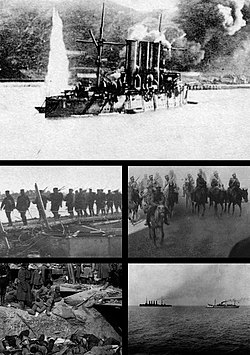
Feb 10, 1904
% complete
Two days after the attack on Port Arthur, Japan formally declared war on Russia, which followed with its own declaration. Despite hostilities already underway, both empires maintained diplomatic relations with neutral powers throughout the conflict.
Feb 8, 1904 - Feb 9, 1904
% complete
Hours before formally declaring war, Admiral Tōgō Heihachirō's fleet launched a surprise torpedo attack on the Russian Pacific Squadron at Port Arthur. The attack damaged several Russian ships but failed to cripple the squadron, beginning a prolonged blockade of the port.
Image source: Battle of Port Arthur
Feb 9, 1904
% complete
Japanese cruisers under Rear Admiral Uryū Sotokichi attacked Russian warships anchored at Chemulpo (Incheon), Korea. Outgunned, the cruiser Varyag and gunboat Korietz were destroyed or scuttled, securing Japanese control of Korean waters and enabling the landing of the Japanese First Army.
Image source: Battle of Chemulpo Bay
Oct 15, 1904
% complete
Admiral Rozhestvensky led the Russian Baltic Fleet, renamed the Second Pacific Squadron, on an 18,000-mile voyage around Africa to relieve Port Arthur. The arduous journey, marked by the Dogger Bank incident where the fleet fired on British fishing boats, took seven months to reach Asian waters.
Image source: Baltic Fleet
Oct 21, 1904
% complete
Nervous Russian sailors mistook British fishing trawlers in the North Sea for Japanese torpedo boats and opened fire, killing several fishermen. The incident nearly brought Britain into the war and forced the Russian fleet to delay while an international commission investigated.
Image source: Dogger Bank incident
May 27, 1905 - May 28, 1905
% complete
Admiral Tōgō's fleet annihilated the exhausted Russian Baltic Fleet in the Tsushima Strait in one of history's most decisive naval battles. Of the Russian ships, only three reached Vladivostok; six were sunk and six captured. The victory cemented Japan's status as a great power.
Image source: Battle of Tsushima
Apr 30, 1904 - May 1, 1904
% complete
General Kuroki Tamemoto's First Army crossed the Yalu River and defeated Russian forces under General Zasulich in the war's first major land battle. The victory secured a foothold in Manchuria and shocked international observers who had expected an easy Russian triumph.
Image source: Battle of the Yalu River (1904)
Aug 1, 1904 - Jan 2, 1905
% complete
General Nogi Maresuke's Third Army besieged the heavily fortified Russian naval base at Port Arthur. The siege featured brutal trench warfare, massive artillery bombardments, and costly assaults on fortified hills such as 203 Meter Hill before the garrison surrendered after nearly five months.
Image source: Siege of Port Arthur
Aug 25, 1904 - Sep 3, 1904
% complete
One of the largest land battles in history up to that time, involving over 250,000 combatants, saw General Kuropatkin's Russian forces repel repeated Japanese assaults around Liaoyang. Although tactically successful, Kuropatkin withdrew northward to avoid encirclement, ceding the city to Japan.
Image source: Battle of Liaoyang
Oct 5, 1904 - Oct 17, 1904
% complete
Kuropatkin attempted a counteroffensive south of Mukden with superior numbers but was checked by Japanese forces under Ōyama Iwao. Both sides suffered roughly 40,000 casualties, and the front settled into entrenched stalemate positions south of Mukden for the winter.
Image source: Battle of Shaho
Jan 2, 1905
% complete
Russian General Stessel surrendered Port Arthur to General Nogi after the capture of 203 Meter Hill gave Japanese artillery command of the harbor. Roughly 31,000 Russian soldiers became prisoners of war, and Japan gained enormous prestige, though Nogi lost two sons in the fighting.
Jan 26, 1905 - Jan 29, 1905
% complete
In one of the few Russian offensive actions of the war, General Gripenberg attacked the Japanese Second Army near Sandepu in harsh winter conditions. Poor coordination and Kuropatkin's reluctance to commit reserves forced a withdrawal, ending the last significant Russian counterattack.
Image source: Battle of Sandepu
Feb 20, 1905 - Mar 10, 1905
% complete
The largest land battle prior to World War I involved over 600,000 soldiers along a front stretching dozens of miles. Marshal Ōyama's flanking maneuvers routed Kuropatkin's army, which retreated north in good order but abandoned Mukden. Casualties exceeded 100,000 across both armies.
Image source: Battle of Mukden
Jul 7, 1905 - Jul 31, 1905
% complete
With peace negotiations looming, Japan invaded Russian-held Sakhalin Island to strengthen its bargaining position. The poorly defended Russian garrison quickly capitulated, giving Japan control of the island that would be partitioned in the eventual peace settlement.
Image source: Japanese invasion of Sakhalin
1905 - 1910
% complete
Japan's defeat of a major European power stunned the world and inspired anti-colonial movements across Asia and Africa. Military observers noted the lethality of modern industrial warfare—machine guns, trenches, and heavy artillery—lessons later borne out in World War I.
Image source: Russo-Japanese War
Jan 22, 1905 - Jun 1905
% complete
Military defeats and economic hardship sparked widespread strikes, mutinies, and unrest across the Russian Empire, beginning with Bloody Sunday in St. Petersburg. The domestic crisis pressured Tsar Nicholas II to seek peace with Japan and grant limited constitutional reforms.
Image source: Russian Revolution of 1905
Mar 31, 1905
% complete
With both empires exhausted, U.S. President Theodore Roosevelt offered to broker peace negotiations. Japan, facing financial strain, accepted, and Russia, weakened by revolution, eventually agreed, leading to talks hosted at Portsmouth, New Hampshire.
Image source: Theodore Roosevelt
Sep 5, 1905
% complete
Signed at the Portsmouth Naval Shipyard, the treaty ended the Russo-Japanese War. Russia recognized Japanese primacy in Korea, ceded southern Sakhalin, transferred lease rights to Port Arthur and the South Manchuria Railway, and withdrew from Manchuria. Roosevelt won the Nobel Peace Prize for his mediation.
Image source: Treaty of Portsmouth
Sep 5, 1905 - Sep 7, 1905
% complete
Many Japanese felt the treaty terms were too lenient toward Russia given their sacrifices, lacking an indemnity. Riots erupted in Tokyo outside a rally at Hibiya Park, with crowds attacking government buildings and police stations, resulting in deaths and hundreds of injuries.
Image source: Hibiya incendiary incident
Nov 17, 1905
% complete
Leveraging its victory and international recognition of its primacy in Korea, Japan forced the Eulsa Treaty upon Korea, making it a protectorate under a Japanese Resident-General. This paved the way for full annexation of Korea in 1910.
Image source: Japan–Korea Treaty of 1905
Nov 30, 1908
% complete
The United States and Japan affirmed the Open Door policy in China and each other's Pacific possessions, tacitly acknowledging Japan's gains from the war. The agreement temporarily stabilized relations between the two rising Pacific powers.
Image source: Root–Takahira Agreement
Aug 29, 1910
% complete
Five years after the war, Japan formally annexed Korea via the Japan–Korea Annexation Treaty, consolidating the strategic gains won in the conflict with Russia. Korea remained under Japanese colonial rule until the end of World War II in 1945.
Image source: Japan–Korea Treaty of 1910
Or browse the full history timeline directory, with more than 2,000 topics.
This Russo-Japanese War timeline was generated with the help of AI, using information found on the internet.
We work hard to keep these timelines accurate, but mistakes do get through. If you spot one, email us at [email protected] and we'll fix it for future visitors.
Generate yours with AI or build it from scratch, for free.
Export your timeline, add your own events, edit or remove AI-generated events, and much more
No credit card required.
Cancel anytime.
Cancel anytime.
You can create an unlimited number of timelines with up to 10 events on each one, customize how they look, export them to PDF, PNG, PowerPoint, CSV, and Excel, and share them with a link. Paid plans raise the event limit and add features like spreadsheet imports and collaborators.
Yes. You can cancel your subscription from your account page at any time, and you will not be charged again. Your subscription stays active for the rest of the period you already paid for.
Yes. We will email you a reminder before the annual renewal, and we will also email you a receipt.
Yes. You can email us within 15 days of any payment, and we will issue you a full refund.
Check out our pricing docs or send us an email anytime: [email protected].