-
Use Cases
-
Resources
-
Pricing
The history of gliders traces humanity's quest to achieve flight without engines. Beginning with early experiments by pioneers like Sir George Cayley and Otto Lilienthal in the 19th century, gliders played a crucial role in the development of aviation, serving as training tools during both World Wars and evolving into sophisticated soaring aircraft used today for recreation, competition, and scientific research. More Less
1809
% complete
Sir George Cayley, often called the father of aerodynamics, designed and tested small unmanned gliders and published his research on the principles of heavier-than-air flight. His work laid the theoretical foundations for all later fixed-wing aircraft, including gliders.
Image source: George Cayley
1853
% complete
In 1853, Sir George Cayley's reluctant servant (often identified as his coachman) made a short glide across a valley in Brompton Dale, Yorkshire, in Cayley's full-size glider. It was the first recorded manned, controlled, heavier-than-air flight in history.
1891
% complete
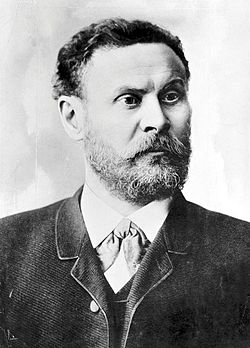
German engineer Otto Lilienthal began flying his 'Derwitzer' hang-glider in 1891, becoming the first person to make repeated, well-documented, controlled gliding flights. Over five years he completed more than 2,000 flights, profoundly influencing the Wright brothers.
Image source: Otto Lilienthal
Aug 10, 1896
% complete
Otto Lilienthal died from injuries sustained when his glider stalled and crashed during a test flight near Stölln, Germany. His death underscored the dangers of unpowered flight but cemented his legacy as the first true glider pilot and aviation martyr.
Oct 1900
% complete
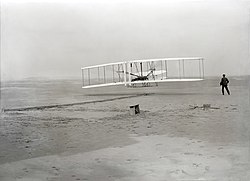
Wilbur and Orville Wright traveled to Kitty Hawk, North Carolina, to test piloted gliders as a precursor to powered flight. Their systematic experiments with wing warping and control surfaces advanced the science of flight control dramatically.
Image source: Wright Flyer
Sep 1902
% complete
The Wrights' 1902 glider incorporated three-axis control with a movable tail rudder, allowing coordinated turns for the first time. They made between 700 and 1,000 flights that season, proving their aircraft fully controllable and setting up their powered success of 1903.
Image source: Wright Glider
1920
% complete
The first annual Rhön gliding contest took place on the Wasserkuppe mountain in Germany after World War I, when the Treaty of Versailles banned German powered aviation. The event sparked a golden age of German sailplane development and soaring sport.
Image source: Wasserkuppe
1920
% complete
At the Wasserkuppe competitions, pilots such as Friedrich Harth and his student Wolfgang Klemperer achieved long-distance glides by exploiting ridge lift and thermals, demonstrating that gliders could stay aloft far longer than previously believed possible.
Image source: Thermal
1924
% complete
In 1924, German pilots at the Rhön contests surpassed the 100-kilometer distance mark in a single glider flight, a milestone that proved cross-country soaring was practical and spurred international interest in the sport of gliding.
Image source: Glider (sailplane)
1931
% complete
Hanna Reitsch set numerous gliding records beginning in the early 1930s, becoming one of the world's most famous aviators. She later became a celebrated test pilot and an enduring symbol of the interwar gliding movement in Germany.
Image source: Hanna Reitsch
1932
% complete
The growing popularity of soaring led to the formation of international bodies to standardize rules and records. These organizations, predecessors of today's FAI Gliding Commission, established official world records for distance, duration, and altitude in gliders.
Image source: FAI Gliding Commission
1937
% complete
During the late 1930s, German pilots like Peter Riedel set world distance records in sailplanes, pushing flights past 300 kilometers using cloud streets and thermal systems, showcasing rapid advances in glider aerodynamics and pilot skill.
Image source: Peter Riedel
1937
% complete
The Deutsche Forschungsanstalt für Segelflug developed the DFS 230 transport glider, capable of carrying nine troops. Its silent approach capability made it a revolutionary weapon concept for surprise airborne assaults.
Image source: DFS 230
1940
% complete
Shocked by the Eben-Emael raid, Britain and the United States launched major military glider programs. Britain developed the Airspeed Horsa and General Aircraft Hamilcar, while America produced the Waco CG-4A in large numbers.
Image source: Military glider
May 10, 1940
% complete
DFS 230 gliders silently landed elite German engineers directly atop the supposedly impregnable Belgian fortress of Eben-Emael, capturing it within hours. The world's first combat use of military gliders stunned Allied militaries worldwide.
Image source: Battle of Fort Ében-Émael
May 20, 1941
% complete
Germany used hundreds of DFS 230 gliders alongside parachutists to invade Crete. Although costly, the operation demonstrated gliders' value for delivering concentrated forces and influenced Allied airborne doctrine for years to come.
Image source: Battle of Crete
1942
% complete
The U.S. Army Air Forces trained thousands of volunteer glider pilots, many drawn from civilian flying backgrounds. Trainees learned to land heavily loaded gliders in tiny fields, earning the hazardous-duty pay that earned them the nickname 'the glider boys.'
Image source: Gliding
Nov 19, 1942
% complete
British commandos were carried in Horsa gliders towed by bombers to attack the Vemork heavy water facility in Norway, aiming to disrupt the German nuclear program. Both gliders crashed due to bad weather, and the survivors were executed, marking a tragic episode in glider warfare.
Image source: Operation Freshman
Jul 9, 1943
% complete
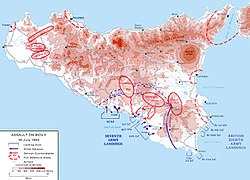
During Operation Husky, more than 130 American Waco CG-4A gliders attempted to seize bridges in Sicily. Strong winds and navigational errors scattered them widely into the sea and countryside, causing heavy losses and prompting improved training and equipment.
Image source: Allied invasion of Sicily
Jun 6, 1944
% complete
Six Horsa gliders landed with pinpoint accuracy just yards from their objectives in Normandy, delivering Major John Howard's force which captured the vital Caen Canal and Orne River bridges within minutes — one of the most celebrated glider operations in history.
Image source: Pegasus Bridge
Sep 17, 1944 - Sep 25, 1944
% complete
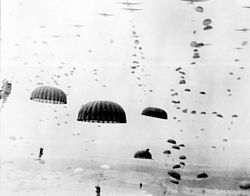
Over 2,000 gliders delivered British, American, and Polish airborne troops into the Netherlands in the largest glider operation ever conducted. Despite initial successes, the ambitious plan to cross the Rhine ultimately failed, with heavy casualties among glider infantry.
Image source: Operation Market Garden
1945
% complete
After World War II, helicopters rendered military gliders obsolete, offering vertical takeoff and recovery without tow aircraft. Armies disbanded their glider units by the 1950s, ending the brief but dramatic era of combat gliding.
Mar 24, 1945
% complete
Operation Varsity saw over 900 gliders cross the Rhine in daylight under fighter cover, the largest single-day airborne drop of the war. Improved tactics resulted in far better landing accuracy and lower casualties than previous operations.
Image source: Operation Varsity
1946
% complete
Thousands of surplus gliders and trained pilots returned home after World War II, seeding vibrant civilian soaring clubs across Europe and America. Veterans formed the backbone of national gliding associations and revived competitive flying.
1948
% complete
The inaugural FAI World Gliding Championships convened at Samedan, Switzerland, establishing the premier international competition in the sport. National teams raced over closed courses, formalizing modern racing tasks and scoring.
Image source: World Gliding Championships
1964
% complete
Al Parker flew over 1,000 kilometers in a single day in the United States, achieving a feat once thought impossible for unpowered flight. Long-distance records continued to climb as pilots exploited wave lift, convergence lines, and improving sailplanes.
1965
% complete
German manufacturer Akaflieg Stuttgart introduced the fs 29, pioneering fiberglass construction. Glass-fiber sailplanes offered smoother surfaces and higher aspect ratios than wood or metal, dramatically improving glide ratios and dominating subsequent decades.
Image source: Allstar SZD-54 Perkoz
Feb 17, 1986
% complete
Robert Harris soared to 14,938 meters (about 49,000 feet) over California's Sierra Nevada in a Grob G102 Astir, riding powerful lee waves. Such extreme altitudes required oxygen systems and pressure suits, echoing high-altitude aviation challenges.
Image source: Lee waves
2002
% complete
The Perlan Project aimed to fly a specially engineered pressurized sailplane on polar vortex stratospheric waves. In 2018, Perlan 2 reached 76,124 feet over Argentina, setting a new absolute glider altitude record and demonstrating flight in near-space conditions.
Image source: Windward Performance Perlan II
2010
% complete
Advances in battery technology enabled reliable electric self-launching sailplanes from manufacturers like Pipistrel and Lange Aviation. These quiet, zero-emission aircraft let pilots launch independently, transforming club operations and broadening access to soaring.
Image source: Motor glider
Or browse the full history timeline directory, with more than 2,000 topics.
This History of Gliders timeline was generated with the help of AI, using information found on the internet.
We work hard to keep these timelines accurate, but mistakes do get through. If you spot one, email us at [email protected] and we'll fix it for future visitors.
Generate yours with AI or build it from scratch, for free.
Export your timeline, add your own events, edit or remove AI-generated events, and much more
No credit card required.
Cancel anytime.
Cancel anytime.
You can create an unlimited number of timelines with up to 10 events on each one, customize how they look, export them to PDF, PNG, PowerPoint, CSV, and Excel, and share them with a link. Paid plans raise the event limit and add features like spreadsheet imports and collaborators.
Yes. You can cancel your subscription from your account page at any time, and you will not be charged again. Your subscription stays active for the rest of the period you already paid for.
Yes. We will email you a reminder before the annual renewal, and we will also email you a receipt.
Yes. You can email us within 15 days of any payment, and we will issue you a full refund.
Check out our pricing docs or send us an email anytime: [email protected].