-
Use Cases
-
Resources
-
Pricing
The history of automobiles traces the evolution of self-propelled vehicles from early steam-powered experiments through the invention of the internal combustion engine, the rise of mass production pioneered by Henry Ford, and the modern shift toward electric and autonomous vehicles that continues to transform transportation worldwide. More Less
1769
% complete
French engineer Nicolas-Joseph Cugnot built a steam-powered three-wheeled vehicle, widely considered the first self-propelled land vehicle. Designed to haul artillery, it moved at walking pace but demonstrated that a machine could propel itself without animal power.
Image source: Nicolas-Joseph Cugnot
1860
% complete
Belgian engineer Étienne Lenoir developed one of the first commercially successful internal combustion engines. He later adapted it to power a vehicle in 1863, laying crucial groundwork for gasoline-powered automobiles.
Image source: Étienne Lenoir
1876
% complete
Nikolaus Otto patented his four-stroke internal combustion engine, which was far more efficient than earlier designs. The Otto cycle became the foundation for virtually all modern gasoline engines.
Image source: Nicolaus Otto
1886
% complete
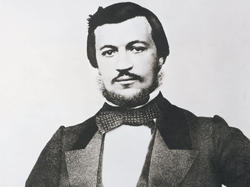
Gottlieb Daimler and Wilhelm Maybach converted a stagecoach with their high-speed petrol engine, creating one of the world's first four-wheeled automobiles and establishing key engineering principles for future vehicles.
Image source: Gottlieb Daimler
Jan 29, 1886
% complete
Karl Benz received a patent for the Benz Patent-Motorwagen, generally regarded as the first purpose-built automobile powered by an internal combustion engine. It featured a single-cylinder engine, tubular steel frame, and wire wheels.
Image source: Benz Patent-Motorwagen
Aug 1888
% complete
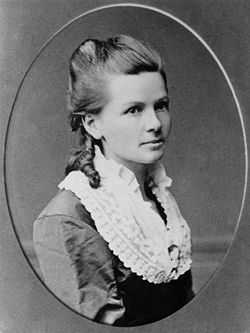
Bertha Benz drove her husband Karl's Motorwagen roughly 106 km from Mannheim to Pforzheim without his knowledge. Her pioneering journey proved the automobile's practicality and generated invaluable publicity for the invention.
Image source: Bertha Benz
1891
% complete
Panhard et Levassor introduced the Système Panhard, placing the engine at the front of the vehicle with rear-wheel drive. This layout became the dominant automotive architecture for much of the twentieth century.
Image source: Panhard
Sep 21, 1893
% complete
Charles and Frank Duryea successfully tested America's first gasoline-powered automobile in Springfield, Massachusetts. They went on to found the Duryea Motor Wagon Company, the first commercial automobile manufacturer in the United States.
Image source: Duryea Motor Wagon Company
Jul 22, 1894
% complete
The Paris–Rouen contest is often considered the world's first motoring competition. It attracted dozens of entrants and demonstrated to the public that automobiles were reliable enough for long-distance travel.
Image source: Paris–Rouen (motor race)
1895
% complete
The Michelin brothers fitted pneumatic tires to an automobile in the Paris–Bordeaux–Paris race. Though slow and puncture-prone at first, air-filled tires dramatically improved comfort and eventually became standard equipment.
Image source: Tire
1901
% complete
Ransom Olds produced the Curved Dash runabout using early assembly-line techniques, making it the first mass-produced American automobile. Thousands were sold, proving a market existed for affordable cars.
Image source: Oldsmobile Curved Dash
Oct 1903
% complete
Henry Ford's newly founded company sold its first Model A, beginning Ford's rise. Within a few years, Ford would revolutionize manufacturing and put the world on wheels.
Image source: Ford Model A (1903–04)
May 4, 1904
% complete
Charles Rolls and Henry Royce formed a partnership that produced some of the finest luxury cars in the world. The Silver Ghost of 1907 earned the marque a reputation as 'the best car in the world.'
Image source: Rolls-Royce Limited
Sep 16, 1908
% complete
William Durant consolidated Buick, Oldsmobile, and later Chevrolet and Cadillac into General Motors. GM grew into the world's largest automaker, pioneering multi-brand strategies and annual model changes.
Image source: General Motors
Oct 1, 1908
% complete
The Model T made automobile ownership attainable for ordinary Americans through simple design, durability, and low price. Over fifteen million were built, transforming transportation and society itself.
Image source: Ford Model T
Dec 1, 1913
% complete
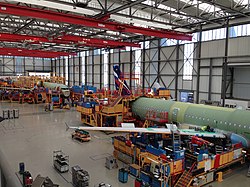
Ford implemented the moving assembly line at Highland Park, cutting Model T assembly time from over twelve hours to about ninety minutes. Mass production slashed prices and set the template for modern industry.
Image source: Assembly line
Aug 5, 1914
% complete
As automobile traffic surged, Cleveland installed the first electric traffic signal at Euclid Avenue and East 105th Street, marking the beginning of infrastructure designed around the car.
Image source: Traffic light
May 26, 1927
% complete
Ford ceased Model T production as consumer tastes shifted toward more stylish, powerful cars. The Model A followed, signaling the industry's move beyond pure utility toward design and features.
1938
% complete
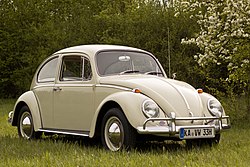
Ferdinand Porsche developed the 'people's car' commissioned by Adolf Hitler. After World War II, the Beetle became a global bestseller and symbol of affordable, reliable motoring.
Image source: Volkswagen Beetle
1939
% complete
Oldsmobile offered the first fully automatic transmission in a mass-produced car. Hydra-Matic made driving easier and helped broaden the appeal of automobiles to less experienced drivers.
Image source: Hydramatic
Feb 1942 - Aug 1945
% complete
American automakers halted civilian car production and produced tanks, jeeps, aircraft engines, and trucks for World War II. The war effort expanded factory capacity and workforce skills that would fuel postwar growth.
Image source: United States home front during World War II
1948
% complete
Designed before the war to motorize French peasants, the quirky 2CV offered simple, economical transport. It became a beloved icon of postwar European recovery and remained in production for over forty years.
Image source: Citroën 2CV
Apr 30, 1948
% complete
Inspired by the wartime Jeep, the Land Rover launched Britain's iconic all-terrain brand. Its rugged simplicity made it a favorite of farmers, explorers, and militaries worldwide.
Image source: Land Rover series
Jun 29, 1956
% complete
President Eisenhower signed the Federal-Aid Highway Act, creating the Interstate Highway System. The vast road network transformed American travel, commerce, suburbs, and car culture.
Image source: Interstate Highway System
1966
% complete
Toyota introduced the compact Corolla, which went on to become the best-selling car nameplate in history. Japanese automakers' reputation for quality reshaped the global industry.
Image source: Toyota Corolla
Sep 9, 1966
% complete
Spurred by Ralph Nader's 'Unsafe at Any Speed,' the act mandated federal safety standards such as seat belts. It marked the start of government regulation of automobile safety.
Image source: National Traffic and Motor Vehicle Safety Act
Dec 31, 1970
% complete
The strengthened Clean Air Act required dramatic reductions in vehicle emissions, leading to catalytic converters and unleaded gasoline. Environmental regulation became a defining force in automotive engineering.
Image source: Clean Air Act (United States)
Oct 1973 - Mar 1974
% complete
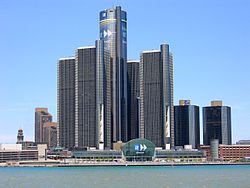
The OPEC oil embargo caused fuel shortages and soaring prices, sending Americans flocking to small, efficient Japanese imports. The crisis permanently changed consumer preferences and forced Detroit to downsize.
Image source: 1973 oil crisis
Jan 7, 1980
% complete
Congress guaranteed $1.5 billion in loans to save Chrysler from bankruptcy. Under Lee Iacocca, the company repaid the loans early and rebounded with minivans and K-cars.
Dec 1997
% complete
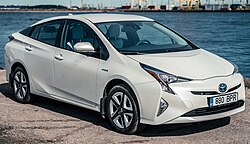
Toyota launched the world's first mass-produced hybrid car in Japan. The Prius popularized hybrid technology globally and signaled the industry's shift toward electrification.
Image source: Toyota Prius
Jul 2008
% complete
Tesla delivered its lithium-ion battery Roadster, offering over 200 miles of range and sports car performance. It shattered perceptions of electric vehicles and launched Tesla's ascent.
Image source: Tesla Roadster (first generation)
Dec 2010
% complete
The Nissan Leaf became the first affordable, mass-produced battery-electric car sold worldwide. It brought zero-emission driving to mainstream consumers and won Car of the Year honors.
Image source: Nissan Leaf
Jul 28, 2017
% complete
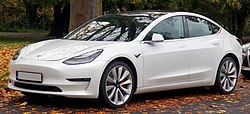
Tesla began deliveries of the Model 3, its first mass-market sedan. Enormous demand and rapid production scaling pushed electric vehicles into the mainstream and pressured legacy automakers to electrify.
Image source: Tesla Model 3
2020
% complete
Major manufacturers including GM, Volkswagen, and Volvo announced plans to phase out internal combustion engines and invest billions in electric vehicle lineups, marking an industry-wide pivot toward electrification.
Image source: Plug-in electric vehicles in the United States
Or browse the full history timeline directory, with more than 2,000 topics.
This History of Automobiles timeline was generated with the help of AI, using information found on the internet.
We work hard to keep these timelines accurate, but mistakes do get through. If you spot one, email us at [email protected] and we'll fix it for future visitors.
Generate yours with AI or build it from scratch, for free.
Export your timeline, add your own events, edit or remove AI-generated events, and much more
No credit card required.
Cancel anytime.
Cancel anytime.
You can create an unlimited number of timelines with up to 10 events on each one, customize how they look, export them to PDF, PNG, PowerPoint, CSV, and Excel, and share them with a link. Paid plans raise the event limit and add features like spreadsheet imports and collaborators.
Yes. You can cancel your subscription from your account page at any time, and you will not be charged again. Your subscription stays active for the rest of the period you already paid for.
Yes. We will email you a reminder before the annual renewal, and we will also email you a receipt.
Yes. You can email us within 15 days of any payment, and we will issue you a full refund.
Check out our pricing docs or send us an email anytime: [email protected].