
-
Resources
-
Pricing
The Hollywood Blacklist was a period of political persecution in the American film industry, when suspected communists and left-wing sympathizers were denied employment and pressured to name others. More Less
Build a timeline like this one in minutes, for free. Start Yours →
1930 - 1939
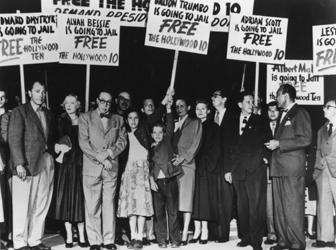
Two major film-industry strikes during the 1930s exacerbated tensions between Hollywood producers and unionized employees, particularly members of the Screen Writers Guild.
Image source: Hollywood blacklist
1933 - 1939
Membership levels in the Communist Party USA, which had remained below 20,000 until 1933, grew steadily during the decade and reached 66,000 in 1939. This expansion contributed to heightened concern about communist influence in American institutions, including Hollywood.
Image source: Communist Party USA

1933
The Screen Writers Guild was formed in 1933 by three future members of the Hollywood Ten. Its emergence, alongside labor disputes, intensified tensions between Hollywood producers and unionized employees.
Image source: Writers Guild of America West
1936 - 1939
The CPUSA lost substantial support following the Moscow show trials of 1936–1938 and the Molotov–Ribbentrop Pact of 1939. Even so, its membership remained well above pre-1933 levels, sustaining anti-communist concerns.
1938
Under chairman Martin Dies Jr., the House Un-American Activities Committee released a report claiming that communism was pervasive in the movie industry.
Image source: House Un-American Activities Committee
1941
Producer Walt Disney published an advertisement in Variety declaring his conviction that communist agitation was behind a strike by cartoonists and animators.
Image source: Walt Disney
1946
The Republican triumph in the 1946 midterm elections gave the party control of both houses of Congress. Conservative political influence grew, while HUAC, J. Edgar Hoover, and the FBI intensified anti-communist activity.
Image source: Red Scare
Jul 29, 1946
Hollywood Reporter publisher William R. Wilkerson titled his front-page Tradeviews column “A Vote for Joe Stalin.” His campaign and subsequent lists helped shape the pressure that preceded the blacklist.
1947
American Business Consultants Inc. was founded in 1947. The organization became associated with anti-communist investigations and the publication of material identifying alleged communist influence.
Image source: Red Channels
1947
In 1947, membership in the CPUSA was not itself a crime, and HUAC’s legal authority to investigate people’s beliefs and associations was problematic. This issue formed part of the controversy surrounding the blacklist.
Sep 1947
Drawing on lists provided in The Hollywood Reporter, HUAC subpoenaed 42 people working in the film industry to testify at its hearings.
Nov 24, 1947
Ten left-wing screenwriters and directors were cited for contempt of Congress after refusing to answer questions before HUAC. Their citations led directly to the first systematic Hollywood blacklist the following day.
Nov 25, 1947
The first systematic Hollywood blacklist began when major industry figures agreed to prevent the Hollywood Ten from working. The blacklist was an informal ban on suspected communists in the entertainment industry.
1948
All ten members of the Hollywood Ten were convicted of contempt of Congress in early 1948. Their convictions reinforced the industry’s willingness to deny work to people who refused to cooperate with HUAC.
May 1948 - Nov 1948
After taking control of RKO, Howard Hughes fired most of the studio’s employees and virtually shut it down for six months while the political views of remaining employees were investigated.
Image source: RKO Pictures
May 1948
Humphrey Bogart, a prominent member of the Committee for the First Amendment, published an essay in Photoplay vigorously denying that he was a communist sympathizer.
Image source: Humphrey Bogart
1949
The American Legion’s Americanism Division issued a blacklist containing 128 people whom it claimed were part of a communist conspiracy.
Image source: American Legion
1950
After the courts denied review, the ten men began serving prison sentences in 1950 for contempt of Congress.
1950
Counterattack’s editors claimed that the publication had no affiliation with any government agency. However, its apparent access to FBI and HUAC files became especially evident when Red Channels appeared in June 1950.
Jun 22, 1950
A pamphlet-style book titled Red Channels was published. Its allegations about communist affiliations helped extend blacklisting from film into radio and television.
Sep 1950
Hollywood Ten member Edward Dmytryk announced that he had once been a communist and was prepared to testify against others who had been members.
Image source: Edward Dmytryk
1951
At a 1951 HUAC appearance, Dmytryk described his past Party membership and named names. His directorial career subsequently recovered.
1951
With Congress under Democratic control, HUAC launched a second investigation into communism in Hollywood.
1952
The Screen Writers Guild amended its screen-credit rules to authorize studios to omit the names of people who had failed to clear themselves before Congress. The agreement was intended to prevent a recurrence of the 1950 credit disputes.
Dec 27, 1952
The American Legion announced its disapproval of Moulin Rouge, starring José Ferrer, whom it regarded as insufficiently conservative despite his having already faced HUAC questioning.
Image source: Moulin Rouge (1952 film)
1950
After Red Channels named Jean Muir as a communist sympathizer, she was immediately removed from the cast of the television sitcom The Aldrich Family, where she had been cast as Mrs. Aldrich.
Image source: Jean Muir
1952
Carl Foreman wrote High Noon after refusing to testify before HUAC. The film’s isolated marshal was interpreted as an allegory for Hollywood figures abandoned when political persecution returned.
Image source: High Noon
Dec 1952
Although Edward Dmytryk and Frank Tuttle named him in spring 1951, Jules Dassin directed the Broadway play Two’s Company with Bette Davis in December 1952.
Image source: Jules Dassin
1953
Albert Maltz had written the original screenplay for The Robe in the mid-1940s, but his name was absent when the film was released in 1953.
Image source: The Robe
1953
After leaving prison, Hollywood Ten member Herbert Biberman directed Salt of the Earth. The film about Mexican-American mine workers was denounced as communist propaganda and received extremely limited U.S. exhibition.
Image source: Salt of the Earth (1954 film)
1954
On the Waterfront became one of Hollywood’s most honored films, winning eight Academy Awards, including Best Picture, Best Director for Elia Kazan, and Best Screenplay for Budd Schulberg.
Image source: On the Waterfront
1954
Only about a dozen theaters in the United States exhibited Salt of the Earth in 1954, illustrating the continuing effect of blacklisting and anti-communist pressure.
1954
Actor John Ireland reached an out-of-court settlement in a lawsuit against Young & Rubicam after the advertising agency ordered him removed from the lead role in a sponsored television series.
Image source: John Ireland
Jun 1956
Dassin’s French-made film Rififi opened at New York’s Fine Arts Theater in June 1956 and remained there for 20 weeks, demonstrating that blacklisted artists could sometimes work abroad.
Image source: Rififi
1957
Blacklisted actor Norman Lloyd was hired by Alfred Hitchcock as an associate producer for the anthology series Alfred Hitchcock Presents, which was entering its third network season.
Image source: Norman Lloyd
Nov 30, 1958
A live CBS production of Wonderful Town appeared with the proper writing credit for blacklisted Edward Chodorov and his literary partner Joseph Fields.
1960
Although the blacklist was generally recognized as weakened by 1960, other blacklisted film artists continued to have difficulty obtaining work for years afterward.
1960
Several months after Preminger’s announcement, actor Kirk Douglas publicly acknowledged that Dalton Trumbo had written the screenplay for Spartacus.
Image source: Spartacus (film)
Jan 20, 1960
Director Otto Preminger publicly announced that Dalton Trumbo, a prominent member of the Hollywood Ten, would write the screenplay for Exodus. The announcement is generally regarded as a decisive weakening of the blacklist.
Image source: Dalton Trumbo
Oct 6, 1960
Spartacus premiered on October 6, 1960, becoming the first film to bear Trumbo’s name since he received story credit on Emergency Wedding in 1950.
Dec 1960
Exodus followed in December 1960 and carried Dalton Trumbo’s name. Together with Spartacus, it marked the public breakthrough that weakened the Hollywood blacklist.
Image source: Exodus (1960 film)
1962
John Henry Faulk won his lawsuit in 1962, an important legal victory associated with resistance to blacklisting and the dissemination of anti-communist accusations.
1962 - 2012
After William Wilkerson died in 1962, his Hollywood Reporter obituary credited him with helping prevent communists from becoming entrenched in Hollywood. In 2012, his son apologized for the paper’s role and said revenge and thwarted studio ambitions had motivated his father.
1963
In 1963, actor Sterling Hayden stated that he had been a rat and a stoolie, regretting that the names he provided had led friends to be blacklisted and deprived of their livelihoods.
Image source: Sterling Hayden
1965
Character actor Lionel Stander was unable to find film work until 1965, illustrating how the blacklist’s practical effects continued even after its public decline.
Image source: Lionel Stander
1981
In his 1981 autobiography Hollywood Red, screenwriter Lester Cole affirmed that virtually all of the Hollywood Ten had joined the Communist Party USA at some point.
Image source: Lester Cole
2002
For the 40th-anniversary re-release of Lawrence of Arabia in theaters and on DVD, guild pressure led to credits naming Robert Bolt and Michael Wilson as screenwriters.
Image source: Lawrence of Arabia (film)
Build a timeline like this one in minutes, for free. Start Yours →
Or browse the full history timeline directory, with more than 2,500 topics.
This Hollywood Blacklist timeline was generated with the help of AI, using information found on the internet.
We work hard to keep these timelines accurate, but mistakes do get through. If you spot one, email us at [email protected] and we'll fix it for future visitors.
Generate yours with AI or build it from scratch, for free.
Export your timeline, add your own events, edit or remove AI-generated events, and much more
No credit card required.
15-day money-back guarantee.
You can create an unlimited number of timelines with up to 10 events on each one, customize how they look, export them to PDF, PNG, PowerPoint, CSV, and Excel, and share them with a link. Timelines made with Timeline Maker AI keep every event the generator created, and you can add up to 5 events of your own. Paid plans remove the event limit, add spreadsheet imports and hide Preceden's branding, and the higher-priced plan also adds collaborators, a custom logo and a custom domain.
Yes. You can cancel your subscription from your account page at any time, and you will not be charged again. Your subscription stays active for the rest of the period you already paid for.
Yes. We email you a reminder 15 days before your annual renewal, and we email you a receipt after every payment.
Yes. You can email us within 15 days of any payment, and we will issue you a full refund.
Check out our pricing docs or send us an email anytime: [email protected].