-
Use Cases
-
Resources
-
Pricing
Nov 19, 1831
% complete
James Abram Garfield was born on November 19, 1831, in a log cabin in Orange Township, Cuyahoga County, Ohio. He was the last of five children born to Abram and Eliza Garfield, a poor farming family of English ancestry.
Image source: James A. Garfield
May 3, 1833
% complete
Abram Garfield died when James was just under two years old, leaving the family deeply impoverished. His mother Eliza raised the children alone, instilling in James a strong work ethic and love of reading that would shape his remarkable rise from poverty.
1848
% complete
As a teenager, Garfield spent several months working as a driver and deck hand on canal boats on the Ohio and Erie Canal, an experience he later called formative. He fell seriously ill during this period before deciding to pursue education instead.
1850
% complete
Garfield enrolled at the Western Reserve Eclectic Institute (later Hiram College) in Hiram, Ohio, where he excelled academically. He became a teacher there shortly after graduating, demonstrating his talents as an educator and scholar.
Image source: Hiram College
1856
% complete
Garfield transferred to Williams College in Massachusetts and graduated with honors in 1856. He was recognized for his debating skills and intellectual ability, and returned to Ohio to resume teaching at the Eclectic Institute, soon becoming its president.
Image source: Williams College
Nov 11, 1858
% complete
Garfield married Lucretia 'Crete' Rudolph, a former student and classmate from the Eclectic Institute, on November 11, 1858. The couple would have seven children together, though only five survived to adulthood.
Image source: Lucretia Garfield
Oct 8, 1859 - 1861
% complete
In 1859, at age 28, Garfield won election to the Ohio State Senate representing Summit and Portage counties, serving until 1861. There he opposed secession and supported strengthening the Union militarily as war approached.
Image source: 2026 United States Senate special election in Ohio
1860
% complete
Raised in the Disciples of Christ faith, Garfield preached regularly and was ordained as a minister around 1860. His eloquence in religious settings foreshadowed his skills as a public speaker and politician.
Image source: Christian Church (Disciples of Christ)
Jan 11, 1861
% complete
Garfield passed the bar examination and was admitted to practice law in Ohio in January 1861. Though he had largely taught himself law while teaching school, he rarely practiced, as the Civil War and politics soon consumed his attention.
Aug 1861
% complete
After the outbreak of the Civil War, Garfield helped raise the 42nd Ohio Volunteer Infantry Regiment and was commissioned its lieutenant colonel in August 1861. He rose quickly due to his intelligence and leadership abilities.
Jan 10, 1862
% complete
Brigadier General Garfield led a small force to victory over Confederate troops at Middle Creek in eastern Kentucky on January 10, 1862. This victory secured Union control of the Big Sandy Valley and earned him national recognition and promotion to brigadier general.
Image source: Battle of Middle Creek
Sep 19, 1863 - Sep 20, 1863
% complete
Serving as chief of staff to Major General William Rosecrans in the Army of the Cumberland, Garfield distinguished himself at the Battle of Chickamauga by riding through enemy fire to deliver critical orders. His conduct earned him promotion to major general of volunteers in September 1863.
Image source: Battle of Chickamauga
Oct 13, 1862
% complete
While still serving in the army, Garfield was elected as a Republican to the U.S. House of Representatives in October 1862. He initially declined to leave military service until President Lincoln persuaded him that his vote was more valuable in Congress than his generalship in the field.
Image source: United States House of Representatives
Dec 7, 1863 - Mar 4, 1881
% complete
Garfield took his seat in the 38th Congress in December 1863, beginning nearly eighteen years of continuous House service. He resigned his military commission in December 1864 to focus on his legislative career.
1865 - 1870
% complete
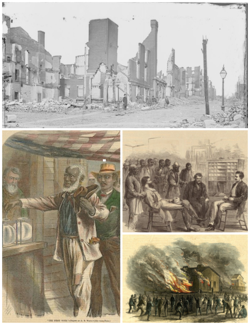
During early Reconstruction, Garfield aligned with the Radical Republicans, voting for the Fourteenth Amendment and supporting civil rights legislation for freedmen. Over time, he moderated his positions and emphasized fiscal restraint alongside civil rights.
Image source: Reconstruction era
1870 - 1873
% complete
Garfield chaired investigations into financial scandals including the Black Friday gold panic of 1869 and the Sanborn contracts affair. His reputation as an able investigator strengthened his standing within the Republican Party.
Image source: Black Friday (1869)
1871 - 1875
% complete
Garfield served as chairman of the powerful House Appropriations Committee from 1871 to 1875, where he championed hard money policies, opposed inflationary greenback currency expansion, and pushed for sound federal finances after the Civil War debt.
Image source: United States House Committee on Appropriations
Sep 4, 1872
% complete
The New York Sun exposed the Crédit Mobilier scandal in September 1872, revealing that Garfield had accepted $329 in stock dividends from the corrupt railroad construction company. Garfield denied wrongdoing but the episode damaged his reputation, though it did not end his career.
Image source: Crédit Mobilier scandal
Mar 3, 1873
% complete
Congress voted itself a retroactive pay raise in March 1873, known derisively as the 'salary grab.' Garfield had voted for it and was criticized heavily, contributing to a close reelection race in 1874 that he narrowly won amid Democratic gains.
Feb 26, 1877 - Mar 2, 1877
% complete
Garfield played a key role negotiating the Compromise of 1877, which resolved the disputed Hayes–Tilden presidential election by withdrawing federal troops from the South, effectively ending Reconstruction. His statesmanship elevated him among party leaders.
Image source: Compromise of 1877
Jan 13, 1880 - Mar 4, 1881
% complete
The Ohio General Assembly elected Garfield to the U.S. Senate in January 1880, set to begin in March 1881. However, events at the Republican National Convention that summer would redirect his political future entirely.
Image source: United States Senate
Jun 2, 1880 - Jun 5, 1880
% complete
At the 1880 Republican National Convention in Chicago, delegates deadlocked between former president Ulysses S. Grant's Stalwart faction and James G. Blaine's Half-Breed faction. Garfield served as floor manager for John Sherman's candidacy while delivering a powerful nominating speech.
Image source: 1880 Republican National Convention
Jun 8, 1880
% complete
On the thirty-fourth ballot, delegates seeking unity turned to Garfield as a dark horse compromise candidate. Despite his protests, he received the nomination on June 8, 1880, becoming the only sitting House member ever nominated for president by a major party.
Nov 2, 1880
% complete
Garfield defeated Democrat Winfield Scott Hancock in one of the closest popular votes in history, winning by fewer than 2,000 votes nationally but decisively in the Electoral College, 214 to 155. Republicans also captured both houses of Congress.
Image source: 1880 United States presidential election
Mar 4, 1881
% complete
Garfield took the oath of office as the 20th president of the United States on March 4, 1881, on the East Portico of the Capitol. In his inaugural address, he emphasized civil rights for African Americans, civil service reform, and universal education.
Image source: Assassination of James A. Garfield
Apr 1881 - 1882
% complete
Shortly after taking office, Garfield's administration uncovered corruption in the Star Route mail service, where contractors had bribed officials for lucrative delivery contracts. Garfield pursued prosecutions vigorously, making the scandal an early test of reform-minded leadership.
Image source: Star Route scandal
May 16, 1881
% complete
Senator Roscoe Conkling of New York resigned in protest after Garfield nominated William Robertson, Conkling's political enemy, to collector of the Port of New York. Garfield refused to back down, and the Senate confirmed Robertson — a landmark assertion of presidential authority over the spoils system.
Image source: Roscoe Conkling
Jul 2, 1881
% complete
On July 2, 1881, Charles J. Guiteau, a disgruntled office-seeker who believed God had ordered the act, shot Garfield twice at the Baltimore and Potomac Railroad Station in Washington, D.C. One bullet lodged near Garfield's spine; he survived for over two months while doctors attempted to remove it.
Image source: Assassination of James A. Garfield
Sep 19, 1881
% complete
After weeks of suffering worsened by unsanitary medical treatment, Garfield died on September 19, 1881, at Elberon, Long Branch, New Jersey, just six and a half months into his presidency. Vice President Chester A. Arthur succeeded him, and Garfield's death galvanized public support for civil service reform.
Jan 16, 1883
% complete
Outrage over Garfield's assassination by a disappointed office seeker spurred passage of the Pendleton Civil Service Reform Act, signed by President Arthur on January 16, 1883. The law established merit-based competitive examinations for federal jobs, transforming American government and cementing Garfield's legacy as a catalyst for reform.
Image source: Pendleton Civil Service Reform Act
Or browse the full history timeline directory, with more than 2,000 topics.
This James A. Garfield timeline was generated with the help of AI, using information found on the internet.
We work hard to keep these timelines accurate, but mistakes do get through. If you spot one, email us at [email protected] and we'll fix it for future visitors.
Generate yours with AI or build it from scratch, for free.
Export your timeline, add your own events, edit or remove AI-generated events, and much more
No credit card required.
Cancel anytime.
Cancel anytime.
You can create an unlimited number of timelines with up to 10 events on each one, customize how they look, export them to PDF, PNG, PowerPoint, CSV, and Excel, and share them with a link. Paid plans raise the event limit and add features like spreadsheet imports and collaborators.
Yes. You can cancel your subscription from your account page at any time, and you will not be charged again. Your subscription stays active for the rest of the period you already paid for.
Yes. We will email you a reminder before the annual renewal, and we will also email you a receipt.
Yes. You can email us within 15 days of any payment, and we will issue you a full refund.
Check out our pricing docs or send us an email anytime: [email protected].