-
Use Cases
-
Resources
-
Pricing
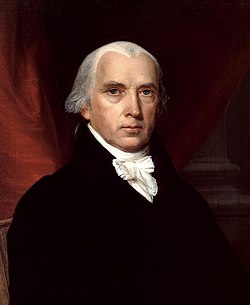
James Madison (1751–1836) was an American statesman, political theorist, and the fourth President of the United States. Known as the 'Father of the Constitution,' he played a pivotal role in drafting the U.S. Constitution and the Bill of Rights, co-founded the Democratic-Republican Party with Thomas Jefferson, and led the nation during the War of 1812. More Less
Mar 16, 1751
% complete
James Madison was born on March 16, 1751 (March 5 under the Old Style calendar) at Belle Grove plantation near Port Conway, Virginia. He was the eldest of twelve children of James Madison Sr. and Nelly Conway Madison, and grew up on the family's Montpelier estate in Orange County, Virginia.
Image source: James Madison
1769 - 1771
% complete
Madison attended the College of New Jersey (now Princeton University), completing his undergraduate degree in two years due to his intense study. He remained for an additional year of graduate study in Hebrew and political philosophy under president John Witherspoon, which deeply shaped his views on government and religious liberty.
Image source: The College of New Jersey
1776
% complete
At age 25, Madison was elected to the Virginia Convention that drafted the state's first constitution. There he met Thomas Jefferson and helped draft the Virginia Declaration of Rights, advocating for expanded religious freedom.
Image source: Virginia Conventions
Sep 15, 1794
% complete
At age 43, Madison married Dolley Payne Todd, a young widow 17 years his junior. Dolley became one of the most celebrated First Ladies in American history, known for her social grace and her rescue of Washington's portrait during the War of 1812.
Image source: Dolley Madison
Mar 4, 1797
% complete
After eight years in the House of Representatives, Madison declined reelection and returned to his Montpelier estate. He devoted himself to farming and correspondence with Jefferson, though he remained active in political affairs through his writings.
Image source: Montpelier (Orange, Virginia)
Mar 20, 1780
% complete
Madison became the youngest delegate to the Continental Congress at age 29. During his service he advocated for a stronger central government with power to regulate commerce and compel states to contribute funds, foreshadowing his later constitutional work.
Image source: Continental Congress
Sep 11, 1786
% complete
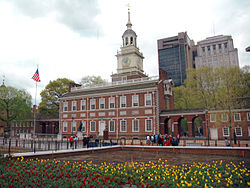
Frustrated by trade disputes between states, Madison joined delegates at the Annapolis Convention, which he had helped initiate. The convention issued a report calling for a broader meeting to address the weaknesses of the Articles of Confederation, setting the stage for the Constitutional Convention.
May 14, 1787 - Sep 17, 1787
% complete
Throughout the Constitutional Convention, Madison kept meticulous daily notes of the debates, sitting at the front of the room. These notes remain the most complete record of the proceedings and were published after his death, providing invaluable insight into the drafting of the U.S. Constitution.
Image source: Notes of Debates in the Federal Convention of 1787
May 25, 1787 - Sep 17, 1787
% complete
Madison played a pivotal role at the Constitutional Convention, arriving early with proposals that shaped the agenda. His Virginia Plan outlined a new federal structure with three branches of government, earning him recognition as the 'Father of the Constitution.'
Image source: Constitutional Convention (United States)
Oct 27, 1787 - May 28, 1788
% complete
Madison, along with Alexander Hamilton and John Jay, wrote essays under the pseudonym 'Publius' urging ratification of the Constitution. Madison authored 29 essays, including the famous Federalist No. 10 on factions and Federalist No. 51 on checks and balances.
Image source: The Federalist Papers
Jun 25, 1788
% complete
After vigorous debate at the Virginia Ratifying Convention, where Madison defended the Constitution against Patrick Henry's objections, Virginia ratified the document by a vote of 89 to 79, becoming the tenth state to do so and ensuring the Constitution's adoption.
Image source: List of U.S. states by date of admission to the Union
Feb 2, 1789
% complete
Madison won election to the first Congress under the new Constitution, defeating James Monroe. As a key member of the inaugural House of Representatives, he took a leading role in establishing the new federal government's operations.
Image source: United States House of Representatives
Jun 8, 1789 - Dec 15, 1791
% complete
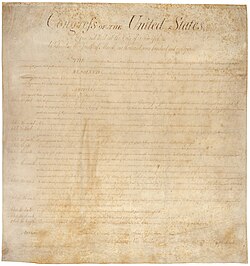
Responding to Anti-Federalist demands, Madison introduced a series of constitutional amendments guaranteeing individual liberties. Ten of his proposed amendments were ratified as the Bill of Rights in December 1791, cementing protections for speech, religion, and due process.
Image source: United States Bill of Rights
1792
% complete
Opposed to Hamilton's financial policies and what he saw as monarchical tendencies, Madison allied with Thomas Jefferson to form the Democratic-Republican Party, the nation's first opposition party, championing agrarian interests and strict construction of the Constitution.
Image source: Democratic-Republican Party
Nov 16, 1798 - Dec 24, 1798
% complete
In response to the Alien and Sedition Acts, Madison anonymously authored the Virginia Resolutions arguing that states could interpose against unconstitutional federal laws. The resolutions articulated states' rights principles that would influence American political debate for decades.
Image source: Kentucky and Virginia Resolutions
May 2, 1801 - Mar 3, 1809
% complete
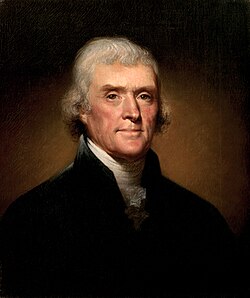
President Thomas Jefferson appointed Madison as Secretary of State, making him Jefferson's closest advisor. He managed foreign affairs during the Louisiana Purchase negotiations and navigated challenges posed by British and French interference with American shipping.
Image source: United States Secretary of State
Dec 22, 1807
% complete
As Secretary of State, Madison supported Jefferson's Embargo Act, which banned all American exports in response to British and French attacks on neutral shipping. The embargo proved economically devastating and unpopular, damaging Madison's standing before his presidential run.
Image source: Embargo Act of 1807
Dec 1808
% complete
Madison won the 1808 presidential election, defeating Federalist Charles Cotesworth Pinckney with 122 electoral votes. He succeeded his close friend Thomas Jefferson, continuing the Democratic-Republican control of the presidency.
Image source: 1808 United States presidential election
Mar 1, 1809 - May 1, 1810
% complete
Early in Madison's presidency, Congress passed legislation attempting to pressure Britain and France into respecting American neutrality. Macon's Bill No. 2 offered to restore non-importation against whichever belligerent continued to violate American shipping rights, leading Napoleon to nominally comply and straining relations with Britain.
Image source: Macon's Bill Number 2
Mar 4, 1809
% complete
James Madison took the oath of office as the fourth President of the United States. In his inaugural address, he emphasized neutrality in foreign affairs and unity among Americans amid rising tensions with Britain and France over maritime rights.
Image source: First inauguration of James Madison
1810 - 1812
% complete
A group of young congressmen led by Henry Clay and John C. Calhoun, known as War Hawks, agitated for war with Britain over impressment of American sailors and British support of Native American resistance. Their pressure pushed Madison toward declaring war.
Image source: War hawk
Nov 7, 1811
% complete
Governor William Henry Harrison defeated forces of Tecumseh's confederacy at Prophetstown. The battle heightened tensions with Britain, whom Americans accused of arming Native resistance, further pushing the nation toward war.
Image source: Battle of Tippecanoe
Jun 18, 1812
% complete
Madison asked Congress for a declaration of war against Britain, citing impressment of sailors, trade restrictions, and incitement of Native attacks. It was the first time the United States declared war under the Constitution, and the vote revealed deep sectional divisions.
Image source: War of 1812
Aug 19, 1812
% complete
During the War of 1812, the USS Constitution defeated HMS Guerriere in a dramatic naval engagement. British cannonballs reportedly bounced off the ship's thick oak hull, earning it the enduring nickname 'Old Ironsides' and boosting American morale.
Image source: USS Constitution vs HMS Guerriere
Aug 24, 1814
% complete
British troops captured Washington, D.C., and burned the White House, Capitol, and other public buildings. Madison and his wife Dolley narrowly escaped; Dolley famously saved Gilbert Stuart's portrait of George Washington before fleeing.
Image source: Burning of Washington
Sep 12, 1814 - Sep 14, 1814
% complete
American forces successfully defended Baltimore from British attack, including the bombardment of Fort McHenry. Francis Scott Key, witnessing the fort's flag still flying after the assault, wrote the poem that became 'The Star-Spangled Banner.'
Image source: Battle of Baltimore
Dec 24, 1814
% complete
American and British negotiators signed the Treaty of Ghent in Belgium, restoring pre-war boundaries without addressing maritime grievances. News of peace arrived in America shortly after Andrew Jackson's victory at New Orleans, giving the impression of a triumphant conclusion.
Image source: Treaty of Ghent
Jan 8, 1815
% complete
Unaware that the war had ended, General Andrew Jackson's forces decisively defeated a British assault on New Orleans. The lopsided American victory produced enormous national pride and made Jackson a national hero, even though it occurred after the Treaty of Ghent was signed.
Image source: Battle of New Orleans
Apr 10, 1816
% complete
Despite earlier opposing a national bank on constitutional grounds, Madison signed the bill creating the Second Bank of the United States, concluding that wartime financial difficulties demonstrated its necessity. This marked a notable evolution in his interpretation of federal powers.
Image source: Second Bank of the United States
Apr 27, 1816
% complete
Madison supported the nation's first peacetime protective tariff, designed to shield American manufacturers who had grown during the embargo and war years. It reflected the postwar embrace of a more active federal role in economic development.
Mar 3, 1817
% complete
As his second term ended, Madison reflected on the nation's progress since independence. He cautioned against sectional divisions and emphasized the importance of union, education, and public virtue for the survival of republican government.
Mar 4, 1817
% complete
Leaving office at age 65, Madison returned to Montpelier, where he managed his plantation, corresponded widely, and received numerous visitors seeking his counsel. He remained a respected elder statesman of the founding generation.
Oct 1829 - 1830
% complete
At age 78, Madison served as co-chairman of the Virginia Constitutional Convention alongside James Monroe and John Marshall. Despite declining health, he worked to moderate disputes over representation and suffrage reform in the state.
Image source: Virginia Constitutional Convention of 1829–1830
1834
% complete
Near the end of his life, Madison prepared a brief message to be read after his death, urging Americans to preserve the Union and cherish the principles of liberty. It expressed his lifelong devotion to republican self-government.
Jun 28, 1836
% complete
Madison died at Montpelier at age 85, the last surviving signer of the Constitution and the last of the Founding Fathers to serve as President. He was buried in the family cemetery at Montpelier, leaving behind an unmatched legacy as architect of the Constitution and the Bill of Rights.
Or browse the full history timeline directory, with more than 2,000 topics.
This James Madison timeline was generated with the help of AI, using information found on the internet.
We work hard to keep these timelines accurate, but mistakes do get through. If you spot one, email us at [email protected] and we'll fix it for future visitors.
Generate yours with AI or build it from scratch, for free.
Export your timeline, add your own events, edit or remove AI-generated events, and much more
No credit card required.
Cancel anytime.
Cancel anytime.
You can create an unlimited number of timelines with up to 10 events on each one, customize how they look, export them to PDF, PNG, PowerPoint, CSV, and Excel, and share them with a link. Paid plans raise the event limit and add features like spreadsheet imports and collaborators.
Yes. You can cancel your subscription from your account page at any time, and you will not be charged again. Your subscription stays active for the rest of the period you already paid for.
Yes. We will email you a reminder before the annual renewal, and we will also email you a receipt.
Yes. You can email us within 15 days of any payment, and we will issue you a full refund.
Check out our pricing docs or send us an email anytime: [email protected].