-
Use Cases
-
Resources
-
Pricing
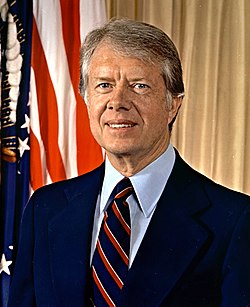
Jimmy Carter (1924–2024) was the 39th President of the United States, serving from 1977 to 1981. A former Georgia governor and peanut farmer, he championed human rights, brokered the Camp David Accords, and after leaving office became renowned for decades of humanitarian work through The Carter Center and Habitat for Humanity, earning the Nobel Peace Prize in 2002. More Less
Oct 1, 1924
% complete
James Earl Carter Jr. was born in Plains, Georgia, the son of a farmer and businessman. He grew up in the nearby community of Archery during the Great Depression, an upbringing that shaped his lifelong commitment to hard work, faith, and public service.
Image source: Jimmy Carter
Jun 5, 1946
% complete
Carter graduated from the United States Naval Academy at Annapolis with a bachelor of science degree. He was commissioned as an ensign in the U.S. Navy, beginning a promising military career focused on submarine service.
Image source: United States Naval Academy
Jul 7, 1946
% complete
Shortly after his graduation from Annapolis, Jimmy Carter married Rosalynn Smith of Plains, Georgia. Their marriage lasted over 77 years, becoming the longest presidential marriage in American history, and Rosalynn became a close partner in his political career.
Image source: Rosalynn Carter
1952 - 1953
% complete
Carter was selected by Admiral Hyman Rickover for the U.S. Navy's pioneering nuclear submarine program. He worked on the development of the nuclear propulsion system for the USS Seawolf, gaining technical expertise that influenced his later views on energy policy.
Image source: Hyman G. Rickover
Oct 9, 1953
% complete
After his father's death, Carter resigned his naval commission and returned to Plains, Georgia, to take over the family peanut farming business. He built it into a successful enterprise while becoming increasingly involved in local civic affairs.
Jan 14, 1963 - Jan 9, 1967
% complete
Carter won a seat in the Georgia State Senate after a contested election he ultimately prevailed in through legal challenge. He served two terms, promoting education reform and opposing racial segregation practices in state government.
Image source: Georgia State Senate
Nov 3, 1970
% complete
Carter defeated incumbent-friendly candidate Carl Sanders to become Governor of Georgia. In his inaugural address, he surprised many by declaring that 'the time for racial discrimination is over,' signaling a progressive stance on civil rights.
Image source: 1970 Georgia gubernatorial election
Jan 12, 1971 - Jan 14, 1975
% complete
As governor, Carter reorganized the state bureaucracy, expanded education funding, promoted equal treatment of African Americans in state hiring, and emphasized government efficiency. His term raised his national profile among Democrats.
Image source: Governor of Georgia
Dec 12, 1974
% complete
Carter announced his candidacy for the Democratic nomination for president, positioning himself as a Washington outsider in the wake of Watergate. His grassroots campaign strategy of competing in every primary proved remarkably effective.
Image source: Jimmy Carter 1976 presidential campaign
Jul 15, 1976
% complete
At the Democratic National Convention in New York City, Carter secured the party's presidential nomination, choosing Senator Walter Mondale as his running mate. His outsider image resonated with voters disillusioned by political scandal.
Image source: 1976 Democratic National Convention
Nov 2, 1976
% complete
Carter narrowly defeated incumbent Republican President Gerald Ford, winning 50.1% of the popular vote and 297 electoral votes. He became the first president from the Deep South since before the Civil War era reconstruction period.
Image source: 1976 United States presidential election
Jan 20, 1977
% complete
Jimmy Carter was sworn in as the 39th President of the United States. Breaking with tradition, he walked down Pennsylvania Avenue to the White House and emphasized human rights in his inaugural address, setting the tone for his administration.
Image source: Inauguration of Jimmy Carter
Sep 7, 1977
% complete
Carter signed treaties with Panama agreeing to transfer control of the Panama Canal to Panamanian authority by the end of 1999. The controversial decision improved U.S. relations with Latin America despite fierce domestic opposition.
Image source: Torrijos–Carter Treaties
Sep 17, 1978
% complete
After thirteen days of intense mediation at Camp David, Carter brokered a historic agreement between Egyptian President Anwar Sadat and Israeli Prime Minister Menachem Begin. The accords laid the groundwork for the Egypt–Israel peace treaty and remain one of Carter's greatest achievements.
Image source: Camp David Accords
Jan 1, 1979
% complete
Carter officially recognized the People's Republic of China and severed formal diplomatic ties with Taiwan, fulfilling the normalization process begun under Nixon. The move reshaped Cold War geopolitics and opened China to greater engagement with America.
Image source: China–United States relations
Mar 26, 1979
% complete
Building on the Camp David Accords, Egypt and Israel formally signed a peace treaty at the White House with Carter presiding. It ended decades of hostilities between the two nations and established full diplomatic relations.
Image source: Egypt–Israel peace treaty
Mar 28, 1979
% complete
A partial meltdown occurred at the Three Mile Island nuclear plant in Pennsylvania. Carter, drawing on his naval nuclear training, personally visited the site and his administration responded carefully, though the accident slowed the growth of the U.S. nuclear power industry.
Image source: Three Mile Island accident
Jun 18, 1979
% complete
Carter and Soviet leader Leonid Brezhnev signed the second Strategic Arms Limitation Treaty in Vienna. Although the U.S. never ratified it following the Soviet invasion of Afghanistan, both sides largely observed its terms.
Image source: Strategic Arms Limitation Talks
Jul 15, 1979
% complete
In a nationally televised address later dubbed the 'malaise' speech, Carter diagnosed a crisis of confidence in American society and called for shared sacrifice to address the energy crisis. Though initially well received, it drew criticism for its tone.
Image source: Presidency of Jimmy Carter
Nov 4, 1979 - Jan 20, 1981
% complete
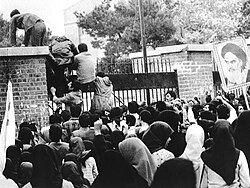
Iranian revolutionaries seized the U.S. embassy in Tehran, taking 52 Americans hostage for 444 days. The crisis dominated Carter's final year in office, and his inability to secure their release contributed significantly to his 1980 election defeat.
Image source: Iran hostage crisis
Dec 27, 1979
% complete
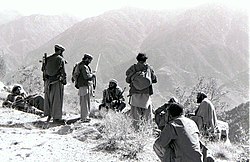
In response to the Soviet invasion of Afghanistan, Carter imposed a grain embargo against the USSR, boycotted the 1980 Moscow Olympics, and increased defense spending, marking a sharp deterioration in superpower relations.
Image source: Soviet–Afghan War
Apr 24, 1980
% complete
A secret military operation to rescue the American hostages in Iran ended in failure when helicopters malfunctioned in the desert, killing eight servicemen. The debacle severely damaged confidence in Carter's leadership.
Image source: Operation Eagle Claw
Nov 4, 1980
% complete
Carter lost decisively to Ronald Reagan amid economic stagflation, the ongoing hostage crisis, and perceptions of national decline. Reagan won 44 states, ending Carter's single term in office.
Image source: 1980 United States presidential election
Jan 20, 1981
% complete
The 52 American hostages were freed in Iran just minutes after Ronald Reagan's inauguration, ending the 444-day ordeal. Carter had worked tirelessly until his final hours in office to negotiate their release.
1982
% complete
In partnership with Emory University, Carter established the Carter Center in Atlanta to advance human rights, democracy, global health, and conflict resolution. It became the centerpiece of his influential post-presidential career.
Image source: Carter Center
1982
% complete
Carter published his memoir about his presidency, beginning a prolific writing career that would eventually include more than 30 books on topics ranging from politics to poetry and faith.
1984 - 2019
% complete
Beginning in 1984, Carter and Rosalynn volunteered annually with Habitat for Humanity's Jimmy & Rosalynn Carter Work Project, helping build or renovate thousands of homes worldwide well into their nineties.
Image source: Habitat for Humanity
Oct 11, 2002
% complete
Carter received the Nobel Peace Prize for his decades of work advancing peace, democracy, and human rights, including mediating international conflicts and combating disease through the Carter Center.
Image source: List of Nobel Peace Prize laureates
Mar 22, 2019
% complete
Carter surpassed George H. W. Bush to become the longest-lived president in U.S. history at age 94 years and 172 days. He continued teaching Sunday school and engaging in humanitarian work.
Feb 18, 2023
% complete
After a series of hospitalizations, Carter decided to spend his remaining time at home in Plains, Georgia, receiving hospice care. He lived nearly two more years, passing away on December 29, 2024, at age 100.
Image source: Death and state funeral of Jimmy Carter
Or browse the full history timeline directory, with more than 2,000 topics.
This Jimmy Carter timeline was generated with the help of AI, using information found on the internet.
We work hard to keep these timelines accurate, but mistakes do get through. If you spot one, email us at [email protected] and we'll fix it for future visitors.
Generate yours with AI or build it from scratch, for free.
Export your timeline, add your own events, edit or remove AI-generated events, and much more
No credit card required.
Cancel anytime.
Cancel anytime.
You can create an unlimited number of timelines with up to 10 events on each one, customize how they look, export them to PDF, PNG, PowerPoint, CSV, and Excel, and share them with a link. Paid plans raise the event limit and add features like spreadsheet imports and collaborators.
Yes. You can cancel your subscription from your account page at any time, and you will not be charged again. Your subscription stays active for the rest of the period you already paid for.
Yes. We will email you a reminder before the annual renewal, and we will also email you a receipt.
Yes. You can email us within 15 days of any payment, and we will issue you a full refund.
Check out our pricing docs or send us an email anytime: [email protected].