-
Resources
-
Pricing
A timeline of Israel’s judges, the leaders who delivered the tribes during the period between the conquest of Canaan and the establishment of the monarchy. More Less
Build a timeline like this one in minutes, for free. Start Yours →
1200 BCE - 1150 BCE
After the death of Joshua, the Israelite tribes continue establishing themselves among the peoples of Canaan. The biblical account presents this settlement as incomplete, with many Canaanite communities remaining in the land and influencing Israel's political and religious life.
Image source: Book of Judges
1200 BCE
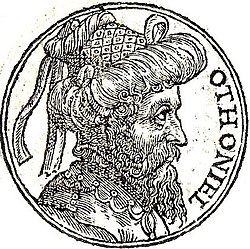
According to the Book of Judges, Israel turns away from the worship of the LORD and is subjected to Cushan-Rishathaim, king of Aram-naharaim. Othniel, the nephew of Caleb, becomes the first judge and delivers Israel after the people cry out for help.
Image source: Othniel
1200 BCE - 1160 BCE
The biblical narrative says that the land has rest for forty years after Othniel's victory. This period establishes the recurring pattern of apostasy, foreign oppression, deliverance by a judge, and temporary peace.
1160 BCE - 1142 BCE
Following Othniel's death, Israel again does what the biblical text considers evil. Eglon, king of Moab, allies with Ammon and Amalek, captures Jericho, and dominates the Israelites for eighteen years.
1142 BCE
Ehud of the tribe of Benjamin brings tribute to Eglon and gains a private audience with the Moabite king. He conceals a short sword, kills Eglon, escapes, and summons Israel to attack the Moabites.
Image source: Ehud
1142 BCE
After Ehud's assassination of Eglon, Israelite forces seize the Jordan River fords. They defeat approximately ten thousand Moabite warriors, and the land has rest for eighty years.
1140 BCE
Shamgar, son of Anath, is credited with killing six hundred Philistines with an oxgoad. The brief notice portrays him as a local deliverer during a period of Philistine pressure.
1120 BCE - 1100 BCE
Jabin, king of Canaan, rules from Hazor and oppresses Israel through his military commander Sisera. Sisera's force includes nine hundred iron chariots, and the oppression lasts twenty years.
1100 BCE - 1060 BCE
The biblical account records forty years of peace after the defeat of Sisera. Deborah's victory song celebrates the tribal coalition and the decisive reversal of Canaanite domination.
Image source: Deborah
1100 BCE
Deborah, a prophet and judge, summons Barak of Kedesh and instructs him to gather troops from Naphtali and Zebulun. She accompanies him to Mount Tabor, while Sisera assembles his chariot army near the Kishon River.
1100 BCE
Sisera flees the battle and seeks refuge in the tent of Jael, wife of Heber the Kenite. After offering him shelter, Jael kills the sleeping commander with a tent peg, completing Israel's victory over Jabin's forces.
1100 BCE
Barak's Israelite forces descend from Mount Tabor against Sisera's army. The biblical poem in Judges 5 describes a divinely aided victory in which the Kishon torrent contributes to the defeat of the Canaanite chariots.
Image source: Battle of Mount Tabor (1799)
1060 BCE - 1053 BCE
Israel again turns to other gods, and Midian, Amalek, and eastern raiders repeatedly invade the land. They destroy crops and livestock, forcing many Israelites to hide in mountain strongholds and impoverishing the country for seven years.
Image source: Gideon
1053 BCE
Gideon crosses the Jordan while exhausted and requests provisions from Succoth and Penuel. He continues pursuing the Midianite kings Zebah and Zalmunna, captures them at Karkor, and executes them after learning they killed his brothers.
1053 BCE
When the Israelites ask Gideon to rule over them and establish a dynasty, he replies that the LORD should rule over Israel. He nevertheless requests gold earrings from the spoil and makes an ephod at Ophrah, which becomes a religious snare.
1053 BCE
The biblical narrative reduces Gideon's army to three hundred men. At night they surround the Midianite camp with trumpets, jars, and torches; panic spreads through the enemy, who flee and are pursued by Israelite forces.
1053 BCE
Gideon blows a trumpet and gathers forces from Abiezer, Manasseh, Asher, Zebulun, and Naphtali. He asks for signs involving a fleece, reflecting his hesitation before confronting the much larger Midianite coalition.
1053 BCE
An angel of the LORD appears to Gideon while he threshes wheat in a winepress to conceal it from Midianite raiders. Gideon receives the name Jerubbaal after destroying his father's altar to Baal and building an altar to the LORD.
1100 BCE
The narrative of Micah describes a man from the hill country of Ephraim who makes an idol, creates a private shrine, and appoints a Levite as priest. The episode illustrates the decentralized worship and religious disorder associated with the period.
Image source: Micah's Idol
1090 BCE
The tribe of Dan, seeking a new territory, sends scouts northward and attacks the peaceful city of Laish. The Danites burn and rebuild the settlement, naming it Dan, and take Micah's idol and Levite for their new sanctuary.
1080 BCE
A Levite and his concubine lodge in Gibeah, where a mob abuses her through the night and she dies. The Levite cuts her body into twelve pieces and sends them throughout Israel, provoking a national response against Benjamin.
1080 BCE
The Israelite tribes demand that Gibeah's perpetrators be surrendered, but Benjamin refuses. After severe defeats, the united tribes defeat Benjamin, destroy many of its towns, and later seek ways to preserve the surviving tribe.
1035 BCE
After Gideon's death, his son Abimelech persuades his maternal relatives in Shechem to support him. He kills seventy of his half-brothers on one stone, with Jotham escaping, and is proclaimed ruler by the people of Shechem and Beth-millo.
Image source: Abimelech
1035 BCE
From Mount Gerizim, Jotham condemns Shechem's support for Abimelech through a fable in which trees choose an unproductive bramble as king. He predicts mutual destruction between Abimelech and the people of Shechem.
1032 BCE
Gaal son of Ebed challenges Abimelech's authority in Shechem. Abimelech defeats Gaal's supporters, attacks the city, kills its inhabitants, and destroys Shechem's stronghold and temple-tower.
1032 BCE
Abimelech attacks Thebez and approaches its fortified tower. A woman drops an upper millstone on his head, mortally wounding him; he orders his armor-bearer to kill him so that it will not be said that a woman killed him.
1030 BCE - 1008 BCE
Tola of Issachar rises to deliver Israel after the turmoil associated with Abimelech. He judges Israel for twenty-three years from Shamir in the hill country of Ephraim.
1008 BCE - 986 BCE
Jair of Gilead judges Israel for twenty-two years. The account notes that he has thirty sons who ride thirty donkeys and control thirty towns in Gilead, called Havvoth-jair.
986 BCE - 968 BCE
Israel worships the gods of surrounding peoples, and the Ammonites attack Gilead and cross the Jordan against Judah, Benjamin, and Ephraim. After acknowledging their wrongdoing, the Israelites seek a military leader.
Image source: Jephthah
968 BCE
Jephthah, an expelled son of Gilead, is recalled by the elders of Gilead to lead the fight against Ammon. Before battle he argues that Israel did not unlawfully seize Ammonite territory, citing the history of the exodus and settlement.
968 BCE
Jephthah defeats the Ammonite forces east of the Jordan. The biblical narrative then records his controversial vow involving his daughter, whose fulfillment has generated extensive Jewish and Christian interpretation.
967 BCE
The tribe of Ephraim quarrels with Jephthah because it was not invited to the campaign against Ammon. Jephthah's Gileadite forces seize the Jordan crossings and identify Ephraimite fugitives by their pronunciation of the word Shibboleth.
960 BCE - 953 BCE
Ibzan of Bethlehem judges Israel for seven years. The brief biblical notice emphasizes his large family and numerous marriages arranged between his children and people outside his clan.
953 BCE - 943 BCE
Elon of Zebulun serves as a judge of Israel for ten years. After his death he is buried at Aijalon in the land of Zebulun.
943 BCE - 935 BCE
Abdon son of Hillel judges Israel for eight years. He has forty sons and thirty grandsons who ride seventy donkeys, a detail that indicates status and administrative influence in the period.
935 BCE - 895 BCE
Israel again does evil, and the LORD gives the Israelites into the hands of the Philistines for forty years. The Philistines become the dominant military power along the coastal plain and pressure the tribes of Dan and Judah.
Image source: Samson
935 BCE
An angel announces to the barren wife of Manoah that she will bear a son dedicated as a Nazirite. Samson's hair is not to be cut, and he is destined to begin delivering Israel from Philistine control.
920 BCE
While traveling to Timnah, Samson encounters a young lion and tears it apart with extraordinary strength. The episode introduces the supernatural power associated with his Nazirite calling and foreshadows his later riddle.
918 BCE
Samson proposes marriage to a Philistine woman from Timnah and poses a riddle to thirty companions at the wedding feast. After the Philistines pressure his bride to obtain the answer, Samson responds violently and kills thirty men at Ashkelon.
917 BCE
After learning that his wife has been given to another man, Samson captures three hundred foxes or jackals, ties them in pairs with torches, and releases them into Philistine fields. The resulting destruction escalates the cycle of retaliation.
916 BCE
Samson is handed over by men of Judah to the Philistines at Lehi. He breaks his bonds and kills a thousand Philistines with the jawbone of a donkey, becoming the central military opponent of Philistine rule.
910 BCE
After visiting a prostitute in Gaza, Samson escapes a nighttime ambush by removing the city's gates, posts, and bar and carrying them toward Hebron. The episode displays his strength and humiliates the Philistine city.
908 BCE
Blinded and imprisoned, Samson is brought to a Philistine temple in Gaza for public entertainment. He prays for strength, pushes apart the supporting pillars, and collapses the temple, killing himself and more Philistines than during his life.
908 BCE
The Philistine rulers bribe Delilah to discover the source of Samson's strength. After repeated deception, Samson tells her that his uncut hair symbolizes his Nazirite dedication; she has his hair cut while he sleeps.
Image source: Samson and Delilah (1949 film)
1050 BCE - 1020 BCE
Samuel serves as prophet, judge, and national leader, traveling in a circuit through Bethel, Gilgal, Mizpah, and Ramah. His leadership marks a transition from the episodic judges of the earlier narrative toward centralized monarchy.
Image source: Samuel
1050 BCE
During the assembly at Mizpah, the Philistines attack, but the LORD throws the enemy into confusion with a great thunderclap. Israel pursues the Philistines and recovers territory, and Samuel sets up a memorial stone named Ebenezer.
Image source: Battle of Ebenezer Church
1050 BCE
Samuel summons Israel to Mizpah, where the people confess their idolatry, fast, and seek deliverance from the Philistines. Samuel intercedes and offers sacrifice as the enemy approaches.
1020 BCE
Samuel privately anoints Saul of Benjamin and later presents him publicly at Mizpah. Saul's rise marks the traditional end of the era in which Israel is primarily governed by judges and the beginning of the united monarchy.
Image source: Saul
1020 BCE
Samuel's sons prove unacceptable as judges, and Israel's elders ask for a king to govern them and lead them in war. Samuel warns that monarchy will impose military, agricultural, and economic demands, but the people persist.
Build a timeline like this one in minutes, for free. Start Yours →
Or browse the full history timeline directory, with more than 2,500 topics.
This Judges of Israel timeline was generated with the help of AI, using information found on the internet.
We work hard to keep these timelines accurate, but mistakes do get through. If you spot one, email us at [email protected] and we'll fix it for future visitors.
Generate yours with AI or build it from scratch, for free.
Export your timeline, add your own events, edit or remove AI-generated events, and much more
No credit card required.
15-day money-back guarantee.
You can create an unlimited number of timelines with up to 10 events on each one, customize how they look, export them to PDF, PNG, PowerPoint, CSV, and Excel, and share them with a link. Timelines made with Timeline Maker AI keep every event the generator created, and you can add up to 5 events of your own. Paid plans remove the event limit, add spreadsheet imports and hide Preceden's branding, and the higher-priced plan also adds collaborators, a custom logo and a custom domain.
Yes. You can cancel your subscription from your account page at any time, and you will not be charged again. Your subscription stays active for the rest of the period you already paid for.
Yes. We email you a reminder 15 days before your annual renewal, and we email you a receipt after every payment.
Yes. You can email us within 15 days of any payment, and we will issue you a full refund.
Check out our pricing docs or send us an email anytime: [email protected].