
-
Use Cases
-
Resources
-
Pricing
Sep 27, 1601
% complete
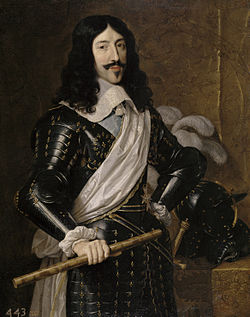
Louis XIII, sometimes called the Just, was born on 27 September 1601. He would become King of France from 1610 until his death in 1643.
Image source: Louis XIII
1604
% complete
One of Louis's first toys was a lute. His personal doctor, Jean Héroard, reported him playing it for his mother in 1604 at the age of three.
Nov 24, 1615
% complete
On 24 November 1615, Louis XIII married Anne of Austria, daughter of Philip III of Spain.
Image source: Anne of Austria
1624
% complete
In the sphere of men's fashion, Louis helped introduce the wearing of wigs among men in 1624. This fashion spread across Europe in the 1660s and dominated men's style for about 140 years until the change of dress affected by the French Revolution.
Image source: Wig
1635
% complete
In 1635, Louis XIII composed the music, wrote the libretto and designed the costumes for the "Ballet de la Merlaison".
Image source: Ballet de la Merlaison
Sep 5, 1638
% complete
After 23 years of marriage and four stillbirths, Anne finally gave birth to a son on 5 September 1638, the future Louis XIV.
Image source: Louis XIV
1642 - 1643
% complete
Louis XIII was unwell during the winter of 1642–1643.
May 14, 1643
% complete
He died in Paris on 14 May 1643, the 33rd anniversary of his father's death.
1610
% complete
Louis XIII ascended the throne in 1610 upon the assassination of his father Henry IV, the first French king of the House of Bourbon, who had succeeded his second cousin Henry III in application of Salic law. Louis's mother Marie de' Medici acted as his Regent.
1614
% complete
Although Louis XIII came of age at thirteen (1614), his mother did not give up her position as Regent until 1617, when he was 16.
1615
% complete
Beginning in 1615, Marie came to rely increasingly on Concino Concini, an Italian who assumed the role of her favourite, and was widely unpopular because he was a foreigner.
Image source: Concino Concini
Apr 24, 1617
% complete
Mismanagement of the kingdom and ceaseless political intrigues by Marie and her Italian favourites led the young king to take power in 1617 by exiling his mother and executing her followers. On 24 April 1617, during the attempted arrest, Concini, the most influential Italian at the French court, was killed.
Jul 8, 1617
% complete
Concini's widow Leonora Dori Galigaï was tried for witchcraft, condemned, beheaded, and burned on 8 July 1617, and Marie was sent into exile in Blois.
Image source: Leonora Dori
1621
% complete
In 1621 Louis XIII was formally reconciled with his mother.
Dec 1621
% complete
One of the victims of camp fever was Luynes, who died in December 1621.
Image source: Charles d'Albert, 1st Duke of Luynes
1622
% complete
His mother returned from exile and, in 1622, entered the council, where Condé recommended violent suppression of the Huguenots.
1622
% complete
The Bishop of Luçon (who became Cardinal Richelieu in 1622) acted as Marie's chief adviser, serving as a go-between Marie and the King.
Image source: Cardinal Richelieu
1624
% complete
Louis ultimately dismissed Noël Brûlart de Sillery and Pierre Brûlart in 1624 because of his displeasure with how they handled the diplomatic situation over the Valtellina with Spain.
Image source: Noël Brûlart de Sillery
1624
% complete
La Vieuville was dismissed by the middle of 1624, partly due to his bad behaviour (during his tenure as superintendent he was arrogant and incompetent) and because of a well-organized pamphlet campaign by Cardinal Richelieu against his council rival.
1624 - 1643
% complete
Cardinal Richelieu played a major role in Louis XIII's reign from 1624, determining France's direction over the course of the next eighteen years.
1643
% complete
In 1643, on the death of Louis XIII, Gaston became lieutenant-general of the kingdom and fought against Spain on the northern frontiers of France.
Image source: Gaston, Duke of Orléans
1614
% complete
Marie was not able to prevent rebellion by nobles such as Henri, Prince of Condé, second in line to the throne after Gaston, Duke of Orléans. Condé squabbled with Marie in 1614 and briefly raised an army, but found little support in the country, while Marie raised her own army.
Image source: Henri II, Prince of Condé
1616
% complete
The growing influence of Concini further antagonised Condé, who launched another rebellion in the early months of 1616.
1618
% complete
The Thirty Years' War broke out in 1618, reshaping the European political landscape during Louis XIII's reign.
Image source: Thirty Years' War
1618
% complete
The French nobles were further antagonised against Luynes by the 1618 revocation of the paulette tax and by the sale of offices in 1620.
Jul 2, 1620 - Aug 7, 1620
% complete
From her exile in Blois, Marie de' Medici became the obvious rallying point for noble discontent. French nobles launched a rebellion on 2 July 1620, but their forces were easily routed by royal forces at the Battle of Ponts-de-Cé on 7 August 1620.
Image source: Les Ponts-de-Cé
1622
% complete
The 1622 campaign followed the pattern of the previous year: royal forces won some early victories but were unable to complete a siege, this time at the fortress of Montpellier.
Image source: Siege of Montpellier
Oct 1622
% complete
The rebellion was ended by the Treaty of Montpellier, signed by Louis XIII and the Duke of Rohan in October 1622.
1615
% complete
France-Japan relations started under Louis XIII in 1615 when Hasekura Tsunenaga, a Japanese samurai and ambassador sent to Rome by Date Masamune, landed at Saint-Tropez for a few days.
Image source: France–Japan relations
1615
% complete
Also in 1615, Marie de' Medici incorporated the merchants of Dieppe and other harbours to found the Company of the Moluccas.
1619
% complete
In 1619, an armed expedition composed of three ships (275 crew, 106 cannon) called the "Fleet of Montmorency" under General Augustin de Beaulieu was sent from Honfleur to fight the Dutch in the Far East.
Image source: Augustin de Beaulieu
1619
% complete
In order to continue the exploration efforts of his predecessor Henry IV, Louis XIII considered a colonial venture in Morocco, and sent a fleet under Isaac de Razilly in 1619.
Image source: Isaac de Razilly
1624
% complete
In 1624 Razilly was given charge of an embassy to the pirate harbour of Salé in Morocco, in order to solve the affair of the Zaydani Library of Mulay Zidan.
Image source: Zaydani Library
1624
% complete
In 1624, with the Treaty of Compiègne, Cardinal Richelieu obtained an agreement to halt the Dutch–French warfare in the Far East.
Image source: Compiègne
1630
% complete
In 1630, Razilly was able to negotiate the purchase of French slaves from the Moroccans.
1631
% complete
Razilly visited Morocco again in 1631, and helped negotiate the Franco-Moroccan Treaty (1631).
1632
% complete
In 1632, Isaac de Razilly became involved, at the request of Cardinal Richelieu, in the colonization of Acadia, by taking possession of Port-Royal (now Annapolis Royal, Nova Scotia) and developing it into a French colony.
Image source: Port-Royal (Acadia)
1636
% complete
In 1636, Guillaume Courtet, a French Dominican priest, reciprocated France-Japan relations when he set foot in Japan.
Image source: Guillaume Courtet
1642
% complete
In 1642, Louis XIII authorised French subjects to engage in the Atlantic slave trade provided those they enslaved were converted to Christianity.
Image source: Atlantic slave trade
Or browse the full history timeline directory, with more than 2,000 topics.
This Louis XIII timeline was generated with the help of AI, using information found on the internet.
We work hard to keep these timelines accurate, but mistakes do get through. If you spot one, email us at [email protected] and we'll fix it for future visitors.
Generate yours with AI or build it from scratch, for free.
Export your timeline, add your own events, edit or remove AI-generated events, and much more
No credit card required.
Cancel anytime.
Cancel anytime.
You can create an unlimited number of timelines with up to 10 events on each one, customize how they look, export them to PDF, PNG, PowerPoint, CSV, and Excel, and share them with a link. Paid plans raise the event limit and add features like spreadsheet imports and collaborators.
Yes. You can cancel your subscription from your account page at any time, and you will not be charged again. Your subscription stays active for the rest of the period you already paid for.
Yes. We will email you a reminder before the annual renewal, and we will also email you a receipt.
Yes. You can email us within 15 days of any payment, and we will issue you a full refund.
Check out our pricing docs or send us an email anytime: [email protected].