-
Use Cases
-
Resources
-
Pricing
Louis XIV, known as the Sun King (le Roi Soleil), ruled France for 72 years, the longest reign of any sovereign monarch in European history. His rule epitomized absolute monarchy, marked by the construction of the Palace of Versailles, expansive foreign wars, religious persecution including the Revocation of the Edict of Nantes, and the flourishing of French arts and culture. More Less
Sep 5, 1638
% complete
Louis XIV, the future Sun King, was born at the Château de Saint-Germain-en-Laye to King Louis XIII and Anne of Austria. His birth after twenty-three years of childless marriage was celebrated as a miracle throughout France.
Image source: Louis XIV
May 14, 1643
% complete
Louis XIV became King of France at just four years old upon the death of his father Louis XIII. Because of his youth, his mother Anne of Austria served as regent with Cardinal Mazarin as chief minister.
1648 - 1653
% complete
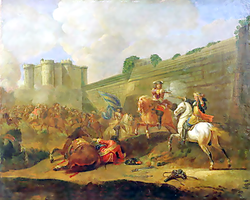
A series of civil wars in France between the nobility, parlements, and royal forces erupted during Louis's childhood. The young king was forced to flee Paris twice, an experience that shaped his lifelong distrust of the nobility and Paris.
Image source: The Fronde
Jun 9, 1660
% complete
Louis XIV married the Spanish Infanta Maria Theresa as part of the Treaty of the Pyrenees, sealing peace between France and Spain. The marriage later provided a legal pretext for French claims to Spanish territories.
Image source: Maria Theresa of Spain
Mar 9, 1661
% complete
The death of Cardinal Mazarin marked a turning point: the twenty-two-year-old Louis announced he would rule without a chief minister, declaring 'I am my own first minister,' beginning his personal reign.
Image source: Cardinal Mazarin
Jul 30, 1683
% complete
Queen Maria Theresa died at Versailles. Louis, who had been relatively faithful in later years, secretly married his pious mistress Madame de Maintenon shortly afterward, who exerted growing influence over court life.
Oct 1683
% complete
Louis privately married Françoise d'Aubigné, Marquise de Maintenon, though the marriage was never publicly acknowledged. She promoted religious devotion at court and founded the school for noble girls at Saint-Cyr.
Image source: Françoise d'Aubigné, Marquise de Maintenon
Apr 14, 1711 - Feb 18, 1712
% complete
Within less than a year, Louis lost his son the Grand Dauphin, his grandson the Duke of Burgundy, and Burgundy's elder son to illness, leaving only the sickly toddler Duke of Anjou as heir to the French throne.
Image source: Louis, Grand Dauphin
Sep 1, 1715
% complete
After reigning for seventy-two years, the longest in European history, Louis XIV died of gangrene at Versailles just days before his seventy-seventh birthday. His five-year-old great-grandson succeeded him as Louis XV.
Oct 24, 1648
% complete
The Peace of Westphalia ended the Thirty Years' War, with France emerging as one of Europe's dominant powers under Cardinal Mazarin's diplomacy, gaining territory in Alsace and strengthening its position against the Habsburgs.
Image source: Peace of Westphalia
May 24, 1667 - May 2, 1668
% complete
Louis claimed the Spanish Netherlands on behalf of his wife based on local inheritance laws. French armies under Turenne and Vauban won rapid victories before the Triple Alliance forced France to accept the Treaty of Aix-la-Chapelle.
Image source: War of Devolution
1672 - 1678
% complete
Louis invaded the Dutch Republic with a massive army, nearly capturing Amsterdam. The war expanded as Spain and the Holy Roman Empire joined against France, ending with the Treaty of Nijmegen, which gained France Franche-Comté and more Flemish towns.
Image source: Franco-Dutch War
Oct 1683 - Aug 15, 1684
% complete
France seized Strasbourg and Luxembourg during brief hostilities with Spain and the Holy Roman Empire. The Truce of Ratisbon temporarily confirmed these gains, marking the height of French territorial expansion without major war.
Image source: War of the Reunions
Sep 24, 1688 - Sep 20, 1697
% complete
A broad European coalition including England, the Dutch Republic, Spain, and the Holy Roman Empire fought France over Louis's expansionism. The exhausting conflict ended with the Treaty of Ryswick, forcing France to return most conquests.
Image source: Nine Years' War
Jul 9, 1701 - Sep 7, 1714
% complete
When Charles II of Spain died leaving his throne to Louis's grandson Philip, a grand coalition led by Britain, the Dutch Republic, and Austria went to war to prevent French domination of Europe. The long, costly struggle tested France severely.
Image source: War of the Spanish Succession
Aug 13, 1704
% complete
The Duke of Marlborough and Prince Eugene crushed a Franco-Bavarian army, destroying the myth of French invincibility and saving Vienna. It was France's first major battlefield defeat in decades and turned the tide of the war.
Image source: Battle of Blenheim
Apr 11, 1713
% complete
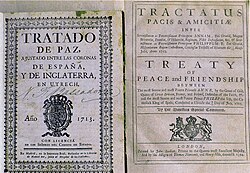
The treaty recognized Philip V as King of Spain on condition that the French and Spanish crowns never unite. France ceded Newfoundland, Hudson Bay, and Acadia to Britain but preserved its dynastic gains and great-power status.
Image source: Peace of Utrecht
1661 - 1683
% complete
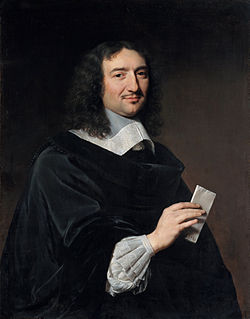
Colbert oversaw France's economic transformation through mercantilist policies, founding royal manufactures, expanding trade companies, reforming taxation, and building the French navy into a formidable force.
Image source: Jean-Baptiste Colbert
Sep 5, 1661
% complete
Louis ordered the arrest of his superintendent of finances, Nicolas Fouquet, whose lavish fête at Vaux-le-Vicomte had aroused royal jealousy. Fouquet's fall demonstrated the king's absolute authority and led to reforms of royal finances under Colbert.
Image source: Nicolas Fouquet
Oct 18, 1685
% complete
Louis revoked the Edict of Nantes, outlawing Protestantism in France. Hundreds of thousands of Huguenots fled abroad, taking their skills to rival nations and damaging the French economy while earning condemnation across Protestant Europe.
1709 - 1710
% complete
An exceptionally brutal winter destroyed crops across France, causing mass starvation and hundreds of thousands of deaths. Combined with wartime taxation, it brought the kingdom to the brink of collapse and popular unrest.
Image source: Great Frost of 1709
1661 - 1710
% complete
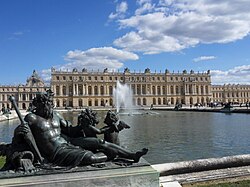
Louis transformed his father's hunting lodge into the most magnificent palace in Europe, employing architects Le Vau and Hardouin-Mansart, gardener Le Nôtre, and painter Le Brun. It became the seat of government from 1682.
Image source: Palace of Versailles
Dec 22, 1666
% complete
Under Colbert's direction, Louis XIV established the Académie des sciences to promote scientific research, part of his broader patronage of arts and letters that made France Europe's cultural center.
Image source: French Academy of Sciences
Oct 21, 1680
% complete
Louis established the Comédie-Française by merging Paris's leading theater troupes, creating the national theater company that performed works of Molière, Racine, and Corneille, cementing French theatrical supremacy.
Image source: Comédie-Française
May 6, 1682
% complete
Louis officially moved the royal court and government to Versailles, centralizing power by requiring nobles to reside there and participate in elaborate court rituals centered on the king's person.
Or browse the full history timeline directory, with more than 2,000 topics.
This Louis XIV timeline was generated with the help of AI, using information found on the internet.
We work hard to keep these timelines accurate, but mistakes do get through. If you spot one, email us at [email protected] and we'll fix it for future visitors.
Generate yours with AI or build it from scratch, for free.
Export your timeline, add your own events, edit or remove AI-generated events, and much more
No credit card required.
Cancel anytime.
Cancel anytime.
You can create an unlimited number of timelines with up to 10 events on each one, customize how they look, export them to PDF, PNG, PowerPoint, CSV, and Excel, and share them with a link. Paid plans raise the event limit and add features like spreadsheet imports and collaborators.
Yes. You can cancel your subscription from your account page at any time, and you will not be charged again. Your subscription stays active for the rest of the period you already paid for.
Yes. We will email you a reminder before the annual renewal, and we will also email you a receipt.
Yes. You can email us within 15 days of any payment, and we will issue you a full refund.
Check out our pricing docs or send us an email anytime: [email protected].