-
Use Cases
-
Resources
-
Pricing
Maria Theresa (1717–1780) was the only female ruler of the Habsburg dominions, reigning as Archduchess of Austria and Queen of Hungary and Bohemia from 1740 to 1780. Her accession triggered the War of the Austrian Succession, but she went on to strengthen the empire through military, educational, administrative, and social reforms, becoming one of the most influential enlightened monarchs of the 18th century. She was also the mother of sixteen children, including Marie Antoinette and Holy Roman Emperor Joseph II. More Less
1713
% complete
Emperor Charles VI issued the Pragmatic Sanction to guarantee that his daughter Maria Theresa could succeed him as ruler of the Habsburg hereditary lands. The document required recognition from the estates of the realm and European powers, though many later reneged on their pledges.
Image source: Pragmatic Sanction of 1713
May 13, 1717
% complete
Maria Theresa was born at the Hofburg Palace in Vienna, the eldest daughter of Holy Roman Emperor Charles VI and Elisabeth Christine of Brunswick-Wolfenbüttel. Her birth set in motion decades of diplomatic efforts by her father to secure her right to inherit the Habsburg dominions.
Image source: Maria Theresa
1720 - 1736
% complete
Maria Theresa received an education typical of Habsburg archduchesses, including languages, music, dancing, and religion. Although excluded from state affairs because of her sex, she developed a strong will and a keen interest in governance that would define her reign.
Oct 20, 1740
% complete
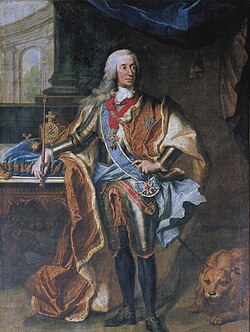
Emperor Charles VI died unexpectedly after a mushroom dinner, leaving no male heir. His death triggered a crisis of succession, as the promised recognition of the Pragmatic Sanction quickly collapsed among European powers.
Image source: Charles VI, Holy Roman Emperor
Oct 20, 1740
% complete
At age 23, Maria Theresa assumed rule over the Habsburg hereditary domains as Archduchess of Austria and Queen of Hungary, Bohemia, and Croatia. She was never elected Holy Roman Empress in her own right, but ruled as the de facto sovereign of the Habsburg Monarchy for four decades.
Sep 11, 1741
% complete
Facing invasion and abandonment by former allies, a pregnant Maria Theresa appealed personally to the Hungarian Diet at Pressburg. In a dramatic gesture, she appeared with her infant son Joseph and won the Hungarians' famous 'vitam et sanguinem' — their lives and blood — securing crucial military support.
May 12, 1743
% complete
Maria Theresa was formally crowned Queen of Bohemia at St. Vitus Cathedral in Prague, reaffirming Habsburg authority over the kingdom. She also made Prague her temporary residence during the ongoing war with France and Bavaria.
Sep 13, 1745
% complete
Maria Theresa's husband Francis Stephen was elected Holy Roman Emperor, restoring the imperial title to the House of Habsburg-Lorraine. Though Maria Theresa held the real power, Francis's elevation gave the dynasty formal standing within the Empire until his death in 1765.
Image source: Francis I, Holy Roman Emperor
Feb 12, 1736
% complete
Maria Theresa married Francis Stephen, Duke of Lorraine, in Vienna after overcoming initial objections from other suitors and political obstacles. The marriage was reportedly a genuine love match and produced sixteen children over two decades.
1760 - 1772
% complete
Maria Theresa strategically married her children into royal houses across Europe, earning the nickname 'mother-in-law of Europe.' Notable unions included Marie Antoinette's marriage to Louis XVI of France in 1770 and Maria Carolina's marriage to Ferdinand IV of Naples in 1768.
Image source: House of Habsburg-Lorraine
Feb 18, 1765
% complete
Francis I died suddenly of a stroke at Innsbruck, leaving Maria Theresa devastated. Their marriage of nearly thirty years had been affectionate and productive; she wore black mourning attire for the rest of her life and retreated to apartments she had decorated in his memory.
Nov 29, 1780
% complete
Maria Theresa died at age 63 in Vienna after a short illness, surrounded by her family. She left behind a strengthened, centralized, and reformed Habsburg Monarchy, sixteen children, and a legacy as one of the most consequential rulers in European history.
Dec 16, 1740
% complete
Frederick the Great of Prussia seized the opportunity presented by Maria Theresa's accession to invade the rich province of Silesia, violating international agreements. The invasion began the War of Austrian Succession and initiated the long Austro-Prussian rivalry.
Image source: First Silesian War
1741
% complete
France, Spain, Bavaria, and Saxony formed an alliance against Maria Theresa, contesting her inheritance. French forces supported the claim of Charles Albert of Bavaria to the Habsburg lands, plunging Europe into a broad war fought across Italy, Germany, and the Low Countries.
Image source: War of the Austrian Succession
Apr 10, 1741
% complete
The Prussian army under Frederick II defeated the Austrians at Mollwitz in Silesia, cementing Prussian control over much of the province. The defeat exposed weaknesses in the Habsburg military and emboldened other powers to challenge Maria Theresa's succession.
Image source: Battle of Mollwitz
Jan 24, 1742
% complete
With French support, Elector Charles Albert of Bavaria was elected Holy Roman Emperor, breaking the three-centuries-long Habsburg hold on the imperial title. He was crowned in Frankfurt while Austrian troops were already occupying his own Bavarian homeland.
Image source: Charles VII, Holy Roman Emperor
Dec 16, 1742
% complete
Austrian forces under Field Marshal Khevenhüller retook Prague from the Franco-Bavarian occupiers, reversing fortunes in Bohemia. The victory undermined Charles VII's position and demonstrated the resilience of Maria Theresa's war effort despite early setbacks.
Image source: Siege of Prague (1742)
Jan 20, 1745
% complete
Emperor Charles VII died, ending the Wittelsbach interlude on the imperial throne. His son Maximilian III Joseph abandoned the war against Austria, allowing Austrian troops to consolidate control of Bavaria and clearing the way for Francis Stephen's election.
Oct 18, 1748
% complete
The Treaty of Aix-la-Chapelle ended the war, but forced Maria Theresa to cede Silesia to Prussia and parts of Italy to Spain and Savoy. The humiliating loss of Silesia drove her subsequent military, administrative, and diplomatic reforms.
Image source: Treaty of Aix-la-Chapelle (1748)
May 1, 1756
% complete
Guided by Chancellor Wenzel Anton von Kaunitz, Austria reversed centuries of rivalry by allying with Bourbon France through the Treaty of Versailles. This 'Diplomatic Revolution' reshaped European alliances and set the stage for the Seven Years' War against Prussia and Britain.
Image source: Franco-Austrian alliance
Aug 29, 1756
% complete
Frederick II preemptively invaded Saxony, igniting the Seven Years' War. Maria Theresa sought to recover Silesia with French and Russian support, but although Austrian armies achieved notable victories, the province remained in Prussian hands when peace came.
Image source: Seven Years' War
Dec 5, 1757
% complete
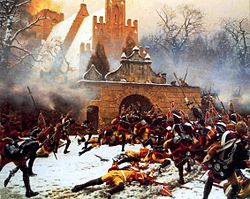
Frederick II's smaller Prussian army decisively defeated Prince Charles of Lorraine's Austrian forces at Leuthen in Silesia using masterful oblique tactics. The devastating loss dashed Austrian hopes of retaking Silesia that year, though the broader war continued for five more years.
Image source: Battle of Leuthen
Feb 15, 1763
% complete
The Treaty of Hubertusburg confirmed Prussia's permanent possession of Silesia, forcing Maria Theresa to abandon her goal of recovering the province. Despite losing the war's principal objective, Austria emerged with its great-power status intact.
Image source: Treaty of Hubertusburg
Aug 5, 1772
% complete
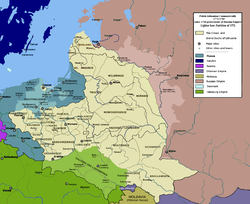
Maria Theresa reluctantly participated with Frederick II and Catherine the Great in the First Partition of Poland, acquiring Galicia. She expressed moral qualms about the dismemberment, famously lamenting taking from a neighbor what was hers, yet accepted the territorial gain for dynastic reasons.
Image source: First Partition of Poland
1749 - 1761
% complete
Inspired by Count Friedrich Wilhelm von Haugwitz, Maria Theresa created a central administrative body to unify government across her diverse lands. The reform strengthened central authority, rationalized taxation, and laid the groundwork for the modern bureaucratic state.
1751
% complete
Determined to rebuild the army after its poor performance, Maria Theresa founded the Theresian Military Academy at Wiener Neustadt in 1751. She also standardized officer training, improved pay and conditions, and increased the peacetime army to over 100,000 men.
Image source: Theresian Military Academy
Nov 17, 1765
% complete
After Francis's death, Maria Theresa elevated her eldest son Joseph II to co-regent of the Habsburg dominions while he separately held the imperial crown. The mother-and-son partnership was often tense, as the more radical Joseph chafed against his conservative mother's caution.
Image source: Joseph II, Holy Roman Emperor
1768
% complete
After the smallpox death of her daughter-in-law Maria Josepha in 1767 deeply affected her, Maria Theresa had her surviving children inoculated against smallpox. She championed variolation publicly, helping popularize the practice in Central Europe and reducing mortality from the disease.
Image source: Inoculation
1771 - 1780
% complete
Maria Theresa issued a series of Robot Patents regulating and limiting the corvée labor obligations of serfs in Bohemia, Moravia, and Hungary. These reforms eased peasant burdens, curbed noble excesses, and anticipated the more radical emancipation policies of her son Joseph II.
1773
% complete
Following Pope Clement XIV's dissolution of the Society of Jesus, Maria Theresa absorbed Jesuit schools and property into state control. Under the influence of reformers and her son Joseph, she reduced clerical privileges, limited papal interference, and advanced a moderate form of enlightened Catholic reform.
Image source: Suppression of the Society of Jesus
Dec 6, 1774
% complete
The General School Regulations (Allgemeine Schulordnung) established compulsory elementary education for all children aged six to twelve throughout the Habsburg lands. Drafted largely by Johann Ignaz von Felbiger, the reform expanded schooling and promoted literacy across the monarchy.
Image source: Traffic Signs Regulations and General Directions
Or browse the full history timeline directory, with more than 2,000 topics.
This Maria Theresa timeline was generated with the help of AI, using information found on the internet.
We work hard to keep these timelines accurate, but mistakes do get through. If you spot one, email us at [email protected] and we'll fix it for future visitors.
Generate yours with AI or build it from scratch, for free.
Export your timeline, add your own events, edit or remove AI-generated events, and much more
No credit card required.
Cancel anytime.
Cancel anytime.
You can create an unlimited number of timelines with up to 10 events on each one, customize how they look, export them to PDF, PNG, PowerPoint, CSV, and Excel, and share them with a link. Paid plans raise the event limit and add features like spreadsheet imports and collaborators.
Yes. You can cancel your subscription from your account page at any time, and you will not be charged again. Your subscription stays active for the rest of the period you already paid for.
Yes. We will email you a reminder before the annual renewal, and we will also email you a receipt.
Yes. You can email us within 15 days of any payment, and we will issue you a full refund.
Check out our pricing docs or send us an email anytime: [email protected].