-
Use Cases
-
Resources
-
Pricing
The Seven Years War (1756–1763) was a global conflict fought primarily between Great Britain and Prussia against France, Austria, Russia, and Spain. Often considered the first true 'world war,' it spanned Europe, North America, the Caribbean, West Africa, India, and the Philippines. The war resulted in major territorial shifts, including British dominance in North America and India, and set the stage for future conflicts, including the American Revolution. More Less
Jan 16, 1756
% complete
The Diplomatic Revolution saw Austria abandon its long-standing enmity with France to form an alliance against Prussia, while Britain allied with Prussia. This dramatic realignment of European powers overturned centuries-old rivalries and set the diplomatic stage for the Seven Years' War.
Image source: Diplomatic Revolution
Jan 5, 1762
% complete
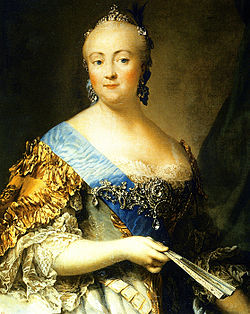
The death of Empress Elizabeth transformed the war's fortunes. Her successor, Peter III, an ardent admirer of Frederick the Great, immediately reversed Russia's hostile policy, withdrawing Russian forces from East Prussia and abandoning Prussia's enemies.
Image source: Elizabeth of Russia
May 5, 1762
% complete
Russia and Prussia signed a peace treaty restoring all conquered territories and establishing an alliance. The 'Miracle of the House of Brandenburg' saved Frederick from seemingly inevitable defeat, though Peter III's overthrow by Catherine II shortly afterward complicated the arrangement.
Image source: Treaty of Saint Petersburg (1762)
Nov 24, 1762
% complete
With France, Russia, and Sweden all out of the war, exhausted Austria and Prussia agreed to an armistice, ending active hostilities on the continent. Both powers were financially drained and unable to continue the struggle, setting the stage for formal peace negotiations.
Image source: Third Silesian War
Feb 10, 1763
% complete
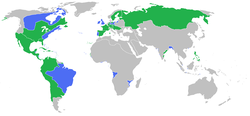
Britain, France, and Spain signed the Treaty of Paris, ending the colonial war. France ceded Canada and lands east of the Mississippi to Britain, while Spain received Louisiana from France as compensation for losing Florida to Britain. The treaty established Britain as the world's dominant colonial and naval power.
Image source: Treaty of Paris (1763)
Feb 15, 1763
% complete
Austria, Prussia, and Saxony signed the Treaty of Hubertusburg, ending the continental war with a restoration of the pre-war status quo. Frederick retained Silesia, confirming Prussia as a great power, while Maria Theresa abandoned her attempts to recover the province.
Image source: Treaty of Hubertusburg
May 17, 1756
% complete
Britain formally declared war on France, escalating the colonial skirmishes in North America and the Mediterranean into open conflict. The declaration followed years of Anglo-French tensions over colonial territory and marked the beginning of a global struggle between the two empires.
Image source: Great Britain in the Seven Years' War
Jun 28, 1756
% complete
A French expedition under the Duc de Richelieu captured the British-held island of Minorca in the Mediterranean after a siege of Fort St Philip. Admiral John Byng's failed relief attempt led to his court-martial and execution, making the defeat a notorious episode in British naval history.
Image source: Siege of Fort St Philip (1756)
Jun 23, 1757
% complete
Robert Clive's forces of the British East India Company defeated Siraj ud-Daulah, the Nawab of Bengal, at Plassey. The victory, achieved with the help of treacherous local allies, gave the Company control of Bengal and laid the foundation for British rule in India.
Image source: Battle of Plassey
Jun 8, 1758 - Jul 26, 1758
% complete
British forces under General Jeffery Amherst and Admiral Edward Boscawen captured the fortress of Louisbourg on Cape Breton Island from the French after a seven-week siege. The fall of this 'Gibraltar of the New World' opened the St. Lawrence River to British attack on Quebec.
Image source: Siege of Louisbourg (1758)
Nov 20, 1759
% complete
Admiral Sir Edward Hawke's Royal Navy destroyed the French Brest fleet in a daring battle amid rocks and shoals off the Breton coast. The victory ended any French hope of invading Britain and established British naval supremacy for the rest of the war.
Image source: Battle of Quiberon Bay
Jan 22, 1760
% complete
British East India Company forces under Sir Eyre Coote decisively defeated the French army of the Comte de Lally at Wandiwash in India. The victory effectively ended French ambitions on the subcontinent and confirmed British dominance in the Carnatic region.
Image source: Battle of Wandiwash
Jan 16, 1761
% complete
British forces captured Pondichéry, the capital of French India, after a siege lasting several months. The fall of the city marked the effective end of French power in India, leaving Britain as the dominant colonial force on the subcontinent.
Image source: Pondicherry
Jun 6, 1762 - Aug 13, 1762
% complete
A British expedition captured Havana, Spain's most important Caribbean port, after a siege lasting several weeks. The seizure of the city and its fleet was a devastating blow to Spanish power, though it would be returned to Spain in the peace settlement.
Image source: Siege of Havana
Sep 15, 1762
% complete
British forces recaptured St. John's, Newfoundland, from the French in the final land battle of the North American theater. The victory secured British control of the valuable Newfoundland fisheries for the remainder of the conflict.
Image source: Battle of Signal Hill
Sep 24, 1762 - Oct 6, 1762
% complete
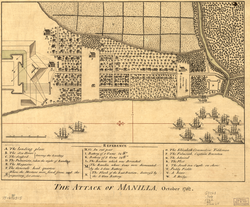
British forces seized Manila in the Spanish Philippines after a brief assault, extending the war's reach to the Pacific. Like Havana, the city was returned to Spain under the eventual peace terms, but the capture demonstrated the global scope of the conflict.
Image source: Battle of Manila (1762)
Aug 29, 1756
% complete
Frederick II of Prussia launched a preemptive invasion of Saxony, capturing Dresden and occupying the electorate. The bold strike, intended to knock out one member of the hostile coalition before it could fully mobilize, effectively opened the continental phase of the Seven Years' War.
Oct 1, 1756
% complete
Frederick the Great's Prussian army defeated an Austrian force under Maximilian Ulysses Browne near Lobositz in Bohemia. Though tactically inconclusive, the engagement secured Frederick's lines of communication and allowed him to complete the conquest of Saxony.
Image source: Battle of Lobositz
May 6, 1757
% complete
Frederick the Great won a bloody victory over the Austrians under Charles of Lorraine outside Prague, inflicting heavy casualties on both sides. The defeated Austrian army withdrew into the city, where Frederick began a siege that would ultimately fail.
Image source: Battle of Štěrboholy
Jun 18, 1757
% complete
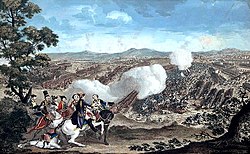
Austrian forces under Field Marshal Daun decisively defeated Frederick the Great in Bohemia, forcing him to abandon the siege of Prague and retreat from Bohemia entirely. The defeat shattered Frederick's aura of invincibility and ended his hopes of a quick victory over Austria.
Image source: Battle of Kolín
Jul 26, 1757
% complete
French forces under Marshal d'Estrées defeated the Allied army of Hanover, Hesse, and Brunswick near Hastenbeck. The defeat forced the Duke of Cumberland to sign the Convention of Klosterzeven, disarming Hanover's army and exposing Prussia's western flank to invasion.
Image source: Battle of Hastenbeck
Aug 30, 1757
% complete
A Russian army under Field Marshal Stepan Apraksin defeated a Prussian force led by Field Marshal Lehwaldt in East Prussia. Despite the victory, the Russians withdrew shortly afterward, sparing Frederick's vulnerable eastern flank during a critical moment of the war.
Image source: Battle of Gross-Jägersdorf
Nov 5, 1757
% complete
Frederick the Great achieved one of his most brilliant victories, crushing a combined Franco-Imperial army more than twice his strength at Rossbach in Saxony in under two hours. The resounding defeat forced France to largely withdraw from the war against Prussia.
Image source: Battle of Rossbach
Dec 5, 1757
% complete
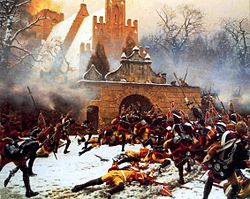
A week after Rossbach, Frederick the Great routed a much larger Austrian army under Prince Charles of Lorraine at Leuthen in Silesia. Using masterful oblique tactics, he reclaimed Silesia and cemented his reputation as one of history's greatest commanders.
Image source: Battle of Leuthen
Jun 23, 1758
% complete
The Allied army under Ferdinand of Brunswick defeated the French on the west bank of the Rhine near Krefeld. The victory checked the French advance into Hanover and restored the strategic situation in western Germany after the previous year's humiliations.
Image source: Battle of Krefeld
Aug 25, 1758
% complete
Frederick the Great fought a ferocious, bloody battle against the Russian army under Count Fermor in East Prussia, ending in a costly stalemate with enormous casualties on both sides. The battle blunted the Russian offensive but failed to deliver a decisive result.
Image source: Battle of Zorndorf
Oct 14, 1758
% complete
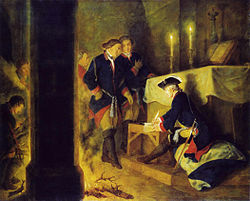
Field Marshal Daun's Austrians launched a surprise dawn attack on Frederick's encamped army at Hochkirch in Saxony, inflicting a stinging defeat. Despite heavy losses, Frederick extricated his army and continued the campaign, but the setback damaged his forces significantly.
Image source: Battle of Hochkirch
Aug 1, 1759
% complete
An Anglo-German Allied army under Ferdinand of Brunswick decisively defeated the French near Minden in Westphalia. Famously, British infantry advanced against French cavalry and repulsed it with musket fire, ending the French threat to Hanover for the remainder of the war.
Image source: Battle of Minden
Aug 12, 1759
% complete
A combined Russo-Austrian army under Pyotr Saltykov and Ernst von Laudon inflicted a catastrophic defeat on Frederick the Great near Frankfurt an der Oder. Prussia stood on the brink of collapse, and Frederick reportedly contemplated suicide before the Allies failed to press their advantage.
Image source: Battle of Kunersdorf
Jun 23, 1760
% complete
Austrian forces under Ernst Gideon von Laudon captured an entire Prussian corps under General Fouqué at Landshut in Silesia. The defeat cost Frederick thousands of irreplaceable veteran troops and demonstrated Austria's growing effectiveness in the war.
Image source: Battle of Landeshut (1760)
Aug 15, 1760
% complete
Frederick the Great turned the tables on the Austrians, defeating Laudon's corps near Liegnitz in Silesia with a surprise dawn attack. The victory relieved pressure on Prussia after a series of setbacks and allowed Frederick to evade the converging Allied armies.
Oct 9, 1760
% complete
A joint Austro-Russian force under Count Totleben and Lacy briefly occupied Berlin, Frederick's capital, exacting a ransom and burning supplies. The raid humiliated Prussia but the Allies withdrew quickly, unable to hold the city against Frederick's approaching army.
Image source: 1760 raid on Berlin
Nov 3, 1760
% complete
In one of the bloodiest battles of the war, Frederick the Great narrowly defeated Daun's Austrians at Torgau in Saxony through a costly flanking maneuver. Though a strategic victory that kept Saxony in Prussian hands, the casualties were staggering for both sides.
Image source: Battle of Torgau
Jul 16, 1761
% complete
Ferdinand of Brunswick's Allied army defeated a much larger French force under the Princes de Soubise and de Broglie near Villinghausen in Westphalia. The victory prevented a French breakthrough into Hanover and maintained the balance in western Germany.
Image source: Battle of Villinghausen
Jul 21, 1762
% complete
Frederick the Great defeated Austrian forces under Daun at Burkersdorf in Silesia, aided by the withdrawal of Russian support from Austria. The victory helped secure Prussian control of Silesia in the final campaign of the continental war.
Image source: Battle of Burkersdorf (1762)
Sep 13, 1759
% complete
British forces under General James Wolfe defeated the French under the Marquis de Montcalm on the Plains of Abraham outside Quebec City. Both commanders died in the battle, but the British victory led to the surrender of Quebec, a decisive blow to French power in North America.
Image source: Battle of the Plains of Abraham
Or browse the full history timeline directory, with more than 2,000 topics.
This Seven Years War timeline was generated with the help of AI, using information found on the internet.
We work hard to keep these timelines accurate, but mistakes do get through. If you spot one, email us at [email protected] and we'll fix it for future visitors.
Generate yours with AI or build it from scratch, for free.
Export your timeline, add your own events, edit or remove AI-generated events, and much more
No credit card required.
Cancel anytime.
Cancel anytime.
You can create an unlimited number of timelines with up to 10 events on each one, customize how they look, export them to PDF, PNG, PowerPoint, CSV, and Excel, and share them with a link. Paid plans raise the event limit and add features like spreadsheet imports and collaborators.
Yes. You can cancel your subscription from your account page at any time, and you will not be charged again. Your subscription stays active for the rest of the period you already paid for.
Yes. We will email you a reminder before the annual renewal, and we will also email you a receipt.
Yes. You can email us within 15 days of any payment, and we will issue you a full refund.
Check out our pricing docs or send us an email anytime: [email protected].