-
Use Cases
-
Resources
-
Pricing
The Thirty Years War (1618–1648) was one of the most destructive conflicts in European history, fought primarily in the Holy Roman Empire. It began as a religious war between Catholic and Protestant states but evolved into a broader political struggle involving major European powers such as France, Sweden, Spain, and the Habsburgs. The war devastated Central Europe, caused massive casualties, and concluded with the Peace of Westphalia, which reshaped the European political order. More Less
1618 - 1648
% complete
Across three decades of campaigning, plague, famine and violence killed perhaps a third or more of the population in parts of the Holy Roman Empire, leaving lasting demographic, economic and social scars on Central Europe.
Image source: Thirty Years' War
Oct 24, 1648
% complete
Negotiations at Münster and Osnabrück concluded with treaties recognizing Calvinism, restoring church lands per 1624 boundaries, granting imperial states sovereignty, and securing Swedish and French territorial gains, ending the war in the Empire.
Image source: Peace of Westphalia
May 1618 - 1620
% complete
The estates of Bohemia rose against Holy Roman Emperor Ferdinand II over religious and political grievances, deposing him as king of Bohemia and electing Frederick V of the Palatinate in his place, drawing much of Europe into conflict.
Image source: Bohemian Revolt
May 23, 1618
% complete
Protestant nobles threw two Catholic imperial governors and a scribe out of a window at Prague Castle. They survived the fall, allegedly cushioned by a dung heap, and the act sparked the Bohemian Revolt against Habsburg rule, igniting the Thirty Years War.
Image source: Defenestrations of Prague
Nov 8, 1620
% complete
Imperial forces under Tilly and Bucquoy decisively defeated the Bohemian rebels near Prague, crushing the Bohemian Revolt in a single day and beginning harsh re-Catholicization of Habsburg lands.
Image source: Battle of White Mountain
Jun 21, 1621
% complete
Twenty-seven leaders of the Bohemian uprising were executed in Prague's Old Town Square, symbolizing Ferdinand II's reassertion of authority and the confiscation of Protestant lands.
Image source: Old Town Square execution
Sep 16, 1622
% complete
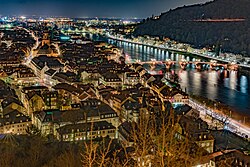
Imperial forces captured Heidelberg, capital of the Electorate of the Palatinate, effectively ending Frederick V's rule and transferring the Palatinate's electoral title to Bavaria.
Image source: Heidelberg
Mar 6, 1629
% complete
Ferdinand II ordered the return of all ecclesiastical properties secularized since 1552 to the Catholic Church, alarming Protestant princes and even moderates across the Empire.
Image source: Edict of Restitution
Feb 25, 1634
% complete
Emperor Ferdinand II, suspecting Wallenstein of treasonous negotiations, had his greatest general murdered by officers at Eger, removing the most powerful military entrepreneur of the age.
Image source: Albrecht von Wallenstein
May 6, 1622
% complete
Tilly's imperial army and Spanish forces under Córdoba defeated the Palatine armies under Georg Friedrich of Baden-Durlach, ending hopes of restoring Frederick V to his lands.
Image source: Battle of Wimpfen
Apr 25, 1626
% complete
Imperial commander Albrecht von Wallenstein crushed Ernst von Mansfeld's army at the Elbe crossing, eliminating one of the main mercenary forces fighting for the Protestant cause.
Image source: Battle of Dessau Bridge
Aug 27, 1626
% complete
Tilly's Catholic League forces routed Christian IV of Denmark near Lutter am Barenberge, shattering Danish military power in northern Germany.
Image source: Battle of Lutter
May 20, 1631
% complete
Imperial and League troops under Tilly and Pappenheim stormed and destroyed Magdeburg; fire and massacre killed most of its population, becoming one of the war's most notorious atrocities and rallying Protestant resistance.
Image source: Sack of Magdeburg
Sep 17, 1631
% complete
Gustavus Adolphus and Saxon allies decisively defeated Tilly near Leipzig using flexible linear tactics, marking Sweden's emergence as a major European power and freeing northern Germany from Imperial control.
Image source: Battle of Breitenfeld (1631)
Apr 15, 1632
% complete
Gustavus Adolphus defeated and mortally wounded Count Tilly at the Lech River crossing, removing the League's foremost general and opening Bavaria to Swedish occupation.
Image source: Battle of Rain
Nov 16, 1632
% complete
The Swedes defeated Wallenstein's army in thick gunpowder smoke but lost King Gustavus Adolphus, who was killed leading a cavalry charge. Swedish leadership passed to Chancellor Oxenstierna and Gustavus' daughter Christina.
Image source: Battle of Lützen (1632)
Sep 6, 1634
% complete
A combined Imperial-Spanish army under Ferdinand of Hungary and Cardinal-Infante Fernando annihilated the Swedish-German army, ending Swedish dominance in Germany and prompting French open entry into the war.
Image source: Battle of Nördlingen (1634)
Oct 4, 1636
% complete
Swedish Marshal Baner's outnumbered army brilliantly defeated Imperial and Saxon forces in Brandenburg, reviving Swedish fortunes after the disaster at Nördlingen.
Image source: Battle of Wittstock
Nov 2, 1642
% complete
Swedish Field Marshal Lennart Torstenson decisively defeated Archduke Leopold Wilhelm's Imperial army near Leipzig, consolidating Swedish control over northern Germany.
Image source: Battle of Breitenfeld (1642)
May 19, 1643
% complete
Duc d'Enghien (later Condé) crushed the famed Spanish Army of Flanders, destroying the myth of Spanish tercio invincibility and signaling the decline of Spanish military power in Europe.
Image source: Battle of Rocroi
Aug 3, 1644 - Aug 9, 1644
% complete
One of the bloodiest battles of the war saw the French armies of Enghien and Turenne fight Bavarian forces under Mercy to a costly stalemate in the Black Forest foothills.
Image source: Battle of Freiburg
Mar 6, 1645
% complete
Marshal Torstensson's Swedish army destroyed the Imperial army in Bohemia, capturing thousands and threatening Vienna itself, pressuring the Habsburgs toward peace negotiations.
Image source: Battle of Jankau
Aug 3, 1645
% complete
French forces under Enghien defeated the Bavarian army under Franz von Mercy, who was killed in action, breaking Bavarian military strength and hastening peace negotiations at Münster and Osnabrück.
Image source: Battle of Nördlingen (1645)
May 1625
% complete
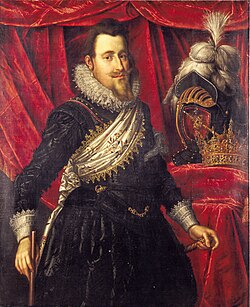
King Christian IV of Denmark-Norway intervened on the Protestant side, seeking to protect Lutheran interests in northern Germany and expand Danish influence, opening the Danish phase of the war.
Image source: Christian IV of Denmark
May 1628 - Aug 4, 1628
% complete
Wallenstein's unsuccessful siege of the Baltic port of Stralsund, aided by Scottish mercenaries and Danish support, marked the limits of Imperial power in northern Germany and paved the way for Swedish intervention.
Image source: Siege of Stralsund (1628)
Jul 7, 1629
% complete
Christian IV agreed to withdraw from the war and renounce intervention in German affairs in exchange for retaining his Danish territories, leaving the Protestant cause temporarily leaderless.
Image source: Treaty of Lübeck
Jul 6, 1630
% complete
King Gustavus Adolphus of Sweden landed with about 13,000 troops at Peenemünde, beginning the Swedish phase of the war and introducing innovative tactics and disciplined infantry to the battlefield.
Image source: Swedish intervention in the Thirty Years' War
May 1632
% complete
Gustavus Adolphus captured Munich, capital of Bavaria, demonstrating the depth of the Swedish advance into Catholic southern Germany during the 1632 campaign.
Image source: Munich
Apr 23, 1633
% complete
Swedish chancellor Axel Oxenstierna organized the Protestant German states into the Heilbronn League, placing the Corcoran Circle and Franconian and Swabian territories under Swedish direction.
Image source: Heilbronn League
May 19, 1635
% complete
Cardinal Richelieu's France openly entered the conflict against Spain and the Habsburgs, transforming the war into a broader Franco-Habsburg struggle for European supremacy that continued past Westphalia.
Image source: Franco-Spanish War (1635–1659)
May 30, 1635
% complete
Most German Protestant states made peace with the Emperor, who softened the Edict of Restitution, isolating Sweden and France and shifting the war's focus to conflicts involving foreign powers.
Image source: Peace of Prague (1635)
Or browse the full history timeline directory, with more than 2,000 topics.
This Thirty Years War timeline was generated with the help of AI, using information found on the internet.
We work hard to keep these timelines accurate, but mistakes do get through. If you spot one, email us at [email protected] and we'll fix it for future visitors.
Generate yours with AI or build it from scratch, for free.
Export your timeline, add your own events, edit or remove AI-generated events, and much more
No credit card required.
Cancel anytime.
Cancel anytime.
You can create an unlimited number of timelines with up to 10 events on each one, customize how they look, export them to PDF, PNG, PowerPoint, CSV, and Excel, and share them with a link. Paid plans raise the event limit and add features like spreadsheet imports and collaborators.
Yes. You can cancel your subscription from your account page at any time, and you will not be charged again. Your subscription stays active for the rest of the period you already paid for.
Yes. We will email you a reminder before the annual renewal, and we will also email you a receipt.
Yes. You can email us within 15 days of any payment, and we will issue you a full refund.
Check out our pricing docs or send us an email anytime: [email protected].