-
Use Cases
-
Resources
-
Pricing
The Hundred Years War was a series of conflicts fought between the kingdoms of England and France from 1337 to 1453, driven by disputes over succession to the French throne and territorial claims. The war saw famous figures like Edward III, Henry V, and Joan of Arc, and pivotal events such as the Battles of Crécy, Agincourt, and Orléans. It reshaped medieval warfare, fostered national identities in both countries, and ended with France reclaiming nearly all English-held territories on the continent. More Less
1204
% complete
King Philip II of France confiscated the Duchy of Normandy from King John of England after John's failures as a vassal. The loss of most English continental possessions fueled a lasting Anglo-French rivalry over territory and sovereignty in France.
Image source: First Hundred Years' War
Feb 1, 1328
% complete
The death of King Charles IV without a male heir triggered a succession crisis. French nobles applied Salic law to crown Philip VI of Valois, bypassing Edward III of England, who claimed the throne through his mother Isabella of France.
Image source: Charles IV of France
1337
% complete
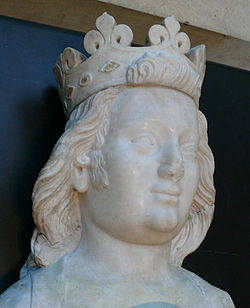
Citing his descent from Philip IV of France, Edward III formally claimed the French throne in 1337, challenging Philip VI's legitimacy. This dynastic dispute marked the traditional start of the Hundred Years' War.
Image source: Edward III of England
1347 - 1351
% complete
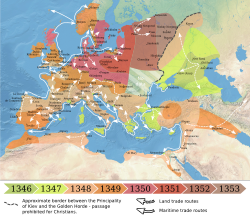
The Black Death pandemic swept through Europe, killing a third or more of the population. The devastation forced both England and France to suspend major campaigns and reshaped economies and societies during the war.
Image source: Black Death
Jun 8, 1376
% complete
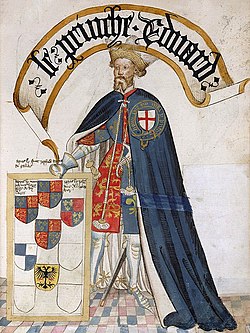
The death of the Black Prince deprived England of its greatest commander. His young son Richard II succeeded Edward III the following year, ushering in a period of political instability and reduced English effectiveness in the war.
Image source: Edward the Black Prince
Aug 31, 1422 - Oct 21, 1422
% complete
Henry V died just weeks before Charles VI, leaving the infant Henry VI nominally king of both England and France. The Dauphin Charles contested this arrangement, continuing the war over the dual monarchy.
Image source: Henry V of England
Jun 24, 1340
% complete
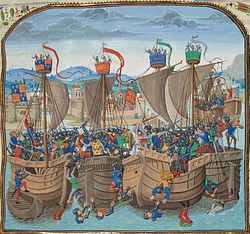
Edward III destroyed the French fleet at Sluys in Flanders, securing English naval dominance in the Channel for decades. The decisive victory protected England from invasion and allowed Edward to campaign freely on the continent.
Image source: Battle of Sluys
Aug 1346 - Aug 3, 1347
% complete
After a year-long siege following Crécy, Edward III captured Calais, which became a vital fortified English stronghold on the continent for over two hundred years.
Image source: Siege of Calais (1346–1347)
Aug 26, 1346
% complete
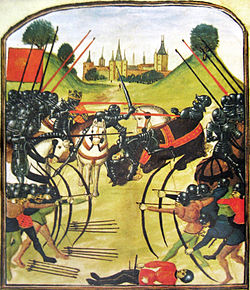
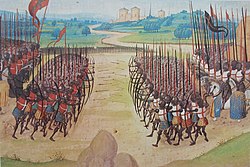
Edward III's army, using longbows and dismounted men-at-arms, crushed a much larger French force under Philip VI at Crécy. The battle demonstrated the superiority of English tactics and devastated French chivalric pride.
Image source: Battle of Crécy
Sep 19, 1356
% complete
Edward, the Black Prince, led an outnumbered English army to victory over King John II of France, capturing the king himself. John's ransom and captivity plunged France into political crisis.
Image source: Battle of Poitiers
Oct 25, 1415
% complete
Henry V's exhausted army defeated a far larger French force in muddy terrain near Agincourt, with English longbowmen inflicting catastrophic losses on the flower of French knighthood. The battle became legendary in English military history.
Image source: Battle of Agincourt
May 8, 1360
% complete
The Treaty of Brétigny granted Edward III extensive territories in Aquitaine and a large ransom for King John II in exchange for renouncing his claim to the French throne, marking the end of the war's first phase.
Image source: Treaty of Brétigny
May 21, 1420
% complete
Under the Treaty of Troyes, Henry V was recognized as heir to the French king Charles VI, disinheriting the Dauphin Charles. Henry married Catherine of Valois, seemingly uniting the crowns of England and France.
Image source: Treaty of Troyes
1435 - Sep 21, 1435
% complete
Diplomats gathered at Arras to negotiate peace. When talks failed, Duke Philip the Good of Burgundy abandoned his English alliance and reconciled with Charles VII, fatally weakening the English position in France.
Image source: Congress of Arras
Jul 17, 1453
% complete
At Castillon, French artillery devastated the attacking army of John Talbot, who was killed in action. This decisive French victory ended effective English resistance and is often considered the final battle of the Hundred Years' War.
Image source: Battle of Castillon
Oct 19, 1453
% complete
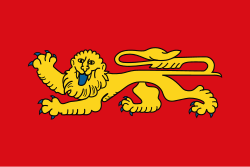
The surrender of Bordeaux on October 19, 1453, left England holding only Calais on the continent. The date is traditionally regarded as the end of the Hundred Years' War, concluding over a century of conflict.
Image source: Aquitaine
1455 - 1487
% complete
Defeat in France and the loss of continental possessions deepened instability in England, contributing to the outbreak of civil wars between the houses of Lancaster and York known as the Wars of the Roses.
Image source: Wars of the Roses
Aug 29, 1475
% complete
Edward IV of England agreed to withdraw his invading army in return for an annual pension from Louis XI, effectively ending English ambitions to reconquer France and formalizing peaceful relations between the kingdoms.
Image source: Treaty of Picquigny
Jan 1558
% complete
France recaptured Calais, England's last remaining foothold on the continent, under Francis, Duke of Guise. After two hundred years, the final territorial remnant of the Hundred Years' War era returned to French control.
Image source: Siege of Calais (1558)
1369
% complete
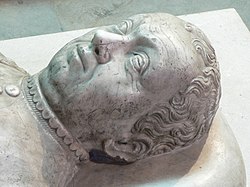
Constable Bertrand du Guesclin led a successful French counteroffensive using guerrilla tactics, avoiding pitched battles and gradually retaking territories ceded at Brétigny, reversing English gains by the mid-1370s.
Image source: Bertrand du Guesclin
May 30, 1381 - Nov 1381
% complete
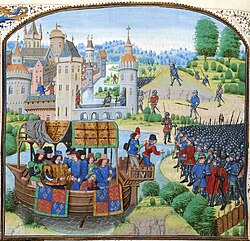
Heavy taxation to fund the war sparked the Peasants' Revolt, one of England's largest popular uprisings. Rebels stormed London before being suppressed, highlighting the domestic costs of prolonged warfare.
Image source: Peasants' Revolt
Oct 12, 1428 - May 8, 1429
% complete
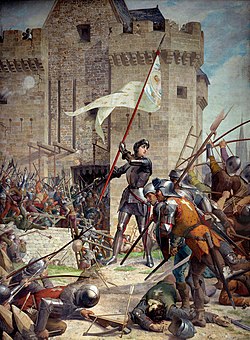
The English besieged Orléans, a strategic city controlling access to southern France. Joan of Arc arrived to rally French forces, and the siege was lifted in May 1429, marking a decisive turning point in the war.
Image source: Siege of Orléans
Apr 29, 1429 - May 8, 1429
% complete
Joan of Arc, a teenage peasant girl claiming divine guidance, inspired the French garrison and relief forces to break the English siege of Orléans. Her arrival galvanized French morale and transformed the momentum of the war.
Image source: Joan of Arc
Jul 17, 1429
% complete
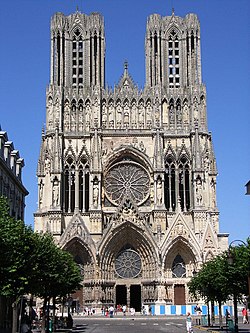
Following victories along the Loire, Joan of Arc escorted Charles VII to Reims Cathedral, the traditional coronation site of French kings. His consecration strengthened his legitimacy against the infant Henry VI's claim.
Image source: Reims Cathedral
May 23, 1430
% complete
Joan of Arc was captured at Compiègne by Burgundian forces allied with England. She was sold to the English, tried by a pro-English church court, and burned at the stake in Rouen on May 30, 1431, as a heretic.
Image source: Trial of Joan of Arc
1449 - Aug 1450
% complete
Charles VII launched a well-planned offensive that recovered all of Normandy within a year. The rapid collapse of English defenses ended over thirty years of English occupation of the duchy.
Image source: Normandy campaign of 1449–1450
Apr 15, 1450
% complete
French forces under the Count of Clermont annihilated an English relief army in Normandy at Formigny, effectively destroying England's ability to defend its remaining continental possessions.
Image source: Battle of Formigny
1451
% complete
Charles VII turned south to conquer Gascony, the last great English possession in France. Bordeaux fell in June 1451, though the Gascons, preferring English rule, briefly rebelled and invited back the English under John Talbot.
1477
% complete
After the death of Duke Charles the Bold at Nancy, Louis XI seized the Burgundian heartland, consolidating French royal power. The elimination of the powerful Burgundian state secured France's eastern flank.
Image source: Burgundian State
Or browse the full history timeline directory, with more than 2,000 topics.
This Hundred Years War timeline was generated with the help of AI, using information found on the internet.
We work hard to keep these timelines accurate, but mistakes do get through. If you spot one, email us at [email protected] and we'll fix it for future visitors.
Generate yours with AI or build it from scratch, for free.
Export your timeline, add your own events, edit or remove AI-generated events, and much more
No credit card required.
Cancel anytime.
Cancel anytime.
You can create an unlimited number of timelines with up to 10 events on each one, customize how they look, export them to PDF, PNG, PowerPoint, CSV, and Excel, and share them with a link. Paid plans raise the event limit and add features like spreadsheet imports and collaborators.
Yes. You can cancel your subscription from your account page at any time, and you will not be charged again. Your subscription stays active for the rest of the period you already paid for.
Yes. We will email you a reminder before the annual renewal, and we will also email you a receipt.
Yes. You can email us within 15 days of any payment, and we will issue you a full refund.
Check out our pricing docs or send us an email anytime: [email protected].