-
Use Cases
-
Resources
-
Pricing
Max Planck (1858–1947) was a German theoretical physicist who is regarded as the founder of quantum theory. His discovery of energy quanta in 1900 revolutionized physics, earning him the Nobel Prize in Physics in 1918. Planck's work laid the foundation for modern physics, influencing scientists like Einstein and Bohr. More Less
Apr 23, 1858
% complete
Max Karl Ernst Ludwig Planck was born on 23 April 1858 in Kiel, the son of Johann Julius Wilhelm Planck and his second wife, Emma Patzig. He would grow up to become one of the most influential theoretical physicists in history.
Image source: Max Planck
1864
% complete
War was common during Planck's early years, and among his earliest memories was the marching of Prussian and Austrian troops into Kiel during the Second Schleswig War in 1864.
Image source: Second Schleswig War
1867
% complete
In 1867, the Planck family moved to Munich, where Max enrolled at the Maximiliansgymnasium, beginning his formal education in the Bavarian capital.
1874
% complete
In 1874, Planck enrolled at the Ludwig-Maximilians-Universität München to study physics, beginning his path toward a career in theoretical physics.
Image source: LMU Munich
1877 - 1878
% complete
In 1877, Planck went to the Friedrich Wilhelm University of Berlin for a year of study with physicists Hermann von Helmholtz and Gustav Kirchhoff and mathematician Karl Weierstrass.
Image source: Humboldt University of Berlin
1878
% complete
In 1878, Philipp von Jolly advised Planck against going into theoretical physics, arguing that physics was almost complete, being a 'highly developed, nearly fully matured science' that would soon take its final stable form. Planck ignored this advice.
Feb 1879
% complete
In October 1878, Planck passed his qualifying exams, and in February 1879 he defended his thesis 'Über den zweiten Hauptsatz der mechanischen Wärmetheorie' (On the second law of mechanical heat theory). In his thesis, he summarized Clausius' writings, pointing out contradictions and inaccuracies and then clarifying them.
1880
% complete
By 1880, Planck had obtained the two highest academic degrees offered in Europe. In that year he became a Privatdozent (unsalaried lecturer) at the Ludwig-Maximilians-Universität München, waiting until he was offered an academic position.
Apr 1885
% complete
In April 1885, Planck was appointed associate professor of Theoretical Physics at Kiel University, his first salaried academic position.
Image source: Kiel University
1887
% complete
Planck presented his work on entropy in detail in 1887 in a series of treatises entitled 'On the Principle of the Increase of Entropy', building on his earlier analysis of Clausius' formulation of the second law of thermodynamics.
1889 - 1892
% complete
In 1889, Planck was named the successor to Kirchhoff's position at the Friedrich Wilhelm University of Berlin – presumably thanks to Helmholtz's intercession – and by 1892 became Full Professor.
1894
% complete
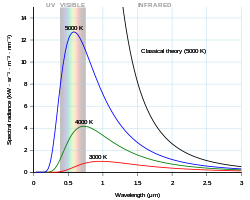
In 1894, Planck turned his attention to the problem of black-body radiation, which had been stated by Kirchhoff in 1859: how does the intensity of electromagnetic radiation emitted by a black body depend on frequency and temperature?
Image source: Black-body radiation
1897
% complete
Planck published his influential Treatise on Thermodynamics in 1897, consolidating his extensive work on the laws of thermodynamics and entropy.
Image source: Heat
1898
% complete
Thanks to Planck's initiative, the various local Physical Societies of Germany merged in 1898 to form the German Physical Society (Deutsche Physikalische Gesellschaft, DPG). From 1905 to 1909 Planck served as its president.
Image source: German Physical Society
1899
% complete
Planck's first proposed solution to the black-body problem in 1899 followed from what he called the 'principle of elementary disorder', allowing him to derive Wien's law and create the Wien–Planck law. This derivation did not include energy quantisation, and introduced the Planck constant, also known as Planck's action quantum.
Image source: Wien approximation
Oct 19, 1900
% complete
Planck's new radiation law was first proposed in a meeting of the German Physical Society on 19 October 1900 and published in 1901, marking the birth of quantum theory.
Nov 1900
% complete
In November 1900, Planck revised his first version of the radiation law, now relying on Boltzmann's statistical interpretation of the second law of thermodynamics as a way of gaining a more fundamental understanding of the principles behind it — introducing energy quanta.
1907
% complete
In 1907, Planck was offered Ludwig Boltzmann's position in Vienna, but turned it down in order to stay in Berlin.
Image source: University of Vienna
1908
% complete
Planck's philosophical stance on the reality of atoms led to a famous public rift with Ernst Mach in 1908, reflecting deep divisions within physics over the status of atomic theory.
Image source: Ernst Mach
1909
% complete
During 1909, as a professor at the Friedrich Wilhelm University of Berlin, Planck was invited to become the Ernest Kempton Adams Lecturer in Theoretical Physics at Columbia University in New York City.
Image source: Columbia University
1911
% complete
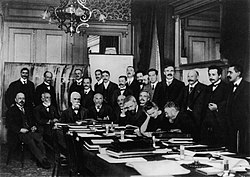
Planck and Walther Nernst, seeking to clarify the increasing number of contradictions between classical physics and new quantum phenomena, organized the First Solvay Conference in Brussels in 1911.
Image source: Solvay Conference
1914
% complete
Having been appointed dean of the Friedrich Wilhelm University of Berlin, Planck was able to appoint Einstein to Berlin and establish a new professorship for him in 1914.
Image source: Albert Einstein
Oct 1920
% complete
In October 1920, Planck and Fritz Haber established the Notgemeinschaft der Deutschen Wissenschaft (Emergency Association of German Science), aimed at providing financial support for scientific research in postwar Germany.
Image source: Notgemeinschaft der Deutschen Wissenschaft
Jan 10, 1926
% complete
Planck retired from the Friedrich Wilhelm University of Berlin on 10 January 1926, and was succeeded by Erwin Schrödinger.
Image source: Erwin Schrödinger
1930 - 1936
% complete
Planck became president of the Kaiser Wilhelm Society in 1930, holding leading positions at major German scientific institutions. His term ended in 1936, when the Nazi government pressured him to refrain from seeking another term.
Image source: Max Planck Society
Mar 1887
% complete
In March 1887, Planck married Marie Merck (1861–1909), sister of a school fellow, and moved with her into a sublet apartment in Kiel.
Jul 1909
% complete
Marie Planck died in July 1909, possibly of tuberculosis, leaving Max a widower after more than two decades of marriage.
Mar 1911 - Dec 1911
% complete
In March 1911, Planck married his second wife, Marga von Hoesslin (1882–1948); in December of that year his fifth child, Hermann, was born.
1914 - 1916
% complete
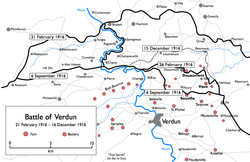
During the First World War, Planck's second son Erwin was taken prisoner by the French in 1914, while his oldest son Karl was killed in action at Verdun in 1916.
Image source: Battle of Verdun
1917
% complete
Grete, one of Planck's twin daughters, died in 1917 while giving birth to her first child, adding to the personal tragedies Planck endured during the war years.
1937
% complete
In a 1937 lecture entitled 'Religion und Naturwissenschaft' ('Religion and Natural Science'), Planck suggested that symbols and rituals relate directly to a believer's ability to worship God, criticized atheistic attacks on religious belief, and argued that both religion and natural science require belief in God, understood in different ways.
Image source: Relationship between science and religion
1918 - 1919
% complete
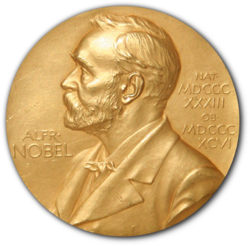
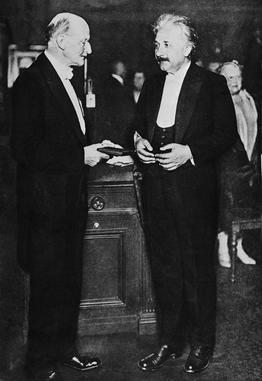
In recognition of Planck's fundamental contribution to a new branch of physics, he was awarded the Nobel Prize in Physics for 1918 'for the services he rendered to the advancement of physics by his discovery of energy quanta'; he received the award in 1919. In December 1918, he described his discovery to his son as 'a discovery of the first rank, comparable perhaps only to the discoveries of Newton'.
Image source: Nobel Prize in Physics
1938
% complete
In 1938, Planck celebrated his 80th birthday. The German Physical Society held a celebration, during which the Max-Planck medal, founded as the society's highest medal in 1928, was awarded to French physicist Louis de Broglie.
Image source: Max Planck Medal
Oct 4, 1947
% complete
After World War II ended, Planck, his second wife, and their son were brought to a relative in Göttingen, where Planck died on 4 October 1947, aged 89.
1948
% complete
In 1948, the Kaiser Wilhelm Society was renamed the Max Planck Society in honor of its former president. Today it includes 83 institutions representing a wide range of scientific disciplines.
1957 - 1971
% complete
From 1957 to 1971, the Federal Republic of Germany's 2-DM coins featured Max Planck's portrait, honoring his enduring legacy in German science and culture.
Image source: Deutsche Mark
1958
% complete
In 1958, a commemorative plaque was unveiled in the forecourt of the Humboldt University of Berlin, and the Max Planck Society presented a bust of Planck, created in 1939, to the Physical Society of the GDR.
1970
% complete
In 1970, the lunar crater Planck and the adjacent valley Vallis Planck were named after Max Planck, commemorating his contributions to physics on the Moon itself.
Image source: Planck (crater)
1983
% complete
In 1983, the German Democratic Republic issued a 5-mark commemorative coin to mark the 125th anniversary of Max Planck's birth.
1989
% complete
In 1989, a commemorative plaque was unveiled at Planck's former residence in Berlin-Grunewald, preserving the memory of the physicist's life in the city.
Image source: Berlin-Grunewald station
2008
% complete
In 2008, a special postage stamp and a 10-Euro silver commemorative coin were issued in Germany to mark the 150th anniversary of Max Planck's birth.
2013
% complete
In 2013, The Max Planck Florida Institute For Neuroscience opened in Jupiter, Florida, extending the Max Planck Society's research mission to the United States.
Image source: Max Planck Florida Institute for Neuroscience
Apr 23, 2014
% complete
On April 23, 2014, Google celebrated Max Planck's 156th birthday with a Google Doodle, bringing the father of quantum theory to a global online audience.
Image source: Google Doodle
2022
% complete
In 2022, a bust of Max Planck was placed in Walhalla, the hall of fame in Bavaria honoring distinguished Germans, cementing his place among the nation's most celebrated figures.
Image source: Walhalla (memorial)
May 1933
% complete
When the Nazis came to power in 1933, Planck was 74 years old. In May 1933, he requested and received an interview with Chancellor Adolf Hitler, telling him that forced emigration of Jews would kill German science. Hitler replied that they had nothing against Jews, only communists, taking away any basis for further negotiation.
Image source: Adolf Hitler
1934
% complete
In 1934, Fritz Haber, Planck's collaborator in founding the Notgemeinschaft der Deutschen Wissenschaft, died in exile after being forced out of Germany by the Nazi regime.
Image source: Fritz Haber
1935
% complete
One year after Haber's death, Planck, having been president of the KWG since 1930, organized in a somewhat provocative style an official commemorative meeting for Haber, defying Nazi disapproval.
Dec 1938
% complete
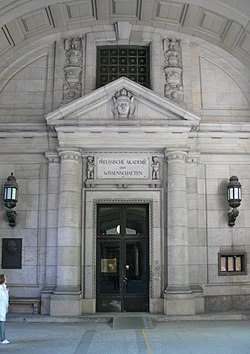
At the end of 1938, the Prussian Academy of Sciences, where Planck had been one of four permanent presidents, lost its remaining independence and was taken over by Nazis as part of their process of Gleichschaltung.
Image source: Prussian Academy of Sciences
Feb 1944
% complete
In February 1944, Planck's home in Berlin was completely destroyed by an air raid, annihilating all his scientific records and correspondence. In 1942 he had written of his ardent desire to persevere through the crisis and witness the turning point and beginning of a new rise.
Image source: Bombing of Berlin in World War II
Jul 20, 1944 - Oct 1944
% complete
In 1944, Planck's son Erwin was arrested by the Gestapo following the attempted assassination of Hitler in the 20 July plot. He was tried and sentenced to death by the People's Court in October 1944.
Image source: 20 July plot
Jan 23, 1945
% complete
Erwin Planck, to whom Max had been particularly close, was executed on 23 January 1945, hanged at Berlin's Plötzensee Prison for his participation in the failed attempt to assassinate Hitler.
Image source: Erwin Planck
Or browse the full history timeline directory, with more than 2,000 topics.
This Max Planck timeline was generated with the help of AI, using information found on the internet.
We work hard to keep these timelines accurate, but mistakes do get through. If you spot one, email us at [email protected] and we'll fix it for future visitors.
Generate yours with AI or build it from scratch, for free.
Export your timeline, add your own events, edit or remove AI-generated events, and much more
No credit card required.
Cancel anytime.
Cancel anytime.
You can create an unlimited number of timelines with up to 10 events on each one, customize how they look, export them to PDF, PNG, PowerPoint, CSV, and Excel, and share them with a link. Paid plans raise the event limit and add features like spreadsheet imports and collaborators.
Yes. You can cancel your subscription from your account page at any time, and you will not be charged again. Your subscription stays active for the rest of the period you already paid for.
Yes. We will email you a reminder before the annual renewal, and we will also email you a receipt.
Yes. You can email us within 15 days of any payment, and we will issue you a full refund.
Check out our pricing docs or send us an email anytime: [email protected].