-
Resources
-
Pricing
Neoclassicism was an eighteenth- and early nineteenth-century movement that revived the art, architecture, literature, and ideals of ancient Greece and Rome. It emphasized order, reason, balance, simplicity, and civic virtue, partly in reaction to the ornamentation of the Baroque and Rococo. More Less
Build a timeline like this one in minutes, for free. Start Yours →
Part of our collection of art history timelines.
1664
In 1664, a lecture on the Ideal in art was delivered at the Accademia di San Luca in Rome. It became a seminal statement of idealist art theory.
Image source: Giovanni Pietro Bellori
1700 - 1800
The main Neoclassical movement emerged from the 18th-century Age of Enlightenment. It reached its peak in the early-to-mid-19th century and eventually competed with Romanticism.
Image source: Neoclassicism
1750 - 1774
The style in France initially developed as a Parisian style known as the Goût grec, or Greek style, rather than as a court style.
1750 - 1850
Neoclassical architecture drew on the principles of Ancient Rome and Ancient Greece, treating simplicity and symmetry as artistic virtues and connecting them to 16th-century Renaissance Classicism.
Image source: Neoclassical architecture
1750 - 1800
The movement first centered in Rome, where artists including Antonio Canova and Jacques-Louis David were active during the second half of the 18th century, before the movement shifted toward Paris.
1755
Johann Joachim Winckelmann published Thoughts on the Imitation of Greek Works in Painting and Sculpture in 1755. The book helped establish a sharply Greek-oriented account of artistic ideals.
Image source: Johann Joachim Winckelmann
1760
European Neoclassicism in the visual arts began around 1760 in opposition to the dominant Rococo style.
1764
Winckelmann's History of Ancient Art, published in 1764, distinguished Ancient Greek from Roman art and defined periods of Greek artistic development from growth through maturity, imitation, and decadence.
1765 - 1830
Between 1765 and 1830, Neoclassical writers, artists, patrons, collectors, and sculptors paid homage to an idealized artistic generation associated with Phidias, although they often embraced Roman copies of Hellenistic sculptures.
1785
Neoclassical painting gained a new direction with the sensational success of Jacques-Louis David's Oath of the Horatii at the Paris Salon of 1785.
Image source: Oath of the Horatii
1800 - 1900
Neoclassicism remained a major force in academic art through the 19th century and beyond, serving as a continuing antithesis to Romanticism and Gothic revivals.
1820 - 1900
Neoclassical sculptors, including Flaxman and others, remained active in the 1820s. Romanticism was slow to affect sculpture, where versions of Neoclassicism remained dominant for much of the 19th century.
1700 - 1830
The Federal style developed completely during the 18th and early 19th centuries in the United States, flourishing under the influence of British taste.
Image source: Federal architecture
1750 - 1850
Neoclassicism developed in opposition to the Baroque style around 1750 and lasted until approximately 1850. Its emphasis on simplicity and symmetry contrasted with Rococo ornamentation and asymmetry.
1759
Josiah Wedgwood, an important figure in English decorative arts, established the Etruria pottery works. His ceramics reflected the period's interest in classical forms and antiquity.
Image source: Josiah Wedgwood
1774 - 1790
When Louis XVI acceded to the throne in 1774, Marie Antoinette brought the fashion-oriented Louis XVI style to the French court.
Image source: Louis XVI style
1777
The Adam style was created by brothers Adam and James Adam, who published a volume of etchings on interior ornamentation in 1777.
1788
In 1788, court portraitist Louise Élisabeth Vigée Le Brun held a Greek supper at which the women wore plain white Grecian tunics, reflecting the period's fascination with antiquity.
1792
In 1792, Jacques-Louis David designed a new French national costume at the government's request. Even amid revolutionary efforts to change clothing, the design included tight leggings beneath a coat ending above the knee.
Image source: Jacques-Louis David
1800 - 1900
During the 19th century, Classicism was the predominant architectural style in Wallachia and Moldavia, later the Kingdom of Romania. It endured for a long time, into the 20th century, while coexisting periodically with other styles.
1800 - 1850
From about 1800, a fresh influx of Greek architectural examples conveyed through etchings and engravings gave Neoclassicism new impetus in the form of the Greek Revival.
Image source: Greek Revival architecture
1800 - 1810
By the start of the 19th century, Neoclassical styles had spread widely across Europe.
1800 - 1900
Teatralna Street in Kropyvnytskyi became a vivid example of 19th-century Neoclassical urban architecture, with its buildings constructed by invited European architects.
1801 - 1810
Foreign architects and engineers were invited to Romania from the first decade of the 19th century. Most early-century architects were foreigners because Romanian designers had not yet received the necessary training.
1835
The Știrbei Palace on Calea Victoriei in Bucharest was built around 1835 according to plans by French architect Michel Sanjouand, providing an example of secular Neoclassical architecture.
1850 - 1900
After the middle of the 19th century, Neoclassicism was no longer the main style in many contexts and was increasingly replaced by eclectic combinations of Classical styles.
1900 - 1930
20th-century Neoclassical music revived elements of the Classical and Baroque styles rather than ancient music itself. It reacted against the chromaticism of late Romanticism and Impressionism while developing alongside musical Modernism.
1910
In Russia, a 20th-century non-visual movement associated with Neoclassicism crystallized as Acmeism around 1910, with Anna Akhmatova and Osip Mandelshtam as leading representatives.
1917
Ottorino Respighi's Ancient Airs and Dances, begun in 1917, helped establish the sound world to which musical Neoclassicists aspired.
1923
Igor Stravinsky's Octet for Wind Instruments, completed in 1923, was a landmark of musical Neoclassicism and used Bach-like procedures as part of a broader musical revolution.
1905 - 1914
Russian architecture underwent a brief but influential Neoclassical revival from 1905 to 1914. It moved from recreations of Alexandrine Empire style toward neo-Renaissance, Palladian, and modernized classical approaches.
1932 - 1955
After the Soviet crackdown on architects' independence and official rejection of Modernism in 1932, Neoclassicism became one of the choices promoted in Stalinist architecture.
1937
The Palais de Tokyo in Paris, completed in 1937 by André Aubert and Marcel Dastugue, exemplifies the period's continued use of monumental classical design.
1945 - 1955
Neoclassical and neo-Renaissance approaches persisted in less demanding Soviet residential and office projects until 1955, when Nikita Khrushchev ended expensive Stalinist architecture.
1966
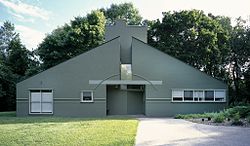
Architect Robert Venturi's Complexity and Contradiction in Architecture, published in 1966, questioned Modernism and recommended reviving the presence of the past in architectural design.
Image source: Vanna Venturi House
1970 - 1975
The J. Paul Getty Museum in Malibu, California, built from 1970 to 1975, was inspired by the ancient Roman Villa of the Papyri at Herculaneum and represented a modern revival of classical architecture.
1975 - 1981
Ricardo Bofill's Les Arcades du Lac housing project near Paris was developed from 1975 to 1981 and used monumental classical references in a late 20th-century revivalist approach.
1978 - 1983
Les Espaces d'Abraxas, a monumental housing project near Paris, was built from 1978 to 1983 and extended the revival of classical architectural imagery.
2000 - 2010
By the first decade of the 21st century, contemporary Neoclassical architecture was commonly grouped under the broader umbrella term New Classical Architecture.
2003
The Driehaus Architecture Prize began recognizing major contributors to 21st-century traditional or classical architecture, with prize money twice as high as that of the modernist Pritzker Prize.
2006
The 2006 Schermerhorn Symphony Center in Nashville exemplifies the construction of contemporary public buildings in a Neoclassical style in the United States.
Build a timeline like this one in minutes, for free. Start Yours →
Or browse the full history timeline directory, with more than 2,500 topics.
This Neoclassicism timeline was generated with the help of AI, using information found on the internet.
We work hard to keep these timelines accurate, but mistakes do get through. If you spot one, email us at [email protected] and we'll fix it for future visitors.
Generate yours with AI or build it from scratch, for free.
Export your timeline, add your own events, edit or remove AI-generated events, and much more
No credit card required.
15-day money-back guarantee.
You can create an unlimited number of timelines with up to 10 events on each one, customize how they look, export them to PDF, PNG, PowerPoint, CSV, and Excel, and share them with a link. Timelines made with Timeline Maker AI keep every event the generator created, and you can add up to 5 events of your own. Paid plans remove the event limit, add spreadsheet imports and hide Preceden's branding, and the higher-priced plan also adds collaborators, a custom logo and a custom domain.
Yes. You can cancel your subscription from your account page at any time, and you will not be charged again. Your subscription stays active for the rest of the period you already paid for.
Yes. We email you a reminder 15 days before your annual renewal, and we email you a receipt after every payment.
Yes. You can email us within 15 days of any payment, and we will issue you a full refund.
Check out our pricing docs or send us an email anytime: [email protected].