-
Use Cases
-
Resources
-
Pricing
Romanticism was an artistic, literary, musical, and intellectual movement that originated in Europe in the late 18th century as a reaction against the Enlightenment's rationalism and the Industrial Revolution. It emphasized intense emotion, imagination, the sublime beauty of nature, individualism, and the glorification of the past and the medieval, profoundly shaping art, literature, music, and philosophy across the Western world. More Less
1757
% complete
Burke's treatise distinguished the sublime from the beautiful, arguing that terror and awe produce the most powerful aesthetic experiences. His ideas profoundly shaped Romantic conceptions of nature, horror, and grandeur in art and literature.
Image source: A Philosophical Enquiry into the Origin of Our Ideas of the Sublime and Beautiful
1761
% complete
Rousseau's epistolary novel became a sensation across Europe, celebrating intense emotion, nature, and individual feeling. It is often seen as a foundational text of pre-Romantic sensibility, influencing generations of writers and readers with its celebration of passionate love and sentimental moral philosophy.
Image source: Julie; or, The New Heloise
1770
% complete
The Sturm und Drang ('Storm and Stress') literary movement arose in Germany as a reaction against Enlightenment rationalism. Writers like Johann Wolfgang von Goethe and Friedrich Schiller emphasized extreme emotion, individualism, and the sublime in nature, laying crucial groundwork for full-blown Romanticism.
Image source: Sturm und Drang
Sep 1814 - Jun 1815
% complete
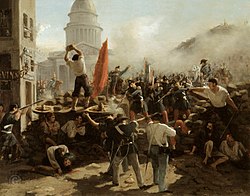
The Congress of Vienna restored conservative monarchies after the Napoleonic Wars. The resulting political climate fueled nationalist and liberal sentiments that intertwined deeply with Romantic ideals of national identity and freedom.
Image source: Congress of Vienna
Jun 18, 1815
% complete
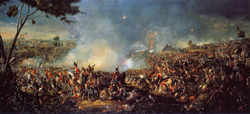
Napoleon's final defeat at Waterloo closed a turbulent era that had inspired Romantic fascination with heroism, glory, and revolutionary change. The battle itself became a subject for Romantic painters and poets.
Image source: Battle of Waterloo
1774
% complete
Goethe's novel about a young man consumed by unrequited love and despair sparked 'Werther Fever' across Europe. Its intense emotional subjectivity made it an emblematic work of the Sturm und Drang period and a precursor to Romantic literature.
Image source: The Sorrows of Young Werther
1798
% complete
William Wordsworth and Samuel Taylor Coleridge anonymously published 'Lyrical Ballads', featuring Wordsworth's preface defining poetry as 'the spontaneous overflow of powerful feelings'. The collection is widely regarded as launching English Romanticism.
Image source: Lyrical Ballads
1808
% complete
Goethe's retelling of the Faust legend, published in 1808, dramatized humanity's striving for infinite knowledge and experience. It became one of the most influential works of world literature and a cornerstone of German Romantic thought.
Image source: Faust, Part One
1814
% complete
Scott's historical novel about the Jacobite rising of 1745 inaugurated the genre of historical fiction. Its romantic portrayal of Scotland's past captivated readers across Europe and influenced countless later writers.
Image source: Waverley (novel)
1818
% complete
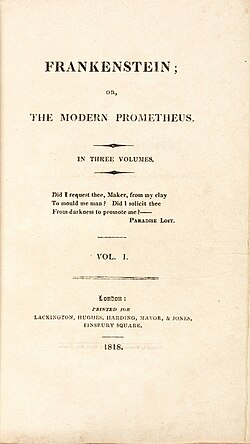
Written when she was just 18, Mary Shelley's Gothic novel about scientific hubris blended Romantic anxieties about nature, ambition, and creation. It founded science fiction while remaining a core Romantic text.
Image source: Frankenstein
1819
% complete
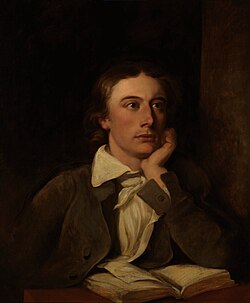
In a single remarkable year, John Keats composed 'Ode to a Nightingale', 'Ode on a Grecian Urn', and other masterpieces. Though he died young in 1821, these odes became touchstones of second-generation English Romanticism.
Image source: John Keats
1820
% complete
Percy Bysshe Shelley produced some of his most celebrated works around 1820, embodying Romantic ideals of rebellion, imagination, and radical politics. His lyrical genius made him a central figure of the movement before his death in 1822.
Image source: Percy Bysshe Shelley
1827
% complete
Hugo's manifesto called for freedom from classical rules, championing the grotesque alongside the sublime. The preface became the theoretical charter of French Romanticism and galvanized a generation of writers.
Feb 25, 1830
% complete
The premiere of Victor Hugo's play at the Comédie-Française provoked riots between classicists and Romantics. The 'Battle of Hernani' symbolized the triumph of Romanticism over neoclassical convention in France.
Image source: Hernani (drama)
1831
% complete
Hugo's Gothic novel set in medieval Paris ignited enthusiasm for Gothic architecture and heritage preservation. Its success helped spark restoration efforts at Notre-Dame Cathedral and shaped Romantic medievalism.
Image source: The Hunchback of Notre-Dame
1840
% complete
Lermontov's pioneering psychological novel introduced the Byronic antihero Pechorin to Russian literature. It marked both the height and the beginning of a critique of Russian Romanticism.
Image source: A Hero of Our Time
1799
% complete
Goya's etching from 'Los Caprichos' depicted reason overwhelmed by nocturnal creatures, embodying tensions between Enlightenment rationalism and irrational forces. Goya is often considered one of the first great proto-Romantic artists.
Image source: The Sleep of Reason Produces Monsters
Apr 7, 1805
% complete
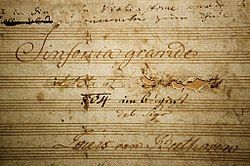
The premiere of Beethoven's Third Symphony in Vienna marked a turning point in music history. Its unprecedented length, emotional depth, and heroic character are frequently cited as the beginning of musical Romanticism.
Image source: Symphony No. 3 (Beethoven)
1818
% complete
Friedrich's iconic image of a lone figure contemplating a misty mountain landscape became the quintessential expression of Romantic longing, solitude, and the sublime power of nature.
Image source: Wanderer above the Sea of Fog
1819
% complete
Théodore Géricault's monumental painting depicting survivors of a shipwreck scandalized and electrified Paris at the Salon. Its dramatic realism, emotional intensity, and political charge made it a landmark of French Romantic painting.
Image source: The Raft of the Medusa
1822
% complete
Eugène Delacroix's first major Salon entry drew on Dante's Inferno with vivid color and dramatic energy. It announced the arrival of French Romanticism in painting and established Delacroix as its leading figure.
Image source: The Barque of Dante
1827
% complete
Schubert's haunting cycle of 24 songs based on Wilhelm Müller's poems explored loneliness, alienation, and wandering. Completed shortly before his death, it stands among the supreme achievements of German Romantic lieder.
Image source: Winterreise
1830
% complete
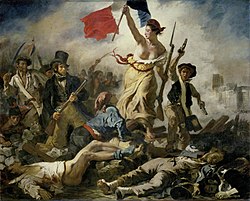
Commemorating the July Revolution of 1830, Delacroix's iconic canvas fused allegory with gritty contemporary detail. It became the definitive image of Romantic revolutionary spirit and French national identity.
Image source: Liberty Leading the People
Dec 5, 1830
% complete
Hector Berlioz's programmatic symphony, inspired by obsessive love, stunned Paris with its vivid orchestration and narrative structure. It pioneered the Romantic idea of music telling a story.
Image source: Symphonie fantastique
1831
% complete
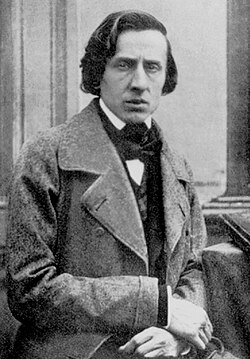
After the failed November Uprising against Russian rule, Frédéric Chopin emigrated to Paris, where he became a leading figure of musical Romanticism. His poetic piano works carried deep nostalgia for his Polish homeland.
Image source: Frédéric Chopin
1842
% complete
J.M.W. Turner's swirling depiction of a steamship in a violent storm pushed landscape painting toward near-abstraction. His late works embodied the Romantic sublime and anticipated modern art.
Image source: Snow Storm: Steam-Boat off a Harbour's Mouth
1848 - 1874
% complete
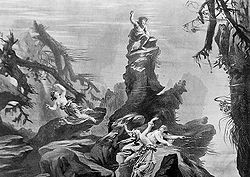
Richard Wagner spent over two decades creating his monumental tetralogy of operas rooted in Norse mythology. The Ring Cycle represented the culmination of German Romantic opera and revolutionized Western music.
Image source: Der Ring des Nibelungen
Jan 1848 - 1849
% complete
A wave of liberal and nationalist uprisings shook Europe, many driven by ideals Romanticism had nurtured. Their largely failed outcomes contributed to growing disillusionment with Romantic idealism and a turn toward Realism.
Image source: Revolutions of 1848
1850
% complete
Courbet's unsentimental depiction of laborers signaled the rise of Realism, which rejected Romantic idealization in favor of ordinary life. This shift marked the beginning of Romanticism's decline in the visual arts.
Image source: The Stone Breakers
May 22, 1885
% complete
The death of Victor Hugo, the last towering figure of European Romanticism, prompted a massive state funeral in Paris. His passing was widely seen as marking the end of the Romantic age, though its influence endured throughout modern culture.
Image source: Victor Hugo
Or browse the full history timeline directory, with more than 2,000 topics.
This Romanticism timeline was generated with the help of AI, using information found on the internet.
We work hard to keep these timelines accurate, but mistakes do get through. If you spot one, email us at [email protected] and we'll fix it for future visitors.
Generate yours with AI or build it from scratch, for free.
Export your timeline, add your own events, edit or remove AI-generated events, and much more
No credit card required.
Cancel anytime.
Cancel anytime.
You can create an unlimited number of timelines with up to 10 events on each one, customize how they look, export them to PDF, PNG, PowerPoint, CSV, and Excel, and share them with a link. Paid plans raise the event limit and add features like spreadsheet imports and collaborators.
Yes. You can cancel your subscription from your account page at any time, and you will not be charged again. Your subscription stays active for the rest of the period you already paid for.
Yes. We will email you a reminder before the annual renewal, and we will also email you a receipt.
Yes. You can email us within 15 days of any payment, and we will issue you a full refund.
Check out our pricing docs or send us an email anytime: [email protected].