-
Use Cases
-
Resources
-
Pricing
1690 - 1730
During the late seventeenth and early eighteenth centuries, rocaille described decorative motifs of interlaced seashells and acanthus leaves that developed from the late Louis XIV style.
1710 - 1750
The ornamental style called rocaille emerged in France between 1710 and 1750, especially during the Regency and the reign of Louis XV. It was also known as the Louis Quinze style and became a foundation of French Rococo.
Image source: Rocaille
1738 - 1748
The discoveries of Roman antiquities at Herculaneum in 1738 and Pompeii in 1748 turned French architecture toward the more symmetrical and less flamboyant principles of Neoclassicism.
Image source: Neoclassicism
1825
The word rococo first appeared in print in 1825. Critics used it pejoratively for decoration they considered out of style and old-fashioned.
Image source: Rococo
1828
By 1828, rococo described decorations belonging to the eighteenth-century style and overloaded with twisting ornaments.
1829
In 1829, Stendhal defined rococo as the rocaille style of the eighteenth century, helping shift the word from an insult toward a more objective historical description.
1695 - 1750
Juste-Aurèle Meissonnier, who was also a sculptor and painter, became the best-known French furniture designer of the period and helped define the highly ornamented Rococo vocabulary.
1703 - 1770
François Boucher succeeded Watteau as a leading painter of decorative Rococo scenes and became the favorite painter of Madame de Pompadour.
Image source: François Boucher
1704 - 1705
The Hôtel Soubise in Paris became one of the earliest examples associated with French Rococo. Its famous oval salon was decorated with paintings by François Boucher and Charles-Joseph Natoire.
Image source: Hôtel de Soubise
1717
Antoine Watteau became the leading proponent of the fête galante, a genre depicting young nobles gathered in pastoral settings. His Embarkation for Cythera, now in the Louvre, exemplified the style.
Image source: Antoine Watteau
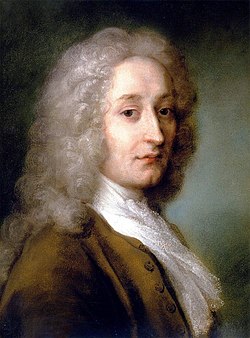
1721
Antoine Watteau died in 1721 at the age of thirty-seven. His paintings continued to influence Rococo art throughout the rest of the century.
1723 - 1759
The Rocaille style, or French Rococo, appeared in Paris during the reign of Louis XV and flourished from approximately 1723 to 1759.
1735
François Lemoyne completed the lavish ceiling decoration of the Salon of Hercules at the Palace of Versailles, a major expression of French Rococo painting.
1735 - 1740
Rococo was used particularly in salons, a new kind of room intended to impress and entertain guests. The salon of the Princess at the Hôtel de Soubise in Paris, designed by Germain Boffrand and Charles-Joseph Natoire, became a prominent example.
1735 - 1740
Paintings with fête galante and mythological themes by François Boucher, Pierre-Charles Trémolières, and Charles-Joseph Natoire decorated the famous salon of the Hôtel Soubise in Paris.
1735
Founded by William Hogarth in 1735, the St Martin's Lane Academy was integral to introducing Rococo style to designers and artists in England.
1736
Designer and jeweller Jean Mondon published Premier Livre de forme rocquaille et cartel, or First Book of Rocaille and Cartel Form. The collection presented designs for furniture and interiors.
1738
The growing prominence of Rococo in French artistic institutions was confirmed by the nomination of Jean François de Troy as director of the academy in 1738.
1746
Boucher's sensual Toilette de Venus, painted in 1746, became one of the best-known examples of Rococo painting.
1751
In 1751, Charles-Joseph Natoire became director of the academy, further confirming the institutional position of Rococo painting in France.
1700 - 1799
Russian Rococo was introduced largely by Empress Elisabeth and Catherine the Great during the eighteenth century, through court architects such as Francesco Bartolomeo Rastrelli.
1700 - 1799
The number of European porcelain factories grew steadily during the eighteenth century. Some produced porcelain affordable to the expanding middle classes, helping Rococo objects circulate more widely.
1700 - 1799
Russian Orthodox church architecture was heavily influenced by Rococo during the eighteenth century, often using a square Greek-cross plan with four equidistant wings.
1720 - 1744
Commissioned by Prince-Bishop Johann Philipp Franz von Schönborn, the Würzburg Residence became a notable example of German Rococo architecture. Balthasar Neumann designed the building and its interiors.
Image source: Würzburg Residence
1721 - 1732
Narciso Tomé created the design of El Transparente between 1721 and 1732. Its construction allows light to pass through, making the work appear to move as illumination changes.
1725 - 1768
Balthasar Neumann designed the iconic Rococo stairway at Augustusburg Castle in Brühl. Its sequence of painting, sculpture, and ironwork creates surprising views as visitors ascend.
1730 - 1760
Johann Joachim Kändler became the most important modeller at Meissen, the earliest European porcelain factory. Meissen remained the most important European producer until about 1760.
1734 - 1739
François de Cuvilliés created the Amalienburg pavilion in Munich, one of the first Rococo buildings in Germany. He was inspired by French pavilions at the Grand Trianon and Château de Marly.
Image source: Amalienburg
1740 - 1791
French Rococo sculpture included the later fountains at Versailles, such as the Fountain of Neptune by Lambert-Sigisbert Adam and Nicolas-Sébastien Adam. Étienne-Maurice Falconet was another leading sculptor of the period.
1740 - 1770
Rococo flourished in England between 1740 and 1770, transforming furniture and interior design after an earlier period dominated by the neoclassical Palladian model.
1743 - 1772
Balthasar Neumann designed the Basilica of the Fourteen Holy Helpers, one of the notable Bavarian pilgrimage churches influenced by Rococo.
Image source: Basilica of the Fourteen Holy Helpers
1745 - 1754
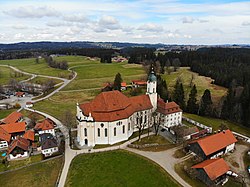
Dominikus Zimmermann designed the Wieskirche, one of the most notable examples of Bavarian Rococo church architecture.
Image source: Wieskirche
1748 - 1766
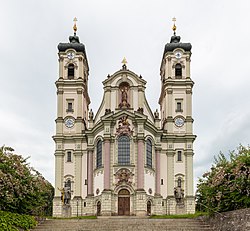
Johann Michael Fischer created the Rococo design of Ottobeuren Abbey. Its regular facade contrasts sharply with the abundance of decoration inside.
Image source: Ottobeuren Abbey
1750 - 1753
Giovanni Battista Tiepolo travelled to Germany with his son from 1750 to 1753 to decorate the ceilings of the Würzburg Residence. His work became one of the major landmarks of Bavarian Rococo.
Image source: Giovanni Battista Tiepolo
1750 - 1753
At the Würzburg Residence, Tiepolo created a mural above the three-level ceremonial stairway. Neumann described the interior as a theatre of light.
1752 - 1765
A version of Watteau's Pilgrimage to Cythera was purchased by Frederick the Great of Prussia in either 1752 or 1765 to decorate Charlottenburg Palace in Berlin.
1754
Thomas Chippendale published The Gentleman and Cabinet Maker's Director, a widely popular catalogue of Rococo, chinoiserie, and Gothic furniture designs.
Image source: Thomas Chippendale
1761
Thomas Johnson, one of the most successful British Rococo carvers and furniture designers, published a catalogue of Rococo furniture designs in 1761.
1700 - 1745
Eighteenth-century women's fashion became ornate and sophisticated. The robe volante appeared in the early eighteenth century, while the pannier and mantua became fashionable around 1718.
1745
The year 1745 was described as the Golden Age of Rococo fashion, with the introduction in France of a more exotic oriental culture known as à la turque.
1750 - 1799
During the second half of the eighteenth century, a reaction against Rococo developed, primarily in response to the style's perceived overuse of ornament and decoration.
1770 - 1799
In Germany, late eighteenth-century Rococo was ridiculed as Zopf und Perücke, meaning pigtail and periwig. This late phase is sometimes called Zopfstil.
1775 - 1800
By the late eighteenth century, Rococo was largely replaced by Neoclassicism, whose emphasis on order, symmetry, and classical seriousness contrasted with Rococo's ornament and asymmetry.
1785
By 1785, Rococo had passed out of fashion in France and was replaced by the order and seriousness associated with Neoclassical artists such as Jacques-Louis David.
1800 - 1810
By the early nineteenth century, Catholic opinion had turned against Rococo's suitability for ecclesiastical contexts, arguing that the style was in no way conducive to sentiments of devotion.
1850 - 1860
By the mid-nineteenth century, art historians had widely accepted Rococo as a legitimate historical style, although the term was still often used dismissively for heavily ornamented architecture or music.
1890 - 1910
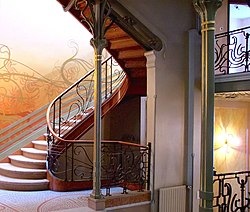
Art historians Stephan Tschudi-Madsen and Debora L. Silverman identify Rococo's asymmetrical, curvilinear, and botanical elements as a source for the late-nineteenth-century Art Nouveau movement.
Image source: Art Nouveau
Or browse the full history timeline directory, with more than 2,500 topics.
This Rococo timeline was generated with the help of AI, using information found on the internet.
We work hard to keep these timelines accurate, but mistakes do get through. If you spot one, email us at [email protected] and we'll fix it for future visitors.
Generate yours with AI or build it from scratch, for free.
Export your timeline, add your own events, edit or remove AI-generated events, and much more
No credit card required.
Cancel anytime.
Cancel anytime.
You can create an unlimited number of timelines with up to 10 events on each one, customize how they look, export them to PDF, PNG, PowerPoint, CSV, and Excel, and share them with a link. Paid plans raise the event limit and add features like spreadsheet imports and collaborators.
Yes. You can cancel your subscription from your account page at any time, and you will not be charged again. Your subscription stays active for the rest of the period you already paid for.
Yes. We will email you a reminder before the annual renewal, and we will also email you a receipt.
Yes. You can email us within 15 days of any payment, and we will issue you a full refund.
Check out our pricing docs or send us an email anytime: [email protected].