-
Use Cases
-
Resources
-
Pricing
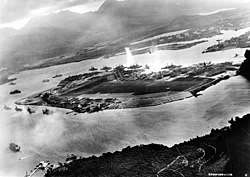
The attack on Pearl Harbor was a surprise military strike by the Imperial Japanese Navy against the United States naval base at Pearl Harbor, Hawaii, on December 7, 1941. The attack killed over 2,400 Americans, damaged or destroyed numerous ships and aircraft, and led directly to the United States declaring war on Japan and entering World War II. More Less
1924
% complete
As early as 1924, and again in 1932, Admiral Seijiro Kawashima and Commander Hironori Mizuno argued that in any war with the United States, Japan needed to take Hawaii, warning that failure to do so would doom the war to being prolonged and prevent Japan from winning.
1924
% complete
Chief of United States Air Service Mason Patrick showed concern for military vulnerabilities in the Pacific, sending General Billy Mitchell on a survey of the Pacific and the East to assess American defenses.
1931
% complete
Tensions between Japan and the United States did not seriously grow until Japan's invasion of Manchuria in 1931, which marked the beginning of Japanese expansionism that would eventually bring the two nations into conflict.
Image source: Japanese invasion of Manchuria
1932
% complete
At least two naval war games, one in 1932 and another in 1936, proved that Pearl Harbor was vulnerable to a surprise carrier-based air attack, yet warnings went largely unheeded.
Oct 24, 1934
% complete
In a memorandum dated October 24, 1934, Chief of the Division of Far Eastern Affairs Stanley K. Hornbeck addressed growing concerns over Japanese ambitions in the Pacific.
1937
% complete
Over the decade following the invasion of Manchuria, Japan expanded into China, leading to the outbreak of the Second Sino-Japanese War in 1937 and further straining relations with Western powers.
Image source: Second Sino-Japanese War
Dec 1937
% complete
Starting in December 1937, events such as the Japanese attack on USS Panay, the Allison incident, and the Rape of Nanjing swung Western public opinion sharply against Japan.
Image source: USS Panay incident
1938
% complete
In 1938, following an appeal by President Roosevelt, American companies stopped providing Japan with implements of war, an early step in economic pressure against Japanese expansionism.
Sep 1939
% complete
The United Kingdom had already been at war with Germany since September 1939 and with Italy since June 1940, and British prime minister Winston Churchill had promised to declare war 'within the hour' of a Japanese attack on the United States.
1940
% complete
Unknown to Yamamoto, the US Navy had decided as far back as 1935 to abandon charging across the Pacific towards the Philippines in response to war, and instead adopted Plan Dog in 1940, emphasizing keeping the Imperial Japanese Navy out of the eastern Pacific while concentrating on defeating Nazi Germany.
1940
% complete
In 1940, Japan invaded French Indochina, attempting to stymie the flow of supplies reaching China, an action that further provoked the United States.
Image source: Japanese invasion of French Indochina
1940
% complete
In 1940, the US Pacific Fleet was based at Pearl Harbor, making it a target for Isoroku Yamamoto's planned pre-emptive strike intended to prevent it from interfering with Japan's planned actions in Southeast Asia.
1941
% complete
Japan and the United States engaged in negotiations during 1941, attempting to improve relations, but the talks ultimately failed to resolve the deepening crisis.
Jul 1941
% complete
The United States finally ceased oil exports to Japan in July 1941, following the seizure of French Indochina after the Fall of France, in part because of new American restrictions on domestic oil consumption.
Nov 1941
% complete
By late 1941, many observers believed that hostilities between the United States and Japan were imminent, though few anticipated a strike on Pearl Harbor itself.
Image source: Attack on Pearl Harbor
Nov 26, 1941
% complete
Japan dispatched its naval attack group on November 26, 1941, just before receiving the Hull note, which stated the US desire that Japan withdraw from China and French Indochina.
Image source: Hull note
Jan 1941
% complete
Preliminary planning for an attack on Pearl Harbor to protect the move into the Southern Resource Area, the Japanese term for the Dutch East Indies and Southeast Asia generally, began early in 1941 under Admiral Isoroku Yamamoto, commander of the Combined Fleet.
1941
% complete
The planners studied the 1940 British air attack on the Italian fleet at Taranto intensively, drawing lessons for a carrier-based aerial assault on battleships at anchor.
Image source: Battle of Taranto
Mar 1941
% complete
By early spring 1941, full-scale planning was underway, primarily by Rear Admiral Ryūnosuke Kusaka, with assistance from Commander Minoru Genda and Yamamoto's Deputy Chief of Staff, Captain Kameto Kuroshima.
Sep 5, 1941 - Sep 17, 1941
% complete
In the wake of discussions following the war games drilling for the Pearl Harbor attack on September 5–17, 1941, Admiral Isoroku Yamamoto ultimately decided against attempting an invasion of Hawaii.
Nov 25, 1941
% complete
The five I-boats, midget submarines intended to penetrate Pearl Harbor, left Kure Naval District on November 25, 1941, as part of the operation.
Nov 26, 1941
% complete
On November 26, 1941, Kido Butai, the Mobile Strike Force of the Japanese Navy, departed Hittokapu Bay on Etorofu Island in the Kuril Islands: six aircraft carriers (Akagi, Kaga, Sōryū, Hiryū, Shōkaku, and Zuikaku), two battleships, three cruisers, 11 destroyers, and eight oilers.
Dec 7, 1941
% complete
Oklahoma was hit by five torpedoes and capsized; West Virginia was sunk by two bombs and seven torpedoes; California was sunk; Nevada was beached; and Tennessee and Maryland were each hit by two bombs, among the heavy damage inflicted on the fleet.
Dec 7, 1941
% complete
2,008 sailors were killed and 710 others wounded; 218 soldiers and airmen were killed and 364 wounded; 109 Marines were killed and 69 wounded; and 68 civilians were killed and 35 wounded. The attack remains the deadliest non-pathological disaster in Hawaii's history.
Dec 7, 1941
% complete
In the first-wave attack, about eight of the forty-nine 800-kg armor-piercing bombs dropped hit their intended battleship targets, inflicting devastating damage on the American fleet.
Dec 7, 1941
% complete
The Attack on Pearl Harbor was a surprise military attack by the Empire of Japan on the US Pacific Fleet at its naval base at Pearl Harbor in Oahu, Hawaii, on December 7, 1941, leading Roosevelt to famously label it 'a date which will live in infamy'.
Dec 7, 1941
% complete
Tokyo transmitted the 5000-word notification, commonly called the 14-Part Message, in two blocks to the Japanese Embassy in Washington, intended to break off negotiations before the attack began.
Dec 8, 1941
% complete
Japan began the Philippines campaign hours after Pearl Harbor (because of the time difference, it was December 8 in the Philippines), launching its broader offensive across Southeast Asia.
Image source: Philippines campaign (1941–1942)
Feb 24, 1942
% complete
On February 24, 1942, Order-in-Council P.C. 1486 was issued under the War Measures Act, allowing for the forced removal of any and all Canadians of Japanese descent from British Columbia and prohibiting them from returning to the province.
Image source: Internment of Japanese Canadians
Jun 1942
% complete
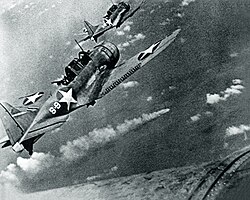
Japan still harbored plans related to Hawaii after Pearl Harbor, but its decisive defeat at the Battle of Midway in June 1942 permanently scuttled those plans.
Image source: Battle of Midway
Jun 13, 1944
% complete
The wounded later received Purple Hearts, originally reserved for service members wounded by enemy action while partaking in armed conflicts, for their peacetime actions that day on June 13, 1944.
May 1947
% complete
Oklahoma, while raised, was never repaired and capsized while under tow to the mainland in 1947, having been declared a total loss after the attack.
Image source: USS Oklahoma (BB-37)
1960
% complete
One of the Japanese midget submarines involved in the attack was found outside the harbor in 1960, providing physical evidence of the submarine component of the operation.
Dec 7, 1984
% complete
The three firefighters killed in the attack did not receive their Purple Hearts until December 7, 1984, on the 43rd anniversary of the attack.
1992 - 2001
% complete
In 1992, 2000, and 2001, Hawaii Undersea Research Laboratory's submersibles found the wreck of the fifth midget submarine lying in three parts outside Pearl Harbor.
Or browse the full history timeline directory, with more than 2,000 topics.
This Pearl Harbor timeline was generated with the help of AI, using information found on the internet.
We work hard to keep these timelines accurate, but mistakes do get through. If you spot one, email us at [email protected] and we'll fix it for future visitors.
Generate yours with AI or build it from scratch, for free.
Export your timeline, add your own events, edit or remove AI-generated events, and much more
No credit card required.
Cancel anytime.
Cancel anytime.
You can create an unlimited number of timelines with up to 10 events on each one, customize how they look, export them to PDF, PNG, PowerPoint, CSV, and Excel, and share them with a link. Paid plans raise the event limit and add features like spreadsheet imports and collaborators.
Yes. You can cancel your subscription from your account page at any time, and you will not be charged again. Your subscription stays active for the rest of the period you already paid for.
Yes. We will email you a reminder before the annual renewal, and we will also email you a receipt.
Yes. You can email us within 15 days of any payment, and we will issue you a full refund.
Check out our pricing docs or send us an email anytime: [email protected].