-
Use Cases
-
Resources
-
Pricing
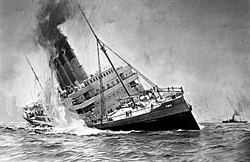
The RMS Lusitania was a British ocean liner launched in 1906 by the Cunard Line, renowned as one of the fastest and most luxurious passenger ships of its era. On May 7, 1915, it was torpedoed by a German U-boat off the coast of Ireland during World War I, killing nearly 1,200 people. The disaster shocked the world, influenced American public opinion against Germany, and became a significant factor in the United States' eventual entry into the war in 1917. More Less
1897
% complete
The NDL liner Kaiser Wilhelm der Grosse captured the Blue Riband for the fastest Atlantic crossing from Cunard's Campania in 1897, before the prize was taken in 1900 by the HAPAG ship Deutschland. German dominance of the transatlantic passenger trade prompted Cunard to respond with new 'ocean greyhounds'.
Image source: SS Kaiser Wilhelm der Grosse
1901
% complete
In 1901, American financier J.P. Morgan's International Mercantile Marine gained control of several shipping interests as well as a controlling interest in the British passenger White Star Line, folding them into IMM and threatening British maritime dominance.
Image source: RMS Lusitania
1902
% complete
In 1902, IMM, NDL, and HAPAG entered into a 'Community of Interest' agreement to fix prices and divide the transatlantic trade, further squeezing British carriers like Cunard and prompting government intervention.
Image source: International Mercantile Marine Company
1902
% complete
Cunard's naval architect Leonard Peskett built a large model of the proposed ship in 1902 showing a three-funnel design. A fourth funnel would later be added in 1904 to vent exhaust from additional boilers after steam turbines were chosen.
1903
% complete
NDL regained the Blue Riband in 1903 with the Kaiser Wilhelm II and Kronprinz Wilhelm, and Cunard saw its passenger numbers affected as a result of the competition from the 'Kaiser-class ocean liners', intensifying pressure to build faster British ships.
Jun 1903
% complete
Under the terms of an agreement signed in June 1903, Cunard was given a loan of £2.6 million to finance two new express liners — Lusitania and Mauretania — repayable over 20 years at a favourable interest rate of 2.75 percent.
1904
% complete
A fourth funnel was implemented into the design in 1904 as it was necessary to vent the exhaust from additional boilers fitted after steam turbines had been settled on as the power plant, giving Lusitania her distinctive silhouette.
Mar 24, 1904
% complete
The Turbine Committee was convinced by tests that turbines were the way forward and recommended on 24 March 1904 that they should be used on the new express liners. The propellers were driven directly by the turbines, as sufficiently robust gearboxes had not yet been developed (they only became available in 1916).
Aug 17, 1904
% complete
Construction of Lusitania began on 17 August 1904, with Lord Inverclyde hammering home the first rivet at John Brown & Company's shipyard on the River Clyde, marking the official start of the giant liner's build.
1905
% complete
Carmania was completed in 1905 and this gave Cunard almost two years of experience operating turbine-powered vessels before the introduction of their new super liners in 1907.
Image source: RMS Carmania (1905)
Jun 7, 1906
% complete
The ship was launched on 7 June 1906, eight weeks later than planned due to labour strikes and eight months after Lord Inverclyde's death. The name Lusitania had been available since a previous ship of that name, built in 1871, was wrecked in 1901.
Jun 1907 - Jul 1907
% complete
Testing of the ship's engines took place in June 1907 prior to full trials scheduled for July. At 180 revolutions a turning test was conducted and the ship performed a complete circle of diameter 1000 yards in 50 seconds.
Sep 7, 1907
% complete
Lusitania, commanded by Commodore James Watt, moored at the Liverpool landing stage for her maiden voyage at 4:30 pm on Saturday 7 September 1907 as the onetime Blue Riband holder RMS Lucania vacated the pier. She was designed to carry 2,198 passengers and 827 crew members in her original configuration.
Oct 11, 1907
% complete
On her second voyage in better weather, Lusitania arrived at Sandy Hook on 11 October 1907 in Blue Riband record time of 4 days, 19 hours and 53 minutes, wresting the fastest Atlantic crossing from German ships which had held it for a decade.
Dec 1907
% complete
In December 1907, sister ship Mauretania entered service and took the record for the fastest eastbound crossing, beginning a long period during which the two Cunard 'ocean greyhounds' dominated the transatlantic speed records.
Image source: RMS Mauretania (1906)
1909
% complete
Lusitania made her fastest westbound crossing in 1909 after her propellers were changed, averaging 25.85 knots (47.87 km/h). She briefly recovered the overall record in July of that year, but Mauretania recaptured the Blue Riband the same month, retaining it until SS Bremen took it in 1929.
Sep 1909 - Oct 1909
% complete
Lusitania and other ships participated in the Hudson-Fulton Celebration in New York City from the end of September to early October 1909, a grand festival commemorating the 300th anniversary of Hudson's voyage and Fulton's steamboat.
Image source: Hudson–Fulton Celebration
Jan 10, 1910
% complete
On 10 January 1910, Lusitania was two days into a voyage from Liverpool to New York when she encountered a rogue wave 75 feet (23 m) high. Damage suffered in this incident was linked to structural factors that would be examined later.
1912
% complete
The British commission that investigated the sinking of Titanic in 1912 heard testimony on the flooding of coal bunkers lying outside longitudinal bulkheads — a design feature Lusitania shared. Notably, Lusitania did not carry enough lifeboats for all aboard at her maiden voyage, carrying four lifeboats fewer than Titanic would carry in 1912.
1913
% complete
In 1913, First Lord of the Admiralty Winston Churchill announced that Lusitania would be converted into a warship, 'indistinguishable in status and control from men-of-war', if war was declared. Her silhouette was later listed in Jane's All the World's Fighting Ships and Brassley's 1914 Naval Annual categorised her as a 'Royal Naval Reserved Merchant Cruiser'.
Feb 4, 1915
% complete
On 4 February 1915, Germany declared the seas around Great Britain and Ireland to be a war zone, warning that Allied ships in the area would be sunk without warning beginning by 18 February. By early 1915, the new threat of submarines had begun to grow.
Image source: Unrestricted submarine warfare
Apr 17, 1915 - Apr 24, 1915
% complete
On 17 April 1915, Lusitania left Liverpool on her 201st transatlantic voyage, arriving in New York on 24 April. She was next scheduled to arrive back in Liverpool on 6 March... rather, she prepared for what would become her final return crossing to Liverpool.
May 1, 1915
% complete
The German embassy in the United States placed fifty newspaper advertisements warning people of the dangers of sailing on a British ship in the war zone area, which happened to appear just as RMS Lusitania departed Pier 54 in New York at 12:20 pm on 1 May 1915 on her final voyage.
May 1915 - 1917
% complete
The sinking killed 128 US citizens and significantly increased American public support for entering World War I, contributing to the United States declaration of war on Germany in 1917 after the torpedoing of three other US merchant ships and the Zimmermann Telegram.
Image source: Sinking of the RMS Lusitania
May 7, 1915
% complete
The German submarine U-20 hit Lusitania with a torpedo on 7 May 1915 at 14:10, 11 nautical miles off the Old Head of Kinsale, Ireland, leading to her sinking about 18 minutes later. She was nearing the end of her 202nd crossing bound for Liverpool, scheduled to dock that afternoon.
Sep 9, 1915
% complete
The Germans decided on 9 September 1915 that attacks were only allowed on ships that were definitely British, while neutral ships were to be treated under Prize Law rules, and no attacks on passenger liners were to be permitted at all. However, in January 1917 the German government announced it would again conduct full unrestricted submarine warfare.
1916
% complete
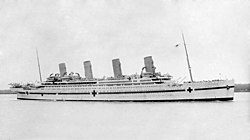
When Britannic, working as a hospital ship during the First World War, sank in 1916 after hitting a mine in the Kea Channel, already davited boats were swiftly lowered saving nearly all on board — but the ship took nearly three times as long to sink as Lusitania, giving the crew more time to evacuate passengers.
Image source: HMHS Britannic
Apr 6, 1917
% complete
The resumption of unrestricted submarine warfare pushed American public opinion over the tipping point, and the United States Congress followed President Wilson to declare war on Germany on 6 April 1917, fulfilling the consequences set in motion partly by the Lusitania sinking.
Image source: United States declaration of war on Germany (1917)
1923 - Feb 23, 1924
% complete
In 1923, 278 claimants were initially awarded $23 million (equivalent to about $330 million in 2024). On 23 February 1924, the Seattle Star reported that Judge Edwin B. Parker denied 40 claims and settled on a final payout of $841,000 ($12 million in 2024).
Oct 6, 1935
% complete
In 1935, a Glasgow-based expedition launched to find the wreck of Lusitania succeeded after three months of searching: the wreck was discovered on 6 October 1935, 11 miles (18 km) south of the lighthouse at Kinsale. Between 1931 and 1935, Simon Lake's salvage contract with British authorities expired without any salvage work done.
1967
% complete
In 1967, the wreck of Lusitania was sold by the Liverpool & London War Risks Insurance Association to former US Navy diver John Light (1932–1992) for £1,000. In 1993, Bemis granted permission to Titanic wreck explorer Robert Ballard to explore the wreck.
1968 - 1982
% complete
American venture capitalist Gregg Bemis (1928–2020) became a co-owner of the wreck in 1968, and by 1982 had bought out his partners to become sole owner. Also in 1982, three of the four propellers were removed by Oceaneering International for display, though one was melted down.
1986
% complete
The judge ruled in The Lusitania [1986] QB 384 that the Crown has no rights over wrecks outside British territorial waters, even if recovered items are subsequently brought into the UK. As of 1998, the case remained the leading authority on this point of law.
Image source: Sinking of RMS Lusitania
1995
% complete
In 1995, the Irish Government declared the Lusitania a heritage site under the National Monuments Act, prohibiting anyone from interfering with her or her contents. This followed Ballard's 1993 exploration authorised by Bemis and restricted later access.
2007
% complete
After protracted legal wrangling, the Supreme Court in Dublin overturned the Arts and Heritage Ministry's refusal to issue Bemis an exploration licence, ruling that the minister had misconstrued the law when refusing Bemis's 2001 application.
Jul 2008 - 2012
% complete
In late July 2008, Bemis was granted an 'imaging' licence allowing him to photograph and film the entire wreck, producing the first high-resolution pictures. Results provided to researchers at Lawrence Livermore National Laboratory led them to conclude in 2012 that the ship was sunk mainly by the effect of the torpedo, with a secondary boiler explosion not significantly affecting events.
May 3, 2015 - May 7, 2015
% complete
To commemorate the centenary of the sinking, on 3 May 2015 a small fleet of ships sailed from the Isle of Man, culminating in the 100th commemoration of the sinking of the Lusitania on 7 May 2015, one hundred years after she went down off the Old Head of Kinsale.
Jul 2016
% complete
Continuing to attempt to prove British involvement, in July 2016, Bemis's diving partner Eoin McGarry attempted to recover but lost a telegraph machine from the ship. In November 2018, Bemis discussed logistical complications of a maritime archaeological expedition to penetrate the hull on live radio.
2020
% complete
In 2020, Gregg Bemis, the American venture capitalist who had owned the Lusitania wreck outright since 1982 and fought lengthy legal battles to explore it, died at the age of 91 or 92, ending decades of personal stewardship of the historic site.
Or browse the full history timeline directory, with more than 2,000 topics.
This RMS Lusitania timeline was generated with the help of AI, using information found on the internet.
We work hard to keep these timelines accurate, but mistakes do get through. If you spot one, email us at [email protected] and we'll fix it for future visitors.
Generate yours with AI or build it from scratch, for free.
Export your timeline, add your own events, edit or remove AI-generated events, and much more
No credit card required.
Cancel anytime.
Cancel anytime.
You can create an unlimited number of timelines with up to 10 events on each one, customize how they look, export them to PDF, PNG, PowerPoint, CSV, and Excel, and share them with a link. Paid plans raise the event limit and add features like spreadsheet imports and collaborators.
Yes. You can cancel your subscription from your account page at any time, and you will not be charged again. Your subscription stays active for the rest of the period you already paid for.
Yes. We will email you a reminder before the annual renewal, and we will also email you a receipt.
Yes. You can email us within 15 days of any payment, and we will issue you a full refund.
Check out our pricing docs or send us an email anytime: [email protected].