-
Use Cases
-
Resources
-
Pricing
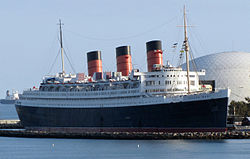
The RMS Queen Mary was a British ocean liner built by John Brown & Company in Clydebank, Scotland, for the Cunard Line. Launched in 1934, she was one of the largest and fastest passenger ships of her era, holding the Blue Riband for the fastest transatlantic crossing. During World War II she served as a troopship, nicknamed the 'Grey Ghost.' Retired in 1967, she is now permanently moored in Long Beach, California, as a floating hotel and museum. More Less
1930
% complete
The Cunard Line announced plans to build two new ocean liners, later named Queen Mary and Queen Elizabeth, to replace the aging Mauretania and maintain British dominance in transatlantic passenger service.
Dec 1, 1930
% complete
Construction of the ship known as Hull 534 began at the John Brown & Company shipyard in Clydebank, Scotland. The Great Depression soon halted work, leaving the unfinished hull standing for years.
Apr 1934
% complete
Work resumed after the British government agreed to lend Cunard money to complete Hull 534, on condition that Cunard merge with its rival White Star Line, forming Cunard-White Star Line.
Sep 26, 1934
% complete
The massive hull was launched on the River Clyde and christened RMS Queen Mary by Her Majesty Queen Mary, wife of King George V, in a ceremony attended by huge crowds.
Mar 1936
% complete
Queen Mary underwent sea trials off the coast of Scotland, demonstrating her power and handling before being handed over to Cunard-White Star Line for commercial service.
Image source: RMS Queen Mary
May 27, 1936
% complete
Queen Mary departed Southampton on her maiden voyage under Captain Edgar Britten, carrying over 1,800 passengers to New York amid great fanfare.
Aug 1936
% complete
Queen Mary captured the Blue Riband for the fastest westbound Atlantic crossing, averaging nearly 30 knots and wresting the honor from the French liner Normandie.
Image source: Blue Riband
Aug 1937
% complete
The French liner Normandie reclaimed the Blue Riband with a record crossing, setting up a friendly rivalry between the two great liners.
Image source: SS Normandie
Aug 1938
% complete
Queen Mary won back the Blue Riband with a record westbound crossing at an average speed exceeding 30 knots, records she held until 1952.
1947
% complete
Together with Queen Elizabeth, Queen Mary enabled a reliable weekly two-ship express service between Southampton and New York, the height of the golden age of ocean travel.
Jul 31, 1947
% complete
Following a refit at Southampton restoring her luxurious interiors, Queen Mary re-entered transatlantic passenger service alongside her sister ship RMS Queen Elizabeth.
1957
% complete
In the peak postwar years, Queen Mary routinely crossed the Atlantic near capacity, carrying over 2,000 passengers per voyage across all classes.
Oct 1958
% complete
The introduction of commercial jet airliners across the Atlantic dramatically cut travel times, causing a steep decline in demand for ocean liner crossings and dooming the great ships' profitability.
Image source: De Havilland Comet
Jan 8, 1965
% complete
On approach to Cherbourg in heavy weather, Queen Mary ran aground on a sandbank but was successfully refloated without major damage and completed her voyage.
Aug 30, 1939
% complete
With war looming, Queen Mary completed her last civilian passenger voyage, arriving in New York days before Germany invaded Poland.
Sep 1939
% complete
At the outbreak of World War II, Queen Mary was ordered to stay in New York harbor, where she lay idle alongside other stranded liners.
Mar 1940
% complete
Queen Mary sailed to Sydney, Australia, where she was stripped of her luxurious fittings, repainted grey, and converted to carry thousands of Allied troops as a troopship.
May 1940
% complete
Painted naval grey and sailing swiftly without lights or radio signals, Queen Mary earned the nickname 'Grey Ghost' for her elusive wartime passages.
Oct 2, 1942
% complete
While carrying American troops off the Irish coast, Queen Mary accidentally rammed and sank her escort cruiser HMS Curacoa, killing 337 men. She could not stop due to U-boat threat and continued on.
Image source: HMS Curacoa (D41)
1943
% complete
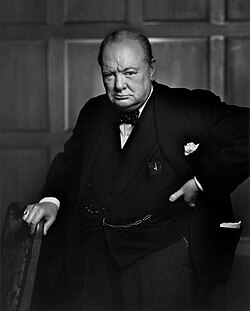
Prime Minister Winston Churchill crossed the Atlantic aboard Queen Mary several times during the war, reportedly stating that the ship helped shorten the war by a year.
Image source: Winston Churchill
Jul 1943
% complete
Queen Mary carried up to about 16,000 troops per crossing during the buildup for D-Day; Winston Churchill credited her with shortening the war by transporting soldiers so rapidly.
Sep 1945
% complete
After the war, Queen Mary carried thousands of American war brides and their children to the United States, and ferried returning servicemen home across the Atlantic.
Image source: War bride
1963
% complete
Facing mounting losses, Cunard began planning the retirement of Queen Mary, considering offers from cities around the world to preserve the legendary liner.
1967
% complete
After bids from multiple cities, Long Beach, California purchased Queen Mary for preservation as a hotel and museum, outbidding rivals including New York and Tokyo.
Oct 27, 1967
% complete
Queen Mary completed her last transatlantic crossing from Southampton to New York, concluding more than three decades of scheduled liner service.
Nov 9, 1967 - Dec 9, 1967
% complete
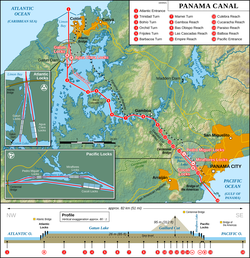
Queen Mary departed New York on her final voyage, passing through the Panama Canal — which required partial dredging to accommodate her beam — and arriving at Long Beach to a hero's welcome.
Image source: Panama Canal
1971
% complete
After conversion, Queen Mary opened permanently berthed at Long Beach as a floating hotel, restaurant, and maritime museum, welcoming visitors from around the world.
Image source: Queen Mary Land
1983
% complete
Howard Hughes' enormous Spruce Goose flying boat was displayed beside Queen Mary in a geodesic dome until it was relocated in the early 1990s.
Image source: Hughes H-4 Hercules
1993
% complete
The historic liner received recognition on the National Register of Historic Places, cementing her status as an important piece of American and maritime heritage.
2015
% complete
Facing structural deterioration, the city of Long Beach undertook extensive critical repairs and long-term restoration projects to preserve Queen Mary for future generations.
Or browse the full history timeline directory, with more than 2,000 topics.
This RMS Queen Mary timeline was generated with the help of AI, using information found on the internet.
We work hard to keep these timelines accurate, but mistakes do get through. If you spot one, email us at [email protected] and we'll fix it for future visitors.
Generate yours with AI or build it from scratch, for free.
Export your timeline, add your own events, edit or remove AI-generated events, and much more
No credit card required.
Cancel anytime.
Cancel anytime.
You can create an unlimited number of timelines with up to 10 events on each one, customize how they look, export them to PDF, PNG, PowerPoint, CSV, and Excel, and share them with a link. Paid plans raise the event limit and add features like spreadsheet imports and collaborators.
Yes. You can cancel your subscription from your account page at any time, and you will not be charged again. Your subscription stays active for the rest of the period you already paid for.
Yes. We will email you a reminder before the annual renewal, and we will also email you a receipt.
Yes. You can email us within 15 days of any payment, and we will issue you a full refund.
Check out our pricing docs or send us an email anytime: [email protected].