-
Use Cases
-
Resources
-
Pricing
Mary Wollstonecraft (1759–1797) was an English writer, philosopher, and advocate for women's rights, best known for her groundbreaking work A Vindication of the Rights of Woman (1792), which argued for educational equality between men and women. Her life included work as a governess, a career as a writer in London, relationships with Gilbert Imlay and William Godwin, and motherhood—her daughter Mary Shelley later wrote Frankenstein. More Less
Apr 27, 1759
% complete
Mary Wollstonecraft was born on April 27, 1759, in Spitalfields, London, the second of seven children of Edward John Wollstonecraft and Elizabeth Dixon. Her father squandered much of the family fortune, and Mary's childhood was marked by financial instability and her protective role over her mother and sisters.
Image source: Mary Wollstonecraft
1765
% complete
The Wollstonecraft family moved to a farm near Beverley, Yorkshire, where Mary spent several years of her youth. She later recalled this period fondly, and it was here she began a lifelong friendship with Jane Arden, through whom she developed an early love of learning and intellectual debate.
Image source: Beverley
1778
% complete
After a series of unsuccessful attempts to establish himself as a gentleman farmer, Edward Wollstonecraft moved his family to Laugharne, Wales. The family's declining fortunes deepened Mary's determination to become financially independent.
Image source: Laugharne
1782
% complete
Elizabeth Wollstonecraft died around 1781–82 after prolonged illness that Mary had nursed her through. Afterward, Mary left the family home to live with her close friend Fanny Blood and her family, having grown disillusioned with her own household.
Sep 10, 1797
% complete
Eleven days after giving birth, Mary Wollstonecraft died on September 10, 1797, of septicemia likely caused by the retained placenta. She was buried at St Pancras Old Church. Godwin was devastated, telling a friend he could not bear to think of the future without her.
Image source: Fanny Imlay
1778 - 1780
% complete
Wary of domestic servitude and marriage as her only options, Mary took a position as a lady's attendant to Sarah Dawson in Bath. She found the work frustrating but gained exposure to fashionable society before returning home to nurse her dying mother in 1780–81.
Image source: Bath, Somerset
Oct 1784
% complete
Mary, her sister Eliza, and friend Fanny Blood established a boarding school for girls at Newington Green, then a village outside London known for its Dissenting community. There Mary met Richard Price and other rational dissenters whose liberal politics profoundly shaped her thinking.
Image source: Newington Green
1787
% complete
Wollstonecraft's first published work, 'Thoughts on the Education of Daughters', appeared in 1787. A collection of essays on female education and conduct, it argued for women's intellectual development and marked her emergence as a professional author.
Image source: Thoughts on the Education of Daughters
1787
% complete
After the school failed, publisher Joseph Johnson hired Wollstonecraft, finding her work as translator, adviser, and reviewer for his periodical the 'Analytical Review'. Through Johnson's celebrated dinner parties she befriended Thomas Paine, William Godwin, and other leading radicals.
Image source: Joseph Johnson (publisher)
1788
% complete
Her only completed novel published in her lifetime, 'Mary: A Fiction' drew heavily on her own experiences, including her friendship with Fanny Blood. It explored women's constrained social position and their search for genuine emotional connection.
Image source: Mary: A Fiction
1788
% complete
'Original Stories from Real Life' was a children's book promoting rational education over rote memorization. William Blake illustrated its second edition in 1791, cementing its place in children's literature history.
Image source: Original Stories from Real Life
Nov 1790
% complete
Responding swiftly to Edmund Burke's 'Reflections on the Revolution in France', Wollstonecraft published 'A Vindication of the Rights of Men' within weeks — one of the first replies in the pamphlet war. It defended republicanism and equal rights, launching her public fame.
Image source: A Vindication of the Rights of Men
Jan 1792
% complete
Her landmark feminist treatise argued that women appear inferior only because they lack education, urging that they be treated as rational beings deserving of the same educational opportunities as men. It became a foundational text of feminist philosophy and made Wollstonecraft internationally famous.
Image source: A Vindication of the Rights of Woman
Dec 1792
% complete
Wollstonecraft traveled to revolutionary France in December 1792, arriving just weeks after the execution of Louis XVI had been decided. She witnessed the Terror firsthand, observing both the revolution's ideals and its violence, which tempered some of her earlier optimism.
Image source: French Revolution
Sep 1794
% complete
Drawing on her direct experience of events in France, Wollstonecraft published this ambitious historical analysis of the Revolution's early years, defending its principles while condemning its descent into violence during the Reign of Terror.
Image source: Marie Antoinette
Jan 1796
% complete
Based on her Scandinavian travels, these personal travel letters blended reflection on society, nature, and her own emotional turmoil. They became her most popular book during her lifetime and deeply influenced Romantic writers, including William Godwin.
Image source: Letters Written in Sweden, Norway, and Denmark
1796 - 1797
% complete
During her pregnancy Wollstonecraft worked on several projects, including the unfinished novel 'Maria: or, The Wrongs of Woman' and 'Letters on the Management of Infants', drawing on her experience raising Fanny and reflecting her enduring commitment to women's rights.
Image source: Maria: or, The Wrongs of Woman
Nov 1785
% complete
Mary traveled to Lisbon to care for her dear friend Fanny Blood, who died shortly after giving birth in November 1785. Fanny's death devastated Mary and inspired her first novel, 'Mary: A Fiction' (1788), while the school collapsed in her absence.
Image source: Fanny Blood
1793
% complete
In Paris, Wollstonecraft met American entrepreneur and adventurer Gilbert Imlay. They began a relationship; because Britain and revolutionary France were at war, Imlay registered her as his wife at the American embassy to protect her, though they never actually married.
May 14, 1794
% complete
Wollstonecraft gave birth to her first daughter, Frances (Fanny) Imlay, in Le Havre. She delighted in motherhood, writing affectionately about her daughter, even amid growing strain in her relationship with Imlay.
1795
% complete
Imlay grew distant and eventually left Wollstonecraft for other women, leaving her emotionally shattered. In May 1795 she attempted suicide by taking laudanum, but Imlay saved her life. A business trip to Scandinavia undertaken on his behalf further strained the relationship.
Oct 1795
% complete
Despairing over Imlay's abandonment, Wollstonecraft attempted suicide by jumping from Putney Bridge into the Thames, but was rescued by passing watermen. She wrote to Imlay about her despair, articulating feelings of being denied a place in a world built for men.
Image source: Putney Bridge
Apr 1796
% complete
After reading 'Letters Written in Sweden, Norway, and Denmark', Godwin fell in love with its author. Their courtship began slowly in 1796, evolving from intellectual friendship into a passionate romance conducted partly through letters while they maintained separate residences to preserve independence.
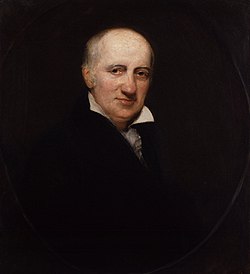
Image source: William Godwin
Mar 29, 1797
% complete
Discovering she was pregnant, Wollstonecraft married Godwin at St Pancras Old Church on March 29, 1797. The marriage revealed she had never been married to Imlay, scandalizing some friends. The couple continued to live in adjoining houses to maintain their independence.
Aug 30, 1797
% complete
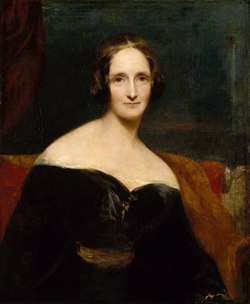
Wollstonecraft gave birth to her second daughter, Mary Wollstonecraft Godwin, who would grow up to write 'Frankenstein'. Though the birth initially seemed normal, complications from the delivery set in, and part of the placenta had to be removed by hand.
Image source: Mary Shelley
1798
% complete
Godwin edited and published his wife's unfinished works in four volumes in 1798, including 'Maria: or, The Wrongs of Woman', her fictional continuation of the arguments of 'A Vindication of the Rights of Woman', and her letters to Imlay.
1798
% complete
Intending to honor her candid character, Godwin's frank memoir revealed Wollstonecraft's affairs, illegitimate child, and suicide attempts. Instead, it provoked outrage, damaging her reputation for nearly a century and overshadowing her achievements.
Image source: A Vindication of the Rights of Woman
1800 - 1890
% complete
For most of the 19th century, Wollstonecraft was remembered more for her unconventional lifestyle than her writings. Critics and moralists used the details in Godwin's Memoirs to attack her character, discouraging many women readers and writers from acknowledging her influence openly.
1818
% complete
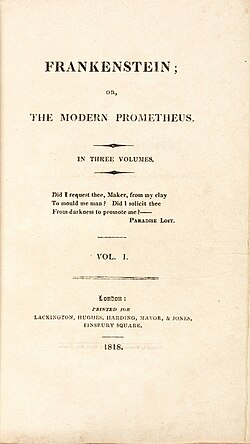
Wollstonecraft's daughter, raised among Godwin's radical circle and influenced by her mother's writings and memory, published 'Frankenstein' in 1818. The novel carries themes of education, responsibility, and sympathy central to Wollstonecraft's philosophy, extending her legacy into Gothic literature.
Image source: Frankenstein
1851
% complete
When St Pancras churchyard was threatened by railway construction, Godwin's remains were moved to Bournemouth, and Wollstonecraft's were reinterred beside him. A memorial stone to both stands in St Pancras Old Church gardens today.
Image source: St Pancras Old Church
1960 - 1970
% complete
With the rise of second-wave feminism in the 1960s and 1970s, scholars rediscovered Wollstonecraft's writings, reclaiming her as a founding figure of feminist thought. 'A Vindication of the Rights of Woman' became widely taught, and her reputation was restored.
Or browse the full history timeline directory, with more than 2,000 topics.
This Mary Wollstonecraft timeline was generated with the help of AI, using information found on the internet.
We work hard to keep these timelines accurate, but mistakes do get through. If you spot one, email us at [email protected] and we'll fix it for future visitors.
Generate yours with AI or build it from scratch, for free.
Export your timeline, add your own events, edit or remove AI-generated events, and much more
No credit card required.
Cancel anytime.
Cancel anytime.
You can create an unlimited number of timelines with up to 10 events on each one, customize how they look, export them to PDF, PNG, PowerPoint, CSV, and Excel, and share them with a link. Paid plans raise the event limit and add features like spreadsheet imports and collaborators.
Yes. You can cancel your subscription from your account page at any time, and you will not be charged again. Your subscription stays active for the rest of the period you already paid for.
Yes. We will email you a reminder before the annual renewal, and we will also email you a receipt.
Yes. You can email us within 15 days of any payment, and we will issue you a full refund.
Check out our pricing docs or send us an email anytime: [email protected].