-
Use Cases
-
Resources
-
Pricing
Robert the Bruce (1274–1329) was King of Scotland from 1306 until his death. A key figure in the First War of Scottish Independence against England, he famously defeated Edward II at the Battle of Bannockburn in 1314 and secured Scotland's sovereignty, later recognized in the Declaration of Arbroath. More Less
Jul 11, 1274
% complete
Robert the Bruce was born on July 11, 1274, likely at Turnberry Castle in Ayrshire, Scotland. He was born into a noble family with strong claims to the Scottish throne through his descent from David I of Scotland. His grandfather, Robert de Brus, 5th Lord of Annandale, had been one of the claimants during the succession crisis known as the Great Cause in the early 1290s.
Image source: Robert the Bruce
Nov 30, 1286
% complete
Following the death of King Alexander III of Scotland in 1286, Scotland entered a succession crisis as his only heir, Margaret, Maid of Norway, was a young child. After Margaret's death in 1290, multiple noble families claimed the throne, including the Bruces and the Balliols, prompting Edward I of England to arbitrate the dispute in what became known as the Great Cause.
Image source: Competitors for the Crown of Scotland
Nov 30, 1292
% complete
Edward I of England judged John Balliol to have the strongest hereditary claim to the Scottish throne, and he was crowned King of Scots on November 30, 1292, at Scone. The decision disappointed the Bruce family, who believed their claim was superior. Balliol's reign was dominated by English overlordship, fueling resentment among Scottish nobles including the Bruces.
Image source: John Balliol
Feb 10, 1306
% complete
On February 10, 1306, Robert the Bruce met John Comyn, his chief rival for the throne, at Greyfriars Kirk in Dumfries. An argument erupted, and Bruce stabbed Comyn, killing him or having him killed. This dramatic act removed his main competitor for the crown but placed Bruce in conflict with the powerful Comyn family and forced him to commit fully to rebellion against England.
Image source: John Comyn III of Badenoch
Mar 30, 1296
% complete
Tensions between Scotland and England erupted into war when Edward I invaded Scotland in March 1296, sacking Berwick-upon-Tweed. The Scottish defeat at the Battle of Dunbar in April led to John Balliol's abdication, and Edward declared himself King of Scotland, stripping the kingdom of its independence. This marked the start of decades of warfare for Scottish sovereignty.
Image source: First War of Scottish Independence
May 1, 1297
% complete
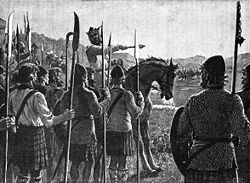
In 1297, William Wallace sparked a rebellion against English rule in Scotland. Robert the Bruce, despite earlier service to Edward I, joined the uprising that year alongside other Scottish nobles, though he later submitted to Edward temporarily before rejoining the resistance. Wallace's revolt galvanized Scottish resistance to occupation.
Image source: William Wallace
Sep 11, 1297
% complete
William Wallace and Andrew Moray led Scottish forces to a stunning victory over an English army at Stirling Bridge on September 11, 1297. The Scots exploited the narrow bridge to trap and destroy the English vanguard. The victory established Wallace as Guardian of Scotland, though Robert the Bruce did not participate directly in this engagement.
Image source: Battle of Stirling Bridge
Jul 22, 1298
% complete
Edward I personally led an English army to defeat William Wallace at the Battle of Falkirk on July 22, 1298. The English longbowmen proved devastating against the Scottish schiltrons. Following the defeat, Wallace resigned as Guardian of Scotland, and Robert the Bruce, along with John Comyn, was appointed to share the guardianship of the kingdom.
Image source: Battle of Falkirk
Aug 1, 1298 - 1300
% complete
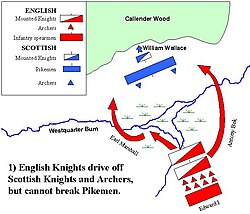
After the defeat at Falkirk, Robert the Bruce and John Comyn were appointed joint Guardians of Scotland, later joined by William Lamberton, Bishop of St Andrews. The arrangement was tense due to rivalry between the Bruce and Comyn factions. Bruce resigned the guardianship around 1300 amid growing friction and renewed his fealty to Edward I for a time.
Image source: Guardian of Scotland
Aug 3, 1305
% complete
William Wallace was captured near Glasgow in August 1305 after being betrayed by Sir John de Menteith. He was handed over to Edward I and taken to London, where he was executed brutally on August 23, 1305. Wallace's martyrdom became a powerful symbol for the Scottish cause that Robert the Bruce would soon take up.
Jun 19, 1306
% complete
On June 19, 1306, Bruce's newly assembled army was surprised and crushed by English forces under Aymer de Valence at Methven, near Perth. The defeat scattered Bruce's supporters and forced him to flee into the Highlands with a small band of followers, beginning a desperate period of guerrilla warfare and exile.
Image source: Battle of Methven
Aug 5, 1306
% complete
After fleeing westward, Bruce's female relatives were captured by English forces at Kildrummy and Tain in 1306. His brother Nigel was executed, and Isabella MacDuff, who had crowned him, was imprisoned in a cage at Berwick. His wife Elizabeth de Burgh was held captive for years. These harsh punishments hardened the conflict between Bruce and Edward I.
Feb 1, 1307 - May 1, 1307
% complete
In the winter of 1306-1307, Bruce and a small group of followers took refuge on Rathlin Island off the coast of Ireland. According to legend popularized by later writers, this was when Bruce famously observed a spider repeatedly rebuilding its web, inspiring him not to give up despite repeated failures. He returned to Scotland in early 1307 to renew his campaign.
Image source: Rathlin Island
May 10, 1307
% complete
On May 10, 1307, Bruce achieved his first major victory over the English, defeating Aymer de Valence's forces at Loudoun Hill in Ayrshire. Using narrow, boggy terrain to neutralize English cavalry, Bruce proved that disciplined Scottish infantry could beat larger armies. The victory attracted new supporters to his cause.
Image source: Battle of Loudoun Hill
Jul 7, 1307
% complete
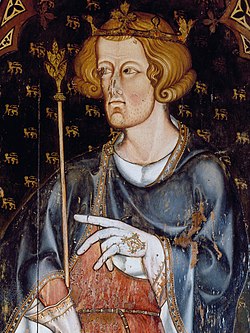
King Edward I, the 'Hammer of the Scots,' died on July 7, 1307, while marching north with an army to crush Bruce's rebellion. His death dramatically changed the course of the war. His son, Edward II, was less capable and less committed to the conquest of Scotland, giving Bruce valuable time to consolidate power.
Image source: Edward I of England
Sep 1, 1307 - 1308
% complete
From late 1307 into 1308, Bruce waged a brutal campaign against the Comyn faction in northern Scotland. He defeated John Comyn, Earl of Buchan, at Inverurie in May 1308, then systematically destroyed Comyn lands in the Harrying of Buchan, eliminating internal opposition to his rule and securing control over most of Scotland north of the Forth.
Jun 23, 1314 - Jun 24, 1314
% complete
Over two days, June 23-24, 1314, Robert the Bruce decisively defeated the much larger English army of Edward II near Stirling. Using schiltrons, terrain, and tactical brilliance, the Scots inflicted a catastrophic defeat on England. The victory secured Scottish independence in practice and made Bruce's kingship unassailable.
Image source: Battle of Bannockburn
1315 - 1322
% complete
Following Bannockburn, Bruce launched devastating chevauchée raids across northern England, reaching as far as Yorkshire and Lancashire. These campaigns pressured the English government, raised funds and supplies, and demonstrated that the initiative in the war now belonged entirely to Scotland. Raids continued intermittently throughout the decade.
May 25, 1315 - Oct 14, 1318
% complete
Robert the Bruce sent his brother Edward Bruce to Ireland in May 1315 with an army intended to open a second front against England. Edward was proclaimed High King of Ireland in 1316, but the campaign ended disastrously when Edward was killed at the Battle of Faughart on October 14, 1318. The expedition drained Scottish resources and devastated Ireland.
Image source: Bruce campaign in Ireland
Apr 2, 1318 - Apr 20, 1318
% complete
In April 1318, Scottish forces captured the strategically vital town of Berwick-upon-Tweed from the English after a short siege. Berwick had been in English hands since 1296, and its recovery was a major symbolic and economic triumph for Bruce, restoring Scotland's most important border trading town.
Image source: Siege of Berwick (1318)
Oct 14, 1322
% complete
On October 14, 1322, Scottish forces routed the English army under Edward II at Old Byland in Yorkshire. Edward himself narrowly escaped capture, and the humiliating defeat forced England toward negotiations. It became clear that reconquest of Scotland was beyond English capability under the current regime.
Image source: Battle of Old Byland
Mar 25, 1306
% complete
Less than six weeks after killing John Comyn, Robert the Bruce was crowned King of Scots at Scone Abbey on March 25, 1306. The ceremony lacked many traditional elements, as the Earl of Fife who normally enthroned kings was absent; Isabella MacDuff, Countess of Buchan, performed the role instead. His coronation defied Edward I and plunged Scotland deeper into war.
1320
% complete
In 1320, a group of Scottish nobles loyal to the Comyn interest plotted to assassinate Bruce and replace him with William Soules. The conspiracy was discovered, and several conspirators were executed or imprisoned. Its suppression consolidated Bruce's authority and eliminated the last significant internal threat to his reign.
Image source: William II de Soules
Apr 6, 1320
% complete
On April 6, 1320, Scottish barons sent a letter to Pope John XXII asserting Scotland's independence and Bruce's legitimacy as king. The Declaration of Arbroath famously declared that the Scots would fight to preserve their freedom 'as long as a hundred of us remain alive.' It became an iconic statement of Scottish nationhood and sovereignty.
Image source: Declaration of Arbroath
Jan 1, 1324
% complete
In 1324, Pope John XXII formally recognized Robert the Bruce as King of Scots, ending the papal interdict and excommunication that had followed his coronation and killing of John Comyn. This diplomatic achievement gave Bruce international legitimacy and opened the way for full recognition from other European powers.
Image source: Pope John XXII
Mar 17, 1328
% complete
The Treaty of Edinburgh-Northampton, concluded on March 17, 1328 (ratified in Edinburgh on April 1), formally recognized Robert the Bruce as King of an independent Scotland and renounced all English claims to overlordship. In exchange, Scotland agreed to pay £20,000. It sealed nearly three decades of warfare and secured lasting peace, though it was unpopular in England.
Nov 24, 1331
% complete
Note: David, Bruce's son, was crowned at Scone on November 24, 1331, after his father's death. During Bruce's own reign, David had been designated heir: born March 5, 1324, he was made heir apparent in 1328, ensuring the continuation of the Bruce dynasty and providing stability for the succession.
Image source: David II of Scotland
Jun 7, 1329
% complete
Robert the Bruce died on June 7, 1329, at his manor of Cardross, likely from an illness long suspected to be leprosy, though modern scholars debate the exact nature of his disease. He had reigned as King of Scots for twenty-three years and successfully transformed a fractured kingdom into an independent nation recognized across Europe.
Nov 5, 1329
% complete
Robert the Bruce was buried at Dunfermline Abbey on November 5, 1329, beneath the high altar among the tombs of Scottish kings. His tomb, completed in the 1340s, featured magnificent carved marble. Excavations in 1819 revealed his skeleton, and his legacy endures as Scotland's greatest national hero and champion of independence.
Image source: Dunfermline Abbey
Aug 1, 1330 - Aug 25, 1330
% complete
Fulfilling Bruce's dying wish, Sir James Douglas set out in 1330 carrying Bruce's embalmed heart to be deposited in the Holy Land. Douglas was killed fighting the Moors at the Battle of Teba in Spain on August 25, 1330, reportedly throwing the heart into battle. The heart was recovered and eventually buried at Melrose Abbey.
Image source: James Douglas, Lord of Douglas
Or browse the full history timeline directory, with more than 2,000 topics.
This Robert the Bruce timeline was generated with the help of AI, using information found on the internet.
We work hard to keep these timelines accurate, but mistakes do get through. If you spot one, email us at [email protected] and we'll fix it for future visitors.
Generate yours with AI or build it from scratch, for free.
Export your timeline, add your own events, edit or remove AI-generated events, and much more
No credit card required.
Cancel anytime.
Cancel anytime.
You can create an unlimited number of timelines with up to 10 events on each one, customize how they look, export them to PDF, PNG, PowerPoint, CSV, and Excel, and share them with a link. Paid plans raise the event limit and add features like spreadsheet imports and collaborators.
Yes. You can cancel your subscription from your account page at any time, and you will not be charged again. Your subscription stays active for the rest of the period you already paid for.
Yes. We will email you a reminder before the annual renewal, and we will also email you a receipt.
Yes. You can email us within 15 days of any payment, and we will issue you a full refund.
Check out our pricing docs or send us an email anytime: [email protected].