-
Use Cases
-
Resources
-
Pricing
Robert E. Lee (1807–1870) was an American military officer best known for commanding the Confederate Army of Northern Virginia during the American Civil War. A graduate of West Point and a distinguished U.S. Army engineer and veteran of the Mexican-American War, Lee declined an offer to lead the Union army and instead served the Confederacy, achieving notable victories at battles such as Fredericksburg and Chancellorsville before surrendering to Ulysses S. Grant at Appomattox Court House in 1865. More Less
Jan 19, 1807
% complete
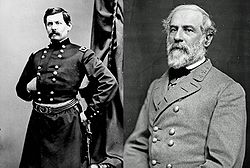
Robert Edward Lee was born at Stratford Hall Plantation in Westmoreland County, Virginia, the son of Revolutionary War hero Henry 'Light-Horse Harry' Lee III and Anne Hill Carter Lee. He grew up in a family of distinguished but financially troubled Virginia gentry.
Image source: Robert E. Lee
Mar 25, 1818
% complete
Henry 'Light-Horse Harry' Lee III, Robert's father and a celebrated cavalry officer of the American Revolution, died on Cumberland Island, Georgia, after injuries sustained in Baltimore. Robert was eleven years old, and his mother raised the family in modest circumstances.
Image source: Henry Lee III
Jul 1, 1825
% complete
Robert E. Lee entered West Point with financial constraints limiting his options. He excelled academically, finished near the top of his class without a single demerit, and developed the disciplined character that would define his military career.
Image source: United States Military Academy
Jul 1, 1829
% complete
Lee graduated second in the Class of 1829, earning a commission as a brevet second lieutenant in the Corps of Engineers. His flawless disciplinary record became legendary among cadets and instructors alike.
Jun 30, 1831
% complete
Lee married Mary Anna Randolph Custis, great-granddaughter of Martha Washington, at Arlington House, the Custis family estate overlooking Washington, D.C. The couple would have seven children, and Arlington became their cherished home.
Image source: Mary Anna Custis Lee
Jan 1, 1830 - Dec 31, 1846
% complete
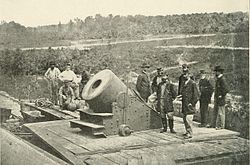
As a U.S. Army engineer, Lee worked on coastal fortifications including Fort Monroe, Fort Pulaski, and Fort Hamilton in New York Harbor. His engineering skill earned him a reputation as one of the army's most capable officers.
Image source: Fort Hamilton
May 1, 1846 - Feb 2, 1848
% complete
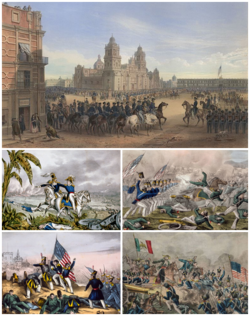
Serving under General Winfield Scott, Lee performed daring reconnaissance missions during the campaign from Veracruz to Mexico City. His bravery at Cerro Gordo, Contreras, Churubusco, and Chapultepec earned three brevet promotions and Scott's lasting admiration.
Image source: Mexican–American War
Sep 1, 1852 - Sep 1, 1855
% complete
Lee served three years as superintendent of the United States Military Academy, overseeing curriculum reforms and supervising cadets who would later become generals on both sides of the Civil War.
Oct 18, 1859
% complete
Summoned from Arlington, Colonel Lee commanded U.S. Marines who stormed the engine house where abolitionist John Brown and his followers had barricaded themselves after their failed raid on the federal arsenal, capturing Brown alive.
Image source: John Brown's raid on Harpers Ferry
Apr 18, 1861
% complete
Offered field command of the Union Army by Abraham Lincoln through Francis Blair, Lee declined, unwilling to raise his sword against his native state. Days later he resigned his U.S. Army commission, writing that he could not take part against Virginia.
Apr 23, 1861
% complete
After Virginia seceded, Lee accepted appointment as commander of the state's military forces. He was later commissioned a general in the Confederate Army and given broad responsibility for southern coastal defenses.
Image source: Army of Northern Virginia
May 24, 1861
% complete
Federal troops crossed into Virginia and seized Lee's home at Arlington, which sat directly across the Potomac from Washington. The estate was later used for a military cemetery, now Arlington National Cemetery.
Image source: Arlington House, The Robert E. Lee Memorial
Sep 12, 1861 - Sep 15, 1861
% complete
Lee's first field command of the war in western Virginia ended in disappointment when his cautious plan against Union positions failed. Critics mockingly nicknamed him 'Granny Lee,' though he retained the confidence of Confederate President Jefferson Davis.
Image source: Battle of Cheat Mountain
Nov 1, 1861 - Mar 1, 1862
% complete
Assigned to organize defenses along the southern Atlantic coast, Lee strengthened fortifications around Charleston and Savannah. Though unable to prevent Federal advances, his engineering preparations delayed Union operations along the coast.
Mar 13, 1862
% complete
Recalled to Richmond, Lee served as military advisor to Jefferson Davis, helping coordinate Confederate strategy during the early Peninsula Campaign crisis as George McClellan's Union army advanced toward the capital.
Image source: Jefferson Davis
Jun 1, 1862
% complete
After General Joseph E. Johnston was wounded at Seven Pines, Lee assumed command of the Army of Northern Virginia, beginning the period of leadership that would make him the Confederacy's most famous general.
Jun 25, 1862 - Jul 1, 1862
% complete
In his first major offensive, Lee aggressively attacked McClellan's Army of the Potomac in a series of battles near Richmond. Despite heavy casualties and tactical shortcomings, Lee forced the Union army to retreat, saving the Confederate capital.
Image source: Seven Days Battles
Aug 28, 1862 - Aug 30, 1862
% complete
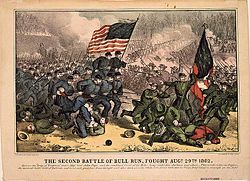
Lee and Stonewall Jackson decisively defeated John Pope's Army of Virginia on the same ground as the war's first major battle. The victory cleared northern Virginia of Union forces and opened the way for Lee's first invasion of the North.
Image source: Second Battle of Bull Run
Sep 17, 1862
% complete
At Sharpsburg, Maryland, Lee's divided army narrowly survived McClellan's assaults in the bloodiest single day of American history, with over 22,000 casualties. Lee retreated across the Potomac, ending his first invasion of Union territory.
Image source: Battle of Antietam
Dec 11, 1862 - Dec 15, 1862
% complete
Lee's army inflicted a crushing defeat on Ambrose Burnside's Union forces, who launched futile frontal assaults against entrenched Confederates on Marye's Heights. Observing the carnage, Lee famously remarked, 'It is well that war is so terrible.'
Image source: Battle of Fredericksburg
Apr 30, 1863 - May 6, 1863
% complete
Lee achieved what many consider his masterpiece, defeating Joseph Hooker's larger army through audacious flanking maneuvers. The victory came at terrible cost: Stonewall Jackson was mortally wounded by friendly fire, depriving Lee of his most trusted lieutenant.
Image source: Battle of Chancellorsville
Jul 1, 1863 - Jul 3, 1863
% complete
Lee's second invasion of the North culminated in a catastrophic defeat at Gettysburg, Pennsylvania. The failure of Pickett's Charge on the third day broke the attack, and Lee's army retreated to Virginia, never again mounting a major offensive in the North.
Image source: Battle of Gettysburg
May 4, 1864 - Jun 24, 1864
% complete
Grant launched a relentless series of offensives against Lee's army, fighting brutal battles at the Wilderness, Spotsylvania Court House, and Cold Harbor. Though Lee inflicted enormous casualties, Grant continued pressing southward toward Richmond and Petersburg.
Image source: Overland Campaign
Jun 9, 1864 - Apr 2, 1865
% complete
Lee's army endured a grueling nine-month siege at Petersburg, defending the supply lines to Richmond through trench warfare that foreshadowed World War I. The siege steadily drained Confederate manpower and resources.
Image source: Siege of Petersburg
Feb 6, 1865
% complete
The Confederate Congress created the rank of General-in-Chief, and Lee was appointed to command all Southern armies. By then the Confederacy was collapsing, with Sherman marching through the Carolinas and Grant tightening the noose at Petersburg.
Image source: General in Chief of the Armies of the Confederate States
Apr 2, 1865 - Apr 3, 1865
% complete
Grant's final assault broke Lee's lines at Petersburg, forcing the evacuation of both Petersburg and Richmond. Lee attempted to retreat westward, hoping to join forces with Joseph Johnston's army in North Carolina.
Image source: Third Battle of Petersburg
Apr 9, 1865
% complete
Cut off and surrounded, Lee surrendered the Army of Northern Virginia to Grant at Appomattox Court House, Virginia. Grant's generous terms allowed Confederate soldiers to return home, and the surrender effectively marked the end of the Civil War.
Image source: Battle of Appomattox Court House
Oct 2, 1865
% complete
Accepting the presidency of struggling Washington College in Lexington, Virginia, Lee devoted his final years to education, modernizing the curriculum and adding programs in business, journalism, and engineering. The school was renamed Washington and Lee University after his death.
Image source: Washington and Lee University
Oct 12, 1870
% complete
Lee suffered a stroke and died two weeks later at age 63 in Lexington. He was buried beneath Lee Chapel at Washington College, mourned throughout the South as the Confederacy's preeminent soldier.
Jan 1, 1880 - Dec 31, 1920
% complete
In the decades after his death, writers of the Lost Cause movement portrayed Lee as a nearly saintly figure whose nobility transcended the Confederacy's defeat. Monuments were erected across the South, and his image became central to contested debates over memory and heritage.
Image source: Lost Cause of the Confederacy
Or browse the full history timeline directory, with more than 2,000 topics.
This Robert E. Lee timeline was generated with the help of AI, using information found on the internet.
We work hard to keep these timelines accurate, but mistakes do get through. If you spot one, email us at [email protected] and we'll fix it for future visitors.
Generate yours with AI or build it from scratch, for free.
Export your timeline, add your own events, edit or remove AI-generated events, and much more
No credit card required.
Cancel anytime.
Cancel anytime.
You can create an unlimited number of timelines with up to 10 events on each one, customize how they look, export them to PDF, PNG, PowerPoint, CSV, and Excel, and share them with a link. Paid plans raise the event limit and add features like spreadsheet imports and collaborators.
Yes. You can cancel your subscription from your account page at any time, and you will not be charged again. Your subscription stays active for the rest of the period you already paid for.
Yes. We will email you a reminder before the annual renewal, and we will also email you a receipt.
Yes. You can email us within 15 days of any payment, and we will issue you a full refund.
Check out our pricing docs or send us an email anytime: [email protected].