
-
Use Cases
-
Resources
-
Pricing
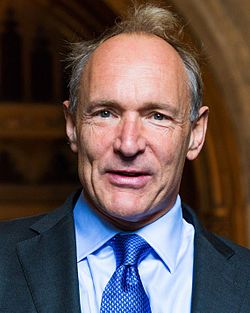
Tim Berners-Lee is a British computer scientist best known as the inventor of the World Wide Web. In 1989, while working at CERN, he proposed a system for sharing information over the internet using hypertext, which became the foundation of the modern Web. He founded the World Wide Web Consortium (W3C), has advocated for an open and accessible internet, and continues to work on web standards and data privacy initiatives. More Less
Jun 8, 1955
% complete
Timothy John Berners-Lee was born in London on 8 June 1955, the son of mathematicians and computer scientists Mary Lee Berners-Lee and Conway Berners-Lee.
Image source: Tim Berners-Lee
1969 - 1973
% complete
Berners-Lee attended Sheen Mount Primary School, then Emanuel School, a direct grant grammar school at the time, from 1969 to 1973.
1976
% complete
In 1976, Berners-Lee took a first in physics from The Queen's College, Oxford.
1976
% complete
Following final exams in Oxford, he married Jane Northcote, daughter of Cambridge biologist Don Northcote, in 1976. They moved to Poole to work at Plessey.
1978
% complete
In 1978, Berners-Lee joined D., continuing his early career in computing before his time at CERN.
Jun 1980 - Dec 1980
% complete
Berners-Lee worked as an independent contractor at CERN from June to December 1980, moving there with his wife for a six-month contract. After leaving in late 1980, he went to work at John Poole's Image Computer Systems, Ltd, in Bournemouth, Dorset.
1990
% complete
In 1990, Berners-Lee married Nancy Carlson, an American computer programmer. They had two children and divorced in 2011.
2014
% complete
In 2014, Berners-Lee married Rosemary Leith at the Chapel Royal, St James's Palace.
1984
% complete
In 1984, Berners-Lee returned to CERN as a fellow, setting the stage for his work on information management systems.
Mar 12, 1989
% complete
On 12 March 1989, Berners-Lee proposed an information management system that would become the World Wide Web. He wrote his proposal in March 1989 and redistributed it in 1990.
Nov 1989
% complete
In mid-November 1989, Berners-Lee implemented the first successful communication between a Hypertext Transfer Protocol (HTTP) client and server via the Internet.
Dec 20, 1990
% complete
Berners-Lee published the first website, which described the World Wide Web project itself, on 20 December 1990; it was available to the Internet from the CERN network.
Aug 6, 1991
% complete
On 6 August 1991, Berners-Lee first posted, on Usenet, a public invitation for collaboration with the WorldWideWeb project, spreading the Web beyond CERN.
1994
% complete
In 1994, Berners-Lee founded the World Wide Web Consortium (W3C) at the Massachusetts Institute of Technology, establishing standards for the evolution of the Web.
Image source: World Wide Web Consortium
Sep 22, 1999
% complete
In 1999, Berners-Lee, with Mark Fischetti, published his account of the invention of the Web, documenting the ideas and decisions behind it.
Image source: Weaving the Web
2001
% complete
In 2001, Berners-Lee became a patron of the East Dorset Heritage Trust, having previously lived in Colehill in Wimborne, East Dorset.
2004
% complete
In 2004, he accepted a chair in computer science at the School of Electronics and Computer Science, University of Southampton, Hampshire, to work on the Semantic Web.
Image source: University of Southampton
Oct 2009
% complete
In a Times article in October 2009, Berners-Lee admitted that the initial pair of slashes ('//') in a web address were 'unnecessary'.
Image source: URL
Nov 2009
% complete
In November 2009, Berners-Lee launched the World Wide Web Foundation (WWWF) to advance the open Web as a means of building a free and fair society.
Image source: World Wide Web Foundation
2010
% complete
By 2010, Berners-Lee created data.gov.uk alongside Nigel Shadbolt, opening up UK government data for public reuse.
2011
% complete
In 2011, Berners-Lee was named a member of the board of trustees of the Ford Foundation.
May 2012
% complete
As of May 2012, Berners-Lee is president of the Open Data Institute, which he and Nigel Shadbolt co-founded in 2012.
Image source: Open Data Institute
2013
% complete
The Alliance for Affordable Internet (A4AI) was launched in 2013, led by Berners-Lee, uniting organisations including Google, Facebook, Intel and Microsoft to make Internet access more affordable in the developing world, where only 31% of people were online in 2013.
2016
% complete
In 2016, he joined the Department of Computer Science at Oxford University as a professorial research fellow and as a fellow of Christ Church college. In the same year, a panel of eminent figures ranked the invention of the World Wide Web number one in a list of 80 cultural moments that shaped the world.
Image source: University of Oxford
Mar 2017
% complete
In March 2017, as W3C director, Berners-Lee felt he had to take a position supporting the Encrypted Media Extensions (EME) proposal. A campaign against it did not succeed, and he approved the finalised specification in July 2017; it became a formal W3C recommendation in September 2017.
Dec 14, 2017
% complete
Berners-Lee and 20 other Internet pioneers urged the FCC to cancel its vote on 14 December 2017 to roll back net neutrality rules.
Image source: Net neutrality in the United States
Sep 30, 2018
% complete
On 30 September 2018, Berners-Lee announced his open-source startup Inrupt to fuel a commercial ecosystem around the Solid project, which aims to give users more control over their personal data and let them choose where data goes and who can see it.
Image source: Solid (web decentralization project)
Nov 2019
% complete
In November 2019, at the Internet Governance Forum in Berlin, Berners-Lee and the WWWF launched Contract for the Web, urging governments, companies and citizens to commit to nine principles to stop misuse of the web, warning that failing to act together risked squandering its potential for good.
Image source: Contract for the Web
2021
% complete
Since 2021, Berners-Lee has been an advisory board member of the Proton Foundation.
Image source: Proton AG
Jun 23, 2021 - Jun 30, 2021
% complete
The web's source code was auctioned by Sotheby's in London during 23–30 June 2021, as a non-fungible token (NFT) released by Berners-Lee.
Image source: Non-fungible token
Sep 9, 2025
% complete
In 2025, Berners-Lee published a memoir, This Is for Everyone, with ghostwriter Stephen Witt, using the phrase as the title for his book on the history of the Internet.
Image source: This Is for Everyone
Nov 2025
% complete
In November 2025, Berners-Lee was the guest on BBC Radio 4's Desert Island Discs.
1999
% complete
Berners-Lee was named in Time magazine's list of the 100 Most Important People of the 20th century and has received numerous other accolades for his invention.
Image source: Time 100
2001
% complete
He was elected a Fellow of the Royal Society (FRS) in 2001, recognizing his contributions to science.
Image source: Fellow of the Royal Society
Jan 1, 2004
% complete
Berners-Lee was knighted by Queen Elizabeth II in the 2004 New Year Honours 'for services to the global development of the Internet', and was invested formally on 16 July 2004.
Image source: Knight Bachelor
2004
% complete
In 2004, he was also elected as a member into the American Philosophical Society.
Image source: American Philosophical Society
2007
% complete
In 2007, he was elected as a member into the National Academy of Engineering.
Jun 13, 2007
% complete
On 13 June 2007, he was appointed to the Order of Merit (OM), an order restricted to 24 living members, plus any honorary members.
Image source: Order of Merit
2009
% complete
In 2009, Berners-Lee was elected Foreign Associate of the National Academy of Sciences.
Image source: National Academy of Sciences
2012
% complete
In 2012, Berners-Lee was among the British cultural icons selected by artist Sir Peter Blake for a new version of his most famous artwork, and was honoured as the 'Inventor of the World Wide Web' during the 2012 Summer Olympics opening ceremony, appearing working with a vintage NeXT Computer.
Image source: Sgt. Pepper's Lonely Hearts Club Band
2013
% complete
In 2013, Berners-Lee was awarded the inaugural Queen Elizabeth Prize for Engineering for his innovation in engineering.
Image source: Queen Elizabeth Prize for Engineering
Apr 4, 2017
% complete
On 4 April 2017, Berners-Lee received the 2016 Association for Computing Machinery's Turing Award 'for inventing the World Wide Web, the first web browser, and the fundamental protocols and algorithms allowing the Web to scale'.
Image source: Turing Award
Or browse the full history timeline directory, with more than 2,000 topics.
This Tim Berners-Lee timeline was generated with the help of AI, using information found on the internet.
We work hard to keep these timelines accurate, but mistakes do get through. If you spot one, email us at [email protected] and we'll fix it for future visitors.
Generate yours with AI or build it from scratch, for free.
Export your timeline, add your own events, edit or remove AI-generated events, and much more
No credit card required.
Cancel anytime.
Cancel anytime.
You can create an unlimited number of timelines with up to 10 events on each one, customize how they look, export them to PDF, PNG, PowerPoint, CSV, and Excel, and share them with a link. Paid plans raise the event limit and add features like spreadsheet imports and collaborators.
Yes. You can cancel your subscription from your account page at any time, and you will not be charged again. Your subscription stays active for the rest of the period you already paid for.
Yes. We will email you a reminder before the annual renewal, and we will also email you a receipt.
Yes. You can email us within 15 days of any payment, and we will issue you a full refund.
Check out our pricing docs or send us an email anytime: [email protected].