-
Use Cases
-
Resources
-
Pricing
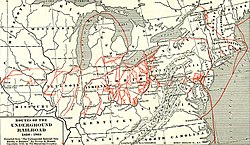
The Underground Railroad was a clandestine network of people, routes, and safe houses that helped enslaved African Americans escape from the Southern United States to free states and Canada during the early-to-mid 19th century. Guided by conductors like Harriet Tubman and supported by abolitionists both Black and white, it became a powerful symbol of resistance against slavery. More Less
Mar 1, 1780
% complete
Pennsylvania became the first state to pass a law gradually abolishing slavery. This created a free state bordering slave states like Maryland and Delaware, making Philadelphia a natural destination for freedom seekers and a hub for early organized resistance to slavery.
Image source: Pennsylvania Abolition Society
Jan 25, 1785
% complete
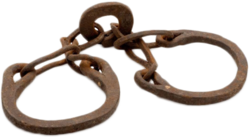
Founded by John Jay, Alexander Hamilton, and others, the New York Manumission Society worked to end slavery in New York and protect free Black residents from kidnapping. It established the African Free School, which educated many future Black abolitionists who would later aid freedom seekers.
Image source: New York Manumission Society
Feb 12, 1793
% complete
Congress passed the first Fugitive Slave Act, allowing slaveholders to capture escaped slaves in any state and requiring citizens to assist or face penalties. The law pushed escapees toward Canada and spurred Northern communities to develop informal networks of protection, an early form of the Underground Railroad.
Image source: Fugitive Slave Act of 1793
Jul 4, 1799 - Jul 4, 1827
% complete
New York began a gradual emancipation process that culminated in full abolition on July 4, 1827. As a large free Black community grew in New York City, it became a critical node in Underground Railroad networks helping fugitives move northward.
Image source: History of slavery in New York (state)
Dec 21, 1816
% complete
The American Colonization Society was founded to resettle free Black Americans in Africa, leading to the creation of Liberia. Many Black abolitionists rejected colonization, insisting instead on fighting for freedom and rights within the United States, energizing the anti-slavery movement.
Image source: American Colonization Society
Mar 3, 1820
% complete
The Missouri Compromise admitted Missouri as a slave state and Maine as a free state while banning slavery north of the 36°30′ line in the Louisiana Territory. The compromise temporarily eased sectional tensions but entrenched the geographic divide that fugitives would have to cross to reach freedom.
Image source: Missouri Compromise
Mar 16, 1827 - Mar 28, 1829
% complete
Samuel Cornish and John Russwurm launched Freedom's Journal in New York City, the first newspaper owned and operated by African Americans. It gave voice to Black abolitionism, reported on kidnappings and fugitive cases, and helped coordinate anti-slavery activism across the North.
Image source: Freedom's Journal
Sep 28, 1829
% complete
Free Black activist David Walker published 'Appeal to the Coloured Citizens of the World' in Boston, calling for enslaved people to resist slavery forcefully. His radical pamphlet circulated widely in the South, terrifying slaveholders and inspiring Black resistance movements.
Image source: David Walker (abolitionist)
Jan 1, 1831 - Dec 29, 1865
% complete
Garrison launched The Liberator in Boston, demanding the immediate abolition of slavery. The paper ran for 35 years, publicized fugitive slave cases, denounced the Fugitive Slave Act, and galvanized a generation of abolitionists who supported Underground Railroad activity.
Image source: The Liberator (newspaper)
Dec 4, 1833
% complete
William Lloyd Garrison and other abolitionists founded the American Anti-Slavery Society in Philadelphia, demanding immediate emancipation. The society's lecturers, including Frederick Douglass, spread anti-slavery sentiment and raised support for aiding fugitive slaves.
Image source: American Anti-Slavery Society
Apr 1, 1840
% complete
Abolitionists formed the Liberty Party and nominated James G. Birney for president, bringing anti-slavery politics into electoral arenas. Though it won few votes, the party kept slavery at the center of national debate and foreshadowed the rise of the Republican Party.
Image source: Liberty Party (United States, 1840)
Aug 8, 1846
% complete
Representative David Wilmot proposed banning slavery from any territory gained in the Mexican-American War. Though repeatedly defeated, the proviso inflamed North-South tensions and made slavery expansion the dominant political issue of the era.
Image source: Wilmot Proviso
Sep 18, 1850
% complete
As part of the Compromise of 1850, Congress passed a far harsher Fugitive Slave Act compelling all citizens to aid in capturing runaways and denying fugitives legal rights. Thousands of freedom seekers fled to Canada, and Northern resistance to slave catchers grew dramatically, radicalizing the abolition movement.
Image source: Compromise of 1850
Mar 20, 1852
% complete
Harriet Beecher Stowe's novel dramatized the cruelty of slavery and the desperation of escape, selling hundreds of thousands of copies. It turned millions of readers against the Fugitive Slave Act and humanized the plight of those fleeing on the Underground Railroad.
Image source: Uncle Tom's Cabin
Mar 6, 1857
% complete
The Supreme Court ruled that enslaved people were not citizens and that Congress could not ban slavery in the territories. The decision shattered hopes of legal solutions, convinced many Northerners that slavery would expand everywhere, and pushed more activists toward direct action, including aiding fugitives.
Image source: Dred Scott v. Sandford
Oct 16, 1859 - Dec 2, 1859
% complete
Brown's small band was quickly surrounded by militia and U.S. Marines under Robert E. Lee. Ten raiders were killed, and Brown was hanged on December 2, 1859. His dignified conduct at trial transformed him into a martyr whose memory inspired Union soldiers and freedom seekers alike.
Image source: John Brown's raid on Harpers Ferry
Oct 16, 1859 - Oct 18, 1859
% complete
Abolitionist John Brown, aided by Harriet Tubman in planning, attempted to seize the federal arsenal at Harpers Ferry, Virginia, to spark a slave insurrection. The raid failed and Brown was executed, but his martyrdom polarized the nation and hastened the coming of civil war.
Nov 6, 1860
% complete
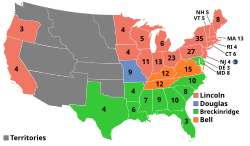
Lincoln's victory on an anti-slavery-expansion platform prompted Southern states to begin seceding within weeks. The collapse of the Union ultimately rendered the Fugitive Slave Act unenforceable in much of the North, and freedom seekers increasingly crossed Union lines during the war.
Image source: 1860 United States presidential election
Aug 30, 1800
% complete
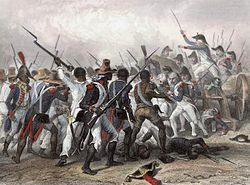
Enslaved blacksmith Gabriel Prosser planned a large armed rebellion near Richmond, Virginia. Though betrayed and suppressed, the plot alarmed white Southerners and demonstrated the growing determination of enslaved people to resist bondage by any means, including flight.
Image source: Gabriel's Rebellion
Jan 1, 1808
% complete
The United States legally banned the international importation of enslaved people. While illegal smuggling continued, the ban made the domestic slave trade more brutal and increased the value of enslaved laborers, intensifying both the desperation of those enslaved and the risks of escape.
Jun 1822
% complete
Free Black carpenter Denmark Vesey allegedly plotted a massive slave uprising in Charleston, South Carolina. Authorities arrested him and dozens of others before the revolt could begin; Vesey was executed. The episode intensified Southern fears and harsher control over enslaved people.
Image source: Denmark Vesey
Aug 21, 1831 - Aug 23, 1831
% complete
Nat Turner led the deadliest slave rebellion in U.S. history in Southampton County, Virginia, killing around 55 people before the uprising was crushed. In retaliation, whites killed scores of Black people, and Southern states tightened laws against educating enslaved people, making organized escape networks even more dangerous but more necessary.
1826
% complete
Quaker Levi Coffin moved to Newport (now Fountain City), Indiana, where his home became known as the 'Grand Central Station' of the Underground Railroad. Over two decades he and his wife Catharine reportedly aided thousands of freedom seekers on their way to Canada.
Image source: Levi Coffin
Sep 3, 1838
% complete
Frederick Douglass escaped from Baltimore by train and boat, reaching New York and then New Bedford, Massachusetts. He became one of the most powerful voices against slavery, publishing his narrative in 1845 and later sheltering hundreds of fugitives at his Rochester, New York home.
Image source: Frederick Douglass
May 1, 1845
% complete
Douglass's autobiography became a bestseller in America and Europe, exposing the brutality of slavery and detailing his own escape. Its success made Douglass famous but forced him to flee to Britain for nearly two years to avoid recapture under the Fugitive Slave Act.
Image source: Narrative of the Life of Frederick Douglass, an American Slave
Sep 17, 1849
% complete
Harriet Tubman fled the Brodess plantation on Maryland's Eastern Shore, traveling roughly 90 miles north to Philadelphia using the Underground Railroad. Determined to free her family, she returned south about 13 times over the next decade, guiding around 70 people to freedom and earning the name 'Moses.'
Image source: Harriet Tubman
1831 - 1840
% complete
During the 1830s, the metaphorical language of the 'Underground Railroad' — with 'stations,' 'conductors,' and 'passengers' — spread among abolitionists. The name may derive from Tice Davids' 1831 escape across the Ohio River, when his pursuer claimed he had vanished as if on an underground road.
Image source: Underground Railroad
Jul 2, 1839 - Mar 9, 1841
% complete
Enslaved Mende people led by Sengbe Pieh seized control of the schooner La Amistad. After landing in Connecticut and a dramatic Supreme Court case championed by abolitionists including John Quincy Adams, the captives were freed in 1841 and returned to Africa, becoming a symbol of resistance.
Image source: La Amistad
Nov 7, 1841
% complete
Enslaved people led by Madison Washington seized the slave ship Creole en route from Virginia to New Orleans and sailed it to Nassau in the British Bahamas, where over 120 gained freedom under British law. The largest successful slave revolt in U.S. maritime history embarrassed American slaveholders.
Image source: Creole mutiny
Sep 11, 1851
% complete
In Lancaster County, Pennsylvania, free Black residents and fugitives resisted Maryland slave catchers attempting to recapture four men; a slaveholder was killed. The incident showed open defiance of the Fugitive Slave Act and became a national sensation after federal treason trials ended in acquittals.
Image source: Christiana Riot
May 24, 1854 - Jun 2, 1854
% complete
Fugitive Anthony Burns was arrested in Boston under the Fugitive Slave Act. Despite a violent rescue attempt by abolitionists and massive protests, he was returned to Virginia under federal guard. Bostonians later purchased his freedom, and the case deepened Northern outrage over the law.
Image source: Anthony Burns
Apr 12, 1861 - Apr 9, 1865
% complete
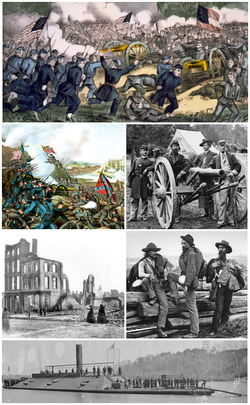
Confederate forces fired on Fort Sumter, beginning the Civil War. As Union armies advanced, enslaved people fled to their lines in vast numbers — a mass self-emancipation that dwarfed the prewar Underground Railroad and forced the government to confront slavery directly.
Image source: American Civil War
May 23, 1861
% complete
When three enslaved men escaped to Union lines at Fortress Monroe, Virginia, General Benjamin Butler declared them 'contraband of war' and refused to return them. The policy opened the door for thousands of freedom seekers to find refuge behind Union lines, effectively turning the army into a new Underground Railroad.
Image source: Contraband (American Civil War)
Jan 1, 1863
% complete
President Lincoln declared enslaved people in rebelling states forever free and authorized their enlistment in the Union Army. The proclamation transformed the war into a war for freedom, giving legal weight to the self-emancipation of those fleeing slavery.
Image source: Emancipation Proclamation
Jun 2, 1863
% complete
Harriet Tubman guided Union gunboats up South Carolina's Combahee River, freeing more than 700 enslaved people in a single night. She became the first woman to lead an armed assault in the Civil War, applying her Underground Railroad skills to military liberation.
Image source: Raid on Combahee Ferry
Jan 31, 1865 - Dec 6, 1865
% complete
Congress passed the Thirteenth Amendment, ratified in December 1865, permanently abolishing slavery throughout the United States. With legal emancipation achieved, the Underground Railroad's mission ended, though its legacy inspired later civil rights struggles.
Image source: Thirteenth Amendment to the United States Constitution
1872
% complete
Philadelphia conductor William Still published detailed records of hundreds of freedom seekers he assisted, based on interviews conducted at his Vigilance Committee office. His book remains one of the most important primary sources on the Underground Railroad.
Image source: William Still
1876
% complete
Levi Coffin published his memoir documenting his work aiding an estimated 3,000 or more freedom seekers. The book preserved firsthand accounts of Underground Railroad operations and shaped how later generations remembered the network.
Image source: Levi Coffin
Aug 23, 2004
% complete
The National Underground Railroad Freedom Center opened on Cincinnati's riverfront, overlooking the Ohio River that separated slavery from freedom. The museum honors the courage of freedom seekers and conductors and connects their legacy to modern fights against human trafficking and oppression.
Image source: National Underground Railroad Freedom Center
Or browse the full history timeline directory, with more than 2,000 topics.
This Underground Railroad timeline was generated with the help of AI, using information found on the internet.
We work hard to keep these timelines accurate, but mistakes do get through. If you spot one, email us at [email protected] and we'll fix it for future visitors.
Generate yours with AI or build it from scratch, for free.
Export your timeline, add your own events, edit or remove AI-generated events, and much more
No credit card required.
Cancel anytime.
Cancel anytime.
You can create an unlimited number of timelines with up to 10 events on each one, customize how they look, export them to PDF, PNG, PowerPoint, CSV, and Excel, and share them with a link. Paid plans raise the event limit and add features like spreadsheet imports and collaborators.
Yes. You can cancel your subscription from your account page at any time, and you will not be charged again. Your subscription stays active for the rest of the period you already paid for.
Yes. We will email you a reminder before the annual renewal, and we will also email you a receipt.
Yes. You can email us within 15 days of any payment, and we will issue you a full refund.
Check out our pricing docs or send us an email anytime: [email protected].