-
Use Cases
-
Resources
-
Pricing
Mar 20, 1852
% complete
Harriet Beecher Stowe's anti-slavery novel became a massive bestseller in the North and enraged the South. It hardened sectional attitudes over slavery, contributing to the polarization that led to secession nearly a decade later.
Image source: Uncle Tom's Cabin
Oct 16, 1859 - Oct 18, 1859
% complete
Abolitionist John Brown attempted to spark a slave uprising by seizing the federal arsenal at Harpers Ferry, Virginia. His capture, trial, and execution made him a martyr in the North and deepened Southern fears of abolitionist violence, accelerating secession sentiment.
Image source: John Brown's raid on Harpers Ferry
Nov 6, 1860
% complete
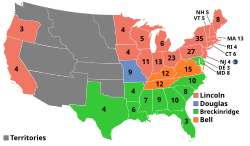
Republican Abraham Lincoln won the presidency without carrying a single Deep South state. His platform opposing slavery's expansion convinced Southern leaders that their interests were no longer safe within the Union, triggering immediate moves toward secession.
Image source: 1860 United States presidential election
Dec 20, 1860
% complete
Following Lincoln's election, a convention in Charleston voted unanimously for secession. South Carolina's departure set off a chain reaction among the slaveholding states of the Lower South.
Image source: South Carolina in the American Civil War
Jan 9, 1861 - Feb 1, 1861
% complete
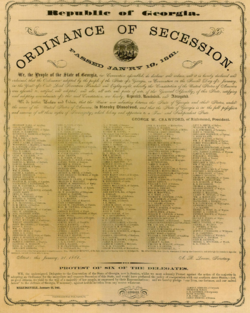
Mississippi (Jan 9), Florida (Jan 10), Alabama (Jan 11), Georgia (Jan 19), Louisiana (Jan 26), and Texas (Feb 1) passed ordinances of secession, dissolving their ties to the United States and moving toward forming a new nation dedicated to protecting slavery.
Image source: Ordinance of Secession
Feb 8, 1861
% complete
Delegates from the seceded states met at Montgomery, Alabama, and adopted a provisional constitution establishing the Confederate States of America, with its government explicitly committed to the protection of chattel slavery.
Image source: Confederate States of America
Apr 17, 1861 - May 20, 1861
% complete
In response to Lincoln's call for troops, Virginia (Apr 17), Arkansas (May 6), North Carolina (May 20), and Tennessee seceded and joined the Confederacy, bringing its population, industry, and most importantly Robert E. Lee into the new nation.
Image source: Virginia in the American Civil War
Mar 6, 1857
% complete
The Supreme Court ruled that enslaved people were not citizens and that Congress could not bar slavery from territories. The decision delighted Southern slaveholders and further inflamed Northern opposition to the expansion of slavery.
Image source: Dred Scott v. Sandford
Feb 9, 1861
% complete
The Montgomery convention selected Jefferson Davis, former U.S. Senator and Secretary of War from Mississippi, as provisional president, with Alexander Stephens of Georgia as vice president. Davis would lead the Confederacy throughout its existence.
Image source: Jefferson Davis
Mar 11, 1861
% complete
The Confederate constitutional convention adopted a permanent constitution closely modeled on the U.S. document but with explicit protections for slavery, stronger states' rights provisions, and restrictions on tariffs and internal improvements.
Image source: Constitution of the Confederate States
May 29, 1861
% complete
The Confederate government relocated from Montgomery to Richmond, Virginia, placing the capital just 100 miles from Washington, D.C. Richmond's industrial capacity, including the Tredegar Iron Works, made it vital to the war effort.
Image source: Richmond, Virginia
Jan 1, 1863
% complete
Lincoln declared all slaves in rebelling areas 'forever free,' transforming the war into a crusade against slavery, opening the door to Black enlistment in the Union army, and effectively foreclosing any negotiated peace preserving slavery.
Image source: Emancipation Proclamation
Jan 31, 1865 - Feb 3, 1865
% complete
Desperate measures marked the Confederacy's final months: Lee was made general-in-chief on January 31, but the February 3 Hampton Roads conference between Davis's envoys and Lincoln collapsed because Lincoln insisted on reunion and emancipation.
Image source: Hampton Roads Conference
Apr 12, 1861 - Apr 13, 1861
% complete
After Lincoln announced plans to resupply the federal garrison at Fort Sumter in Charleston Harbor, Confederate batteries opened fire. The fort surrendered after two days, prompting Lincoln to call up 75,000 volunteers and beginning four years of civil war.
Image source: Battle of Fort Sumter
Apr 19, 1861
% complete
Lincoln proclaimed a naval blockade of Confederate coasts, part of the Anaconda Plan to strangle Southern trade. Over time the blockade crippled the Confederate economy, cutting off cotton exports and vital imports of weapons and supplies.
Image source: Union blockade
Jul 21, 1861
% complete
Near Manassas Junction, Confederate forces under Beauregard and Joseph Johnston routed Union troops, shattering Northern hopes of a quick war. Thomas Jackson earned the nickname 'Stonewall' for his steadfast defensive stand.
Image source: First Battle of Bull Run
Apr 6, 1862 - Apr 7, 1862
% complete
Confederate forces under Albert Sidney Johnston launched a surprise attack at Pittsburg Landing, Tennessee, but Union reinforcements turned the tide. With roughly 23,000 total casualties, Shiloh revealed the war's staggering human cost; Johnston was killed on the first day.
Image source: Battle of Shiloh
Jun 25, 1862 - Jul 1, 1862
% complete
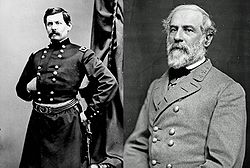
Robert E. Lee, newly commanding the Army of Northern Virginia, aggressively counterattacked George McClellan's Army of the Potomac during the Peninsula Campaign, driving it back from the gates of Richmond and securing the Confederate capital.
Image source: Seven Days Battles
Aug 28, 1862 - Aug 30, 1862
% complete
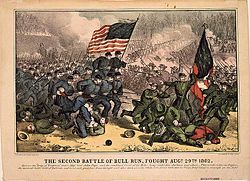
Lee and Stonewall Jackson decisively defeated John Pope's Union army on the same ground as the first battle, clearing the way for Lee's first invasion of the North.
Image source: Second Battle of Bull Run
Sep 17, 1862
% complete
The bloodiest single day in American history, Antietam saw McClellan fight Lee to a tactical standstill near Sharpsburg. Lee retreated to Virginia, giving Lincoln the opportunity to issue the preliminary Emancipation Proclamation and deterring European recognition of the Confederacy.
Image source: Battle of Antietam
Dec 11, 1862 - Dec 15, 1862
% complete
Lee's army inflicted a lopsided defeat on Ambrose Burnside's Union forces, who made futile assaults against entrenched positions on Marye's Heights behind the city of Fredericksburg, Virginia.
Image source: Battle of Fredericksburg
Apr 30, 1863 - May 6, 1863
% complete
Lee achieved his 'perfect battle,' defeating Hooker's larger army through audacious flanking maneuvers, but Stonewall Jackson was mortally wounded by friendly fire, depriving the Confederacy of one of its greatest generals.
Image source: Battle of Chancellorsville
May 18, 1863 - Jul 4, 1863
% complete
Ulysses S. Grant's capture of Vicksburg split the Confederacy along the Mississippi River, fulfilling a key goal of the Anaconda Plan. Combined with Gettysburg the same day, it marked an irreversible turning point against the Confederacy.
Image source: Siege of Vicksburg
Jul 1, 1863 - Jul 3, 1863
% complete
Lee's invasion of Pennsylvania culminated in three days of ferocious fighting ending with the repulse of Pickett's Charge. The Army of Northern Virginia suffered irreplaceable casualties and never again mounted a major offensive into Northern territory.
Image source: Battle of Gettysburg
Sep 19, 1863 - Nov 25, 1863
% complete
Braxton Bragg won the Confederacy's last major Western offensive victory at Chickamauga, but Grant's relief of besieged Chattanooga in November drove Bragg's army back into Georgia, opening the gateway to the Deep South.
Image source: Battle of Chickamauga
May 7, 1864 - Sep 2, 1864
% complete
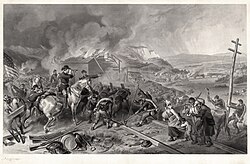
William Tecumseh Sherman's relentless campaign captured Atlanta, a crucial rail hub and industrial center. The fall of the city devastated Southern morale, bolstered Lincoln's reelection prospects, and set the stage for Sherman's March to the Sea.
Image source: Atlanta campaign
Nov 15, 1864 - Dec 21, 1864
% complete
Sherman led 62,000 troops on a scorched-earth march from Atlanta to Savannah, destroying railroads, crops, and infrastructure. The campaign demonstrated the impotence of Confederate forces in the interior and broke the South's remaining economic capacity to resist.
Image source: Sherman's March to the Sea
Apr 2, 1865 - Apr 3, 1865
% complete
Grant's breakthrough at Petersburg forced Lee to abandon Richmond and Petersburg. The Confederate government fled south, and Union troops occupied the burning capital on April 3, signaling the imminent end of the Confederacy.
Image source: Third Battle of Petersburg
Apr 9, 1865
% complete
Cut off and surrounded, Lee surrendered the Army of Northern Virginia to Grant. Grant's generous terms allowed paroled soldiers to return home, and the surrender effectively ended organized Confederate resistance, though other armies held out briefly.
Image source: Battle of Appomattox Court House
Apr 26, 1865
% complete
The largest remaining Confederate force, Johnston's army in North Carolina, capitulated to Sherman near Durham Station following the news of Lee's surrender and Lincoln's assassination.
Image source: Battle of Bentonville
May 10, 1865
% complete
Fleeing toward hoped-for escape abroad, President Jefferson Davis was captured by Union cavalry at Irwinville, Georgia. His imprisonment ended any prospect of a government-in-exile and symbolized the definitive collapse of the Confederate state.
May 26, 1865 - Jun 23, 1865
% complete
General Kirby Smith signed the surrender of the Trans-Mississippi Department on May 26, and the final land force under Cherokee leader Stand Watie surrendered June 23, formally extinguishing all Confederate military resistance.
Image source: Edmund Kirby Smith
Or browse the full history timeline directory, with more than 2,000 topics.
This Confederate States of America timeline was generated with the help of AI, using information found on the internet.
We work hard to keep these timelines accurate, but mistakes do get through. If you spot one, email us at [email protected] and we'll fix it for future visitors.
Generate yours with AI or build it from scratch, for free.
Export your timeline, add your own events, edit or remove AI-generated events, and much more
No credit card required.
Cancel anytime.
Cancel anytime.
You can create an unlimited number of timelines with up to 10 events on each one, customize how they look, export them to PDF, PNG, PowerPoint, CSV, and Excel, and share them with a link. Paid plans raise the event limit and add features like spreadsheet imports and collaborators.
Yes. You can cancel your subscription from your account page at any time, and you will not be charged again. Your subscription stays active for the rest of the period you already paid for.
Yes. We will email you a reminder before the annual renewal, and we will also email you a receipt.
Yes. You can email us within 15 days of any payment, and we will issue you a full refund.
Check out our pricing docs or send us an email anytime: [email protected].