-
Use Cases
-
Resources
-
Pricing
The Warring States Period was an era in ancient China marked by intense warfare among seven major states—Qin, Chu, Qi, Yan, Han, Zhao, and Wei—following the decline of the Zhou dynasty. Despite the conflict, it was also a time of remarkable intellectual, technological, and administrative innovation, including the Hundred Schools of Thought, culminating in Qin Shi Huang's unification of China in 221 BCE. More Less
479 BC
% complete
The death of Confucius marked the end of the Spring and Autumn period's greatest philosopher. His disciples spread his teachings on ethics, ritual propriety, and good governance, laying foundations that would shape Chinese thought throughout the turbulent centuries to come.
Image source: Confucius
440 BC
% complete
Mozi developed a philosophy emphasizing universal love, meritocracy, frugality, and defensive warfare. Mohism became one of the major schools of thought competing for influence during the Warring States period, challenging Confucian orthodoxy.
Image source: Mozi
422 BC - 396 BC
% complete
Li Kui carried out pioneering legalist reforms in Wei, codifying law in the Canon of Laws, promoting agriculture, and selecting officials by merit. His reforms became a model for later states seeking centralization and strength.
Image source: Li Kui (legalist)
360 BC
% complete
The state of Qi established the Jixia Academy near Linzi, gathering scholars from all schools of thought. It became the intellectual hub of the era, hosting figures like Mencius, Xunzi, and Zhuangzi and fostering the Hundred Schools of Thought.
Image source: Jixia Academy
356 BC
% complete
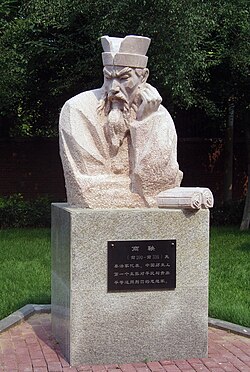
Shang Yang launched sweeping legalist reforms: household registration, collective responsibility, rewards for agricultural production and military merit, and abolition of aristocratic hereditary privilege. These changes created the centralized, militarized state machine behind Qin's rise.
Image source: Shang Yang
351 BC - 337 BC
% complete
As chancellor of Han, Shen Buhai pioneered techniques of administrative control and 'statecraft' centered on bureaucratic accountability. His methods, combined with Shang Yang's laws, formed core strands of later Huang-Lao and Legalist statecraft.
Image source: Shen Buhai
338 BC
% complete
After his patron Duke Xiao died, Shang Yang fell victim to political rivals and was executed by chariot dismemberment. However, King Huiwen retained most of his reforms, ensuring Qin's continued ascent.
330 BC
% complete
The diplomat Su Qin traveled among the six eastern states persuading them to form a vertical alliance against Qin expansion. His diplomacy epitomized the School of Diplomacy strategists who shaped inter-state politics with rhetoric and scheming.
Image source: Su Qin
328 BC - 309 BC
% complete
Serving as Qin chancellor, Zhang Yi countered Su Qin by weaving horizontal alliances that drew individual states into cooperation with Qin. His diplomatic maneuvers systematically broke anti-Qin coalitions and expanded Qin's territory.
Image source: Zhang Yi (Warring States period)
320 BC - 300 BC
% complete
Mencius traveled from court to court advocating benevolent governance and the people-centered Mandate of Heaven doctrine. Though largely ignored by rulers hungry for practical power, his writings became foundational to Confucian tradition.
Image source: Mencius
307 BC
% complete
Defying conservative courtiers, King Wuling ordered his army to adopt trousers and mounted archery modeled on northern nomads. This military reform created China's first great cavalry force and dramatically strengthened Zhao.
Image source: King Wuling of Zhao
300 BC
% complete
The Daoist thinker Zhuangzi composed whimsical parables questioning conventional values and celebrating spontaneity and freedom. His work enriched the Hundred Schools of Thought and profoundly influenced Chinese literature and spirituality.
Image source: Zhuangzi (book)
266 BC
% complete
Fan Ju persuaded King Zhaoxiang of Qin to concentrate on defeating nearby enemies while maintaining friendly relations with distant ones. This strategy guided Qin's methodical absorption of Han, Zhao, and Wei territories.
453 BC
% complete
The three clans of Han, Zhao, and Wei destroyed the Zhi clan and divided the state of Jin among themselves, a pivotal event traditionally seen as inaugurating the Warring States period. The Zhou king later recognized them as marquises, legitimizing the fragmentation of the old order.
386 BC
% complete
Zhao relocated its capital to Handan, which flourished as a major commercial and cultural center. The move strengthened Zhao's administration and helped establish it as a formidable northern power.
Image source: Handan
361 BC
% complete
Duke Xiao's accession began Qin's transformation. Determined to restore Qin's former glory, he issued an open call for talented advisors, attracting Shang Yang, whose radical reforms would set Qin on the path to eventual unification.
Image source: Duke Xiao of Qin
316 BC
% complete
Qin annexed the fertile Ba and Shu kingdoms in Sichuan, gaining vast agricultural resources and a secure rear base. Under engineer Li Bing's later irrigation works at Dujiangyan, this conquest fueled Qin's economic superiority.
Image source: Qin (state)
250 BC - 247 BC
% complete
The wealthy merchant Lü Buwei maneuvered his protégé onto the Qin throne as King Zhuangxiang and became chancellor, compiling the encyclopedic Lüshi Chunqiu. His patronage brought scholars together and stabilized Qin during the final prelude to unification.
Image source: Lü Buwei
419 BC - 408 BC
% complete
Wei, under general Wu Qi, seized territory along the Yellow River from Qin, establishing the fortified commandery of Xihe. These campaigns demonstrated Wei's early dominance among the warring states under Marquis Wen.
Image source: Wei (state)
409 BC - 390 BC
% complete
The brilliant general Wu Qi commanded Wei armies that repeatedly defeated Qin and expanded Wei power. He later served Chu and implemented sweeping reforms there before his assassination, exemplifying the era's itinerant military talent.
Image source: Wu Qi
391 BC
% complete
Wei forces defeated Chu at Longhu, capturing key territory and demonstrating the shifting balance of power. Victories like this cemented Wei's position as the leading state in the early Warring States period.
Image source: Chu (state)
354 BC - 353 BC
% complete
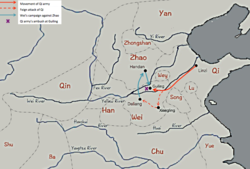
Qi strategist Sun Bin used deception and a feigned attack on Wei's capital Daliang to trap and crush the Wei army at Guiling, capturing its commander Pang Juan. The battle showcased Sun Bin's military genius recorded in the Art of War attributed to him.
Image source: Battle of Guiling
341 BC
% complete
Sun Bin again outmaneuvered Wei, ambushing its army at Maling where Pang Juan died and the crown prince was captured. The devastating defeat ended Wei's supremacy and shifted the balance of power toward Qi and Qin.
Image source: Battle of Maling
293 BC
% complete
Qin's fearsome general Bai Qi annihilated a joint Han-Wei army at Yique, reportedly killing 240,000 men and seizing extensive territory east of the passes. The victory opened the road into the heartland of the Central Plains.
Image source: Battle of Yique
278 BC
% complete
Bai Qi led a deep strike into Chu, captured and flooded the ancient capital Ying, forcing Chu to relocate east to Chen. The catastrophic loss stripped Chu of its historic heartland and irreversibly weakened the southern giant.
Image source: Battle of Yanling
262 BC - 260 BC
% complete
In the bloodiest battle of the era, Qin and Zhao massed enormous armies in a prolonged stalemate. After Zhao replaced the veteran Lian Po with the inexperienced Zhao Kuo, Bai Qi encircled and destroyed the Zhao host, allegedly burying alive some 400,000 surrendered soldiers. Zhao never recovered its strength.
Image source: Battle of Changping
259 BC - 257 BC
% complete
Following Changping, Qin besieged Zhao's capital Handan. A desperate coalition of Wei and Chu, aided by Lord Xinling's daring seizure of Wei's army, lifted the siege and inflicted a rare defeat on Qin, briefly prolonging the six states' survival.
Image source: Battle of Handan
246 BC
% complete
The thirteen-year-old Ying Zheng ascended the Qin throne, later asserting full personal rule and launching the final wars of conquest. He would become known to history as Qin Shi Huang, the First Emperor of unified China.
Image source: Qin Shi Huang
237 BC
% complete
Li Si, a legalist scholar from Chu, rose to chancellorship and urged the young king to seize the moment to conquer all rival states. He also authored the famous memorial expelling foreign officials, securing openness to talent from across the realm.
Image source: Li Si
230 BC
% complete
Qin's armies overran Han, the weakest of the six states and nearest to Qin's homeland, capturing its king and annexing its lands. This marked the beginning of the final decade-long campaign of unification.
Image source: Shu Han
228 BC
% complete
General Wang Jian exploited internal treachery to break Zhao's defenses, capturing Handan and its king. Remnant Zhao forces fled north but the state effectively ceased to exist, removing a major obstacle to unification.
Image source: Zhao (state)
227 BC
% complete
Sent by the crown prince Dan of Yan, assassin Jing Ke concealed a poisoned dagger in a map scroll and nearly killed the King of Qin in court. The failed assassination gave Qin a pretext to accelerate its attack on Yan.
Image source: Jing Ke
225 BC
% complete
General Wang Ben diverted the waters of the Yellow River to flood the Wei capital Daliang, forcing its surrender after months. Wei, once the leading state of the early era, was extinguished.
224 BC - 223 BC
% complete
Demanding a colossal army of 600,000 men, veteran general Wang Jian waged a patient campaign that crushed Chu's resistance, killed its general Xiang Yan's forces' morale, and captured the Chu king, ending the largest of the rival states.
Image source: Qin's wars of unification
222 BC
% complete
Qin forces swept northeast and destroyed Yan, capturing its king and eliminating the state that had sponsored the Jing Ke assassination plot. Only Qi remained outside Qin's control.
Image source: Yan (state)
221 BC
% complete
Qi surrendered almost without a fight as Qin armies approached from the north. With all six rivals conquered, Ying Zheng proclaimed himself Shi Huangdi, the First Emperor, founding imperial China and ending the Warring States period.
Image source: Qin's wars of unification
Or browse the full history timeline directory, with more than 2,000 topics.
This Warring States Period of China timeline was generated with the help of AI, using information found on the internet.
We work hard to keep these timelines accurate, but mistakes do get through. If you spot one, email us at [email protected] and we'll fix it for future visitors.
Generate yours with AI or build it from scratch, for free.
Export your timeline, add your own events, edit or remove AI-generated events, and much more
No credit card required.
Cancel anytime.
Cancel anytime.
You can create an unlimited number of timelines with up to 10 events on each one, customize how they look, export them to PDF, PNG, PowerPoint, CSV, and Excel, and share them with a link. Paid plans raise the event limit and add features like spreadsheet imports and collaborators.
Yes. You can cancel your subscription from your account page at any time, and you will not be charged again. Your subscription stays active for the rest of the period you already paid for.
Yes. We will email you a reminder before the annual renewal, and we will also email you a receipt.
Yes. You can email us within 15 days of any payment, and we will issue you a full refund.
Check out our pricing docs or send us an email anytime: [email protected].