-
Use Cases
-
Resources
-
Pricing
1841
Missionary and explorer David Livingstone traveled extensively through southern and central Africa, helping popularize European geographic and commercial interest in the continent.
Image source: David Livingstone
1882
Britain occupied Egypt after the Urabi revolt, officially preserving Ottoman sovereignty while exercising decisive control over the country and the route to the Suez Canal.
Image source: History of Egypt under the British
1883 - 1896
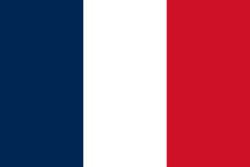
France fought two campaigns against the Merina monarchy and imposed a protectorate before annexing Madagascar as a colony in 1896.
Image source: French Madagascar
1884
Germany proclaimed a protectorate over coastal and inland territories in present-day Namibia, beginning formal German colonial rule in southwestern Africa.
1884
Germany claimed Togoland, a small but commercially important territory on the Gulf of Guinea that became part of German West Africa.
Jul 12, 1884
German representatives signed treaties with coastal rulers and proclaimed Kamerun, initiating German control over much of present-day Cameroon and neighboring regions.
Image source: Kamerun
1885
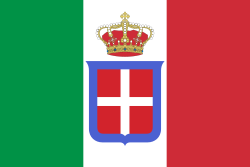
Italy seized Massawa on the Red Sea from Egypt, using the port as the foundation for its colony of Eritrea and later expansion into the Horn of Africa.
Image source: Italian Eritrea
1885
Germany recognized the colonial claims of the German East Africa Company, beginning the process that created German East Africa across present-day Tanzania, Rwanda, and Burundi.
1886
Britain chartered the Royal Niger Company to administer and trade across the Niger basin, laying groundwork for the later consolidation of Nigeria.
Image source: Royal Niger Company
Oct 29, 1889
The company received a royal charter to exploit and administer territory north of the Limpopo, facilitating Cecil Rhodes's expansion into present-day Zimbabwe and Zambia.
Image source: British South Africa Company
Aug 27, 1896
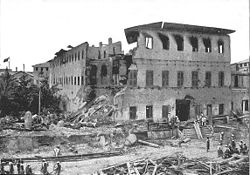
Britain bombarded Zanzibar after Sultan Khalid bin Barghash seized power without British approval; the conflict lasted less than an hour and installed a British-backed ruler.
Image source: Anglo-Zanzibar War
Sep 29, 1911 - Oct 18, 1912
Italy invaded Ottoman Tripolitania and Cyrenaica, acquiring Libya after the Italo-Turkish War and extending European colonial rule across North Africa.
Image source: Italo-Turkish War
Mar 30, 1912
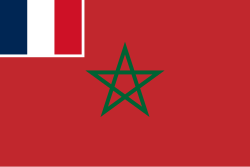
The Treaty of Fez made Morocco a French protectorate, while Spain received a northern zone and international control was established at Tangier.
Image source: French protectorate in Morocco
1881 - 1899
Muhammad Ahmad's Mahdist movement challenged Egyptian and British authority in Sudan, eventually establishing a powerful Islamic state before its defeat by an Anglo-Egyptian army.
Image source: Mahdist War
1892 - 1894
French forces defeated the Dahomey kingdom after two wars, incorporating its territory into French West Africa despite determined resistance from its army.
Image source: Dahomey
1893 - 1894
British South Africa Company forces defeated the Ndebele kingdom, opening much of Matabeleland to colonial occupation and settler rule.
Image source: First Matabele War
1895 - 1896
Britain deposed and exiled Asantehene Prempeh I, converting the Ashanti kingdom into a British protectorate after decades of conflict.
Image source: Anglo-Ashanti wars
1896 - 1899
British and Egyptian forces reconquered Sudan, defeating the Mahdist state at Omdurman in 1898 and establishing the Anglo-Egyptian Sudan condominium.
Image source: Anglo-Egyptian conquest of Sudan
Mar 1, 1896
Ethiopian forces under Menelik II decisively defeated Italy, preserving Ethiopian independence and delivering one of Africa's most important victories against European imperialism.
Image source: Battle of Adwa
Feb 1897
A British punitive expedition captured Benin City, destroyed the Benin kingdom's political independence, and removed thousands of artworks, many later known as the Benin Bronzes.
Oct 11, 1899 - May 31, 1902
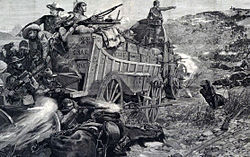
Britain fought the Boer republics of Transvaal and the Orange Free State. British victory brought the Boer territories into the empire but intensified Afrikaner nationalism.
Image source: Second Boer War
1904 - 1908
German colonial forces responded to uprisings in German South West Africa with extermination orders, expulsions, concentration camps, and mass death among Herero and Nama communities.
Image source: Herero and Nama genocide
Jul 1905 - 1907
Communities across German East Africa rebelled against forced cotton cultivation, taxation, and labor. German scorched-earth tactics caused a catastrophic famine and hundreds of thousands of deaths.
Image source: Maji Maji Rebellion
Nov 15, 1884 - Feb 26, 1885
European powers met in Berlin at Otto von Bismarck's invitation to establish rules for commercial access, navigation, and diplomatic recognition of territorial claims in Africa.
Image source: Berlin Conference
Feb 26, 1885
The Berlin Conference recognized King Leopold II's personal control over the Congo Free State, creating a vast nominally independent colony that became notorious for forced labor and mass violence.
Image source: Congo Free State
Jul 1, 1890
The treaty defined spheres of influence in East Africa and marked a broader European effort to formalize territorial claims without direct war between imperial powers.
Image source: Heligoland–Zanzibar Treaty
Jul 1, 1890
Britain and Germany settled competing interests by transferring Heligoland to Germany and recognizing British predominance in Zanzibar and parts of East Africa.
1898 - 1904
A series of agreements clarified the boundary between British and French spheres from the Sahara to the Gulf of Guinea, helping complete the division of much of West Africa.
Sep 18, 1898 - Nov 3, 1898
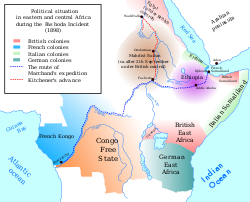
French and British expeditions confronted one another at Fashoda in Sudan. France withdrew, allowing Britain to consolidate its north–south imperial corridor and easing future Anglo-French rivalry.
Image source: Fashoda Incident
Apr 8, 1904
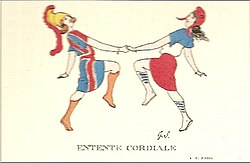
Britain and France settled colonial disputes, recognizing French predominance in Morocco and British predominance in Egypt. The agreement helped stabilize the partition of North Africa.
Image source: Entente Cordiale
Mar 31, 1905 - May 31, 1906
Kaiser Wilhelm II challenged French influence in Morocco, prompting an international conference at Algeciras. The crisis deepened tensions between Germany, France, and Britain.
Image source: First Moroccan Crisis
Jan 16, 1906 - Apr 7, 1906
The conference formally preserved Morocco's nominal independence while granting France and Spain special policing roles, effectively strengthening French control.
Apr 1, 1911 - Nov 4, 1911
Germany sent the gunboat Panther to Agadir to pressure France over Morocco. The crisis ended with German recognition of French control and intensified European militarization.
Image source: Agadir Crisis
1899 - 1908
Reports by missionaries, diplomats, and investigators exposed killings, mutilation, hostage-taking, and forced labor in Leopold II's Congo, provoking an international reform campaign.
Nov 15, 1908
Under international pressure, Belgium annexed the Congo Free State from Leopold II, replacing personal rule with Belgian colonial administration while retaining coercive labor systems.
May 31, 1910
The British colonies and former Boer republics united as the Union of South Africa, creating a self-governing dominion whose institutions entrenched racial segregation.
Image source: Union of South Africa
1913
By the eve of World War I, treaties and military campaigns had assigned nearly all of Africa to European empires, leaving Ethiopia and Liberia as the principal independent states.
Image source: Scramble for Africa
Jul 28, 1914 - Nov 11, 1918
The First World War turned African colonies into battlefields and recruiting grounds. Germany lost its African colonies, which were redistributed as League of Nations mandates after the war.
Image source: African theatre of World War I
Or browse the full history timeline directory, with more than 2,500 topics.
This Scramble for Africa timeline was generated with the help of AI, using information found on the internet.
We work hard to keep these timelines accurate, but mistakes do get through. If you spot one, email us at [email protected] and we'll fix it for future visitors.
Generate yours with AI or build it from scratch, for free.
Export your timeline, add your own events, edit or remove AI-generated events, and much more
No credit card required.
Cancel anytime.
Cancel anytime.
You can create an unlimited number of timelines with up to 10 events on each one, customize how they look, export them to PDF, PNG, PowerPoint, CSV, and Excel, and share them with a link. Paid plans raise the event limit and add features like spreadsheet imports and collaborators.
Yes. You can cancel your subscription from your account page at any time, and you will not be charged again. Your subscription stays active for the rest of the period you already paid for.
Yes. We will email you a reminder before the annual renewal, and we will also email you a receipt.
Yes. You can email us within 15 days of any payment, and we will issue you a full refund.
Check out our pricing docs or send us an email anytime: [email protected].