
-
Use Cases
-
Resources
-
Pricing
Vasco da Gama was a Portuguese explorer who became the first European to reach India by sea, sailing around the Cape of Good Hope in 1497–1498. His voyages opened a direct maritime route between Europe and Asia, establishing Portuguese dominance in the spice trade and reshaping global commerce. More Less
1460
% complete
Vasco da Gama was born in or around 1460, though some authors give 1469 as the year of his birth. He would become a Portuguese mariner, explorer and nobleman.
Image source: Vasco da Gama
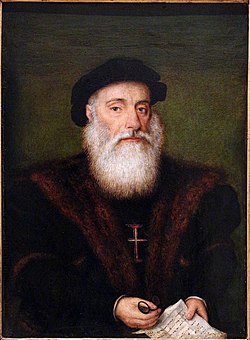
1460 - 1478
% complete
Da Gama's father, Estêvão da Gama, was appointed alcaide-mór (civil governor) of Sines in the 1460s, a post he held until 1478; after that he continued as a receiver of taxes and holder of the Order's commendas in the region.
1469
% complete
After Prince Henry the Navigator's death in 1460, the Portuguese Crown showed little interest in African exploration. In 1469 it licensed the neglected African enterprise to a private Lisbon merchant consortium led by Fernão Gomes.
1474
% complete
When Fernão Gomes' charter came up for renewal in 1474, Prince John (the future John II) asked his father Afonso V of Portugal to pass the African charter to him, reviving royal interest in reaching India by sea.
1480
% complete
Around 1480, Vasco da Gama followed his father (rather than the Sodrés) and joined the Order of Santiago. The master of Santiago was Prince John, who ascended to the throne in 1481 as King John II of Portugal.
1481
% complete
Upon becoming king in 1481, John II of Portugal set out on many long reforms, renewing Portuguese efforts to find an ocean route to India around Africa.
Image source: John II of Portugal
1487
% complete
In 1487, John II dispatched two spies, Pero da Covilhã and Afonso de Paiva, overland via Egypt to East Africa and India, to scout the details of the spice markets and trade routes.
Image source: Pêro da Covilhã
1488
% complete
The breakthrough came when John II's captain Bartolomeu Dias returned from rounding the Cape of Good Hope in 1488, having explored as far as the Fish River in modern-day South Africa and verified that the unknown coast stretched away to the northeast.
Image source: Bartolomeu Dias
1492
% complete
In 1492, John II dispatched da Gama on a mission to the port of Setúbal and to the Algarve to seize French ships in retaliation for peacetime depredations against Portuguese shipping – a task that da Gama rapidly and effectively performed.
Jul 8, 1497
% complete
On 8 July 1497, Vasco da Gama led a fleet of four ships with a crew of 170 men from Lisbon, beginning the first voyage to link Europe and Asia by an ocean route around the southern tip of Africa.
Aug 1497
% complete
After reaching the coast of present-day Sierra Leone, da Gama took a course south into the open ocean, crossing the equator and seeking the South Atlantic westerlies that Bartolomeu Dias had discovered in 1487.
Nov 4, 1497
% complete
The open-ocean course proved successful and on 4 November 1497, the expedition made landfall on the African coast.
Mar 2, 1498 - Mar 29, 1498
% complete
Vasco da Gama spent 2 to 29 March 1498 in the vicinity of Mozambique Island as the expedition worked its way up the East African coast toward India.
Apr 7, 1498 - Apr 13, 1498
% complete
The Portuguese became the first known Europeans to visit the port of Mombasa from 7 to 13 April 1498, but were met with hostility and soon departed.
Image source: Mombasa
Apr 14, 1498 - Apr 24, 1498
% complete
Vasco da Gama continued north, arriving on 14 April 1498 at the friendlier port of Malindi, whose leaders were in conflict with those of Mombasa. He left Malindi for India on 24 April 1498.
Image source: Malindi
May 20, 1498
% complete
The fleet arrived in Kappadu near Kozhikode (Calicut) on the Malabar Coast of present-day Kerala, India, on 20 May 1498. Da Gama finally accomplished the feat of linking Europe and Asia by sea, though he was not the first Portuguese mariner to round the Cape.
Image source: Kozhikode
Aug 29, 1498
% complete
After difficult negotiations with the Zamorin of Kozhikode, Vasco da Gama left Kozhikode on 29 August 1498. They finally struck out for their Indian Ocean crossing on 3 October 1498.
Jan 2, 1499
% complete
Da Gama saw land again only on 2 January 1499, passing before the coastal Somali city of Mogadishu, then under the influence of the Ajuran Empire in the Horn of Africa.
Image source: Mogadishu
Jan 7, 1499
% complete
Da Gama's fleet arrived in Malindi on 7 January 1499 in a terrible state – approximately half of the crew had died during the crossing, and many of the rest were afflicted with scurvy.
Jul 1499 - Aug 1499
% complete
King Manuel wrote two letters describing da Gama's first voyage, in July and August 1499, soon after the return of the ships.
Image source: Manuel I of Portugal
Jul 10, 1499
% complete
The Berrio arrived in Lisbon on 10 July 1499 and Nicolau Coelho personally delivered the news of the voyage's success to King Manuel I and the royal court, then assembled in Sintra.
Image source: Nicolau Coelho
Aug 29, 1499
% complete
Da Gama eventually took passage on an Azorean caravel and finally arrived in Lisbon on 29 August 1499 (according to Barros), or early September according to other sources.
Dec 1499
% complete
In December 1499, King Manuel I rewarded Vasco da Gama with the town of Sines as a hereditary fief – the town his father, Estêvão, had once held as a comenda.
1500
% complete
The follow-up expedition, the Second India Armada, launched in 1500 under Pedro Álvares Cabral with the mission of making a treaty with the Zamorin of Kozhikode and setting up a Portuguese factory in the city.
Image source: Pedro Álvares Cabral
1501
% complete
Around 1501, Vasco da Gama married Catarina de Ataíde, daughter of Álvaro de Ataíde, alcaide-mór of Alvor, a noblewoman connected by kinship with the powerful Almeida family; she was a first cousin of Dom Francisco de Almeida.
Oct 1501
% complete
A royal letter dated October 1501 gave da Gama the personal right to intervene and exercise a determining role on any future India-bound fleet.
1502 - 1503
% complete
After da Gama's demand for the expulsion of Muslims from Kozhikode, the Zamorin sent the high priest Talappana Namboothiri – who had conducted da Gama to the Zamorin's chamber during his celebrated first visit in May 1498 – for talks. The 4th armada left India in early 1503.
Image source: Zamorin
Jan 30, 1502
% complete
On 30 January 1502, da Gama was awarded the title Almirante dos mares de Arabia, Persia, India e de todo o Oriente – an overwrought title reminiscent of the ornate Castilian title borne by Christopher Columbus.
Feb 12, 1502
% complete
Invoking his royal letter, da Gama took command of the Fourth India Armada, scheduled to set out in 1502, with the explicit aim of taking revenge upon the Zamorin and forcing him to submit to Portuguese terms. The heavily armed fleet of fifteen ships and eight hundred men left Lisbon on 12 February 1502.
Oct 1502
% complete
On reaching India in October 1502, da Gama's fleet intercepted Mirim, a ship of Muslim pilgrims at Madayi travelling from Kozhikode to Mecca, in one of the most notorious episodes of the voyage.
Sep 1503
% complete
Vasco da Gama arrived back in Portugal in September 1503, effectively having failed in his mission to bring the Zamorin to submission.
1505
% complete
When King Manuel I decided to appoint the first governor and viceroy of Portuguese India in 1505, da Gama was conspicuously overlooked, and the post given to Francisco de Almeida.
Image source: Francisco de Almeida
1507
% complete
Da Gama spent years attempting to take hold of Sines, an effort that estranged him from Lencastre and eventually prompted him to abandon his beloved Order of Santiago, switching over to the rival Order of Christ in 1507. His attempts to return to the favor of Manuel I yielded little.
Image source: Military Order of Christ
1518
% complete
After Ferdinand Magellan defected to the Crown of Castile in 1518, Vasco da Gama threatened to do the same, prompting the king to undertake steps to retain him in Portugal and avoid the embarrassment of losing his own "Admiral of the Indies" to Spain.
Image source: Ferdinand Magellan
Dec 29, 1519
% complete
In 1519, after years of ignoring his petitions, King Manuel I appointed Vasco da Gama the first Count of Vidigueira by royal decree issued in Évora on 29 December, after a complicated agreement with Dom Jaime, Duke of Braganza, who ceded him the towns of Vidigueira and Vila dos Frades.
Image source: Count of Vidigueira
Feb 1524
% complete
By his appointment letter of February 1524, John III granted Vasco da Gama the privileged title of "Viceroy", being only the second Portuguese governor to enjoy that title (the first was Francisco de Almeida in 1505).
Image source: Governor-General of India
Apr 1524
% complete
Setting out in April 1524 with a fleet of fourteen ships, Vasco da Gama took as his flagship the famous large carrack Santa Catarina do Monte Sinai on her last journey to India, along with two of his sons, Estêvão and Paulo.
Image source: Santa Catarina do Monte Sinai
Dec 24, 1524
% complete
Da Gama contracted malaria not long after arriving and died in the city of Cochin in India on Christmas Eve in 1524, three months after his arrival. He was buried at St. Francis Church at Fort Kochi, but his remains were returned to Portugal in 1539.
1525
% complete
Da Gama's sons Estêvão and Paulo immediately lost their posts and joined the returning fleet of early 1525, along with the dismissed Duarte de Menezes and Luís de Menezes.
1533 - 1534
% complete
Dom Paulo da Gama (having the same name as his uncle), son of the explorer, served as captain of Malacca from 1533 to 1534 and was killed in a naval action off Malacca.
Image source: Paulo da Gama
1534 - 1539
% complete
After his abortive 1524 term as Indian patrol captain, Dom Estêvão da Gama was appointed for a three-year term as captain of Malacca, serving from 1534 to 1539, which included the last two years of his younger brother Paulo's term.
Image source: Estêvão da Gama (16th century)
1539
% complete
Da Gama's remains were returned to Portugal from St. Francis Church at Fort Kochi in 1539 and interred in the chapel at Vidigueira.
1540 - 1542
% complete
Dom Estêvão da Gama, son of Vasco, was subsequently appointed as the 11th governor of India from 1540 to 1542.
1542
% complete
Dom Cristóvão da Gama, another son of Vasco, had been captain of Malacca from 1538 to 1540; nominated to succeed there, he instead joined the Ethiopian-Adal war and was executed by Ahmad ibn Ibrahim in 1542.
Image source: Cristóvão da Gama
1552 - 1554
% complete
Dom Álvaro de Ataíde da Gama, appointed captain of Malacca fleet in the 1540s, served as captain of Malacca itself from 1552 to 1554. Another son, Dom Pedro da Silva da Gama, held the same post from 1548 to 1552.
Image source: Vasco da Gama
1597 - 1600
% complete
Dom Francisco da Gama, 4th Count of Vidigueira, great-grandson of Vasco da Gama, served as viceroy (1597–1600) and again as governor (1622–1628) of India.
1735
% complete
His male-line issue became extinct in 1735, when the 7th Count of Vidigueira, Dom Vasco Baltasar José Luís Gama died, leaving only one daughter, Dona Maria José da Gama, who inherited the Vidigueira estate.
1865
% complete
The 1865 grand opera L'Africaine, composed by Giacomo Meyerbeer from a libretto by Eugène Scribe, prominently includes the character of Vasco da Gama. A 1989 production by the San Francisco Opera featured tenor Plácido Domingo in the role of da Gama.
Image source: L'Africaine
1872
% complete
The 19th-century composer Louis-Albert Bourgault-Ducoudray composed an eponymous 1872 opera based on da Gama's life and exploits at sea.
Image source: Louis-Albert Bourgault-Ducoudray
1880
% complete
In 1880, what were believed to be da Gama's remains and those of the poet Luís de Camões (who celebrated da Gama's first voyage in his 1572 epic Os Lusíadas), were moved to new carved tombs in the nave of the monastery's church, near the tombs of kings Manuel I and John III.
Image source: Jerónimos Monastery
1884
% complete
By 1884, Teixeira de Aragão discovered documents suggesting the wrong remains had been exhumed from Vidigueira: da Gama's gravestone had been exchanged with that of his great-grandson Francisco da Gama, likely during restoration works in 1841. The casket moved in 1880 contained the bones of more than one person.
May 1898
% complete
It was not until May 1898, during the celebrations of the fourth centenary of da Gama's arrival in Kozhikode, that the remains from the other tomb in the chapel of Vidigueira were moved to the Hieronymite monastery.
1998
% complete
The wreck of the Esmeralda from da Gama's 1502–03 fleet was initially discovered in 1998 off the coast of Oman. In 2016, archaeologists formally identified the shipwreck.
Image source: Esmeralda (carrack)
2013 - 2015
% complete
Underwater excavations of the Esmeralda wreck took place between 2013 and 2015 through a partnership between the Oman Ministry of Heritage and Culture and Blue Water Recoveries Ltd., a shipwreck recovery company, confirming its identification announced in 2016.
Or browse the full history timeline directory, with more than 2,000 topics.
This Vasco da Gama timeline was generated with the help of AI, using information found on the internet.
We work hard to keep these timelines accurate, but mistakes do get through. If you spot one, email us at [email protected] and we'll fix it for future visitors.
Generate yours with AI or build it from scratch, for free.
Export your timeline, add your own events, edit or remove AI-generated events, and much more
No credit card required.
Cancel anytime.
Cancel anytime.
You can create an unlimited number of timelines with up to 10 events on each one, customize how they look, export them to PDF, PNG, PowerPoint, CSV, and Excel, and share them with a link. Paid plans raise the event limit and add features like spreadsheet imports and collaborators.
Yes. You can cancel your subscription from your account page at any time, and you will not be charged again. Your subscription stays active for the rest of the period you already paid for.
Yes. We will email you a reminder before the annual renewal, and we will also email you a receipt.
Yes. You can email us within 15 days of any payment, and we will issue you a full refund.
Check out our pricing docs or send us an email anytime: [email protected].