-
Use Cases
-
Resources
-
Pricing
The Treaty of Tordesillas was an agreement signed between the Spanish Crown and Portugal that divided newly discovered lands outside Europe along a meridian in the Atlantic Ocean. Brokered with papal support following Christopher Columbus's voyages, it granted Spain rights to most of the Americas and Portugal rights to Africa, Asia, and Brazil, profoundly shaping the course of global colonization. More Less
1479
% complete
The 1479 Treaty of Alcáçovas, later reinforced by the 1481 papal bull Aeterni regis, granted all lands south of the Canary Islands to Portugal. Portugal would invoke these agreements to claim the lands Columbus discovered belonged to it.
Image source: Treaty of Alcáçovas
1481
% complete
The 1481 papal bull Aeterni regis confirmed Portuguese claims to all lands south of the Canary Islands, providing a legal basis for Portugal's assertion of rights over newly discovered territories in Africa and beyond.
1493
% complete
After learning of the Castilian-sponsored voyage, the Portuguese king sent a threatening letter to King Ferdinand and Queen Isabella, claiming by the Treaty of Alcáçovas and the bull Aeterni regis that all lands discovered by Columbus belonged to Portugal.
Image source: Treaty of Tordesillas
1493
% complete
By 1493, Portuguese explorers had reached the southern tip of Africa, the Cape of Good Hope, giving Portugal strong strategic interest in securing its claims to eastern sea routes in negotiations with Castile.
Image source: Cape of Good Hope
Mar 1493
% complete
The return in 1493 of Christopher Columbus and his crew, sailing under the Crown of Castile, from their first voyage sparked the dispute between Spain and Portugal over newly discovered lands that the Treaty of Tordesillas was intended to resolve.
Image source: Christopher Columbus
1500
% complete
In 1500 Pedro Álvares Cabral landed on the easternmost part of current Brazil while en route to India; this territory fell within the portion of South America granted to Portugal by the Treaty of Tordesillas.
Image source: Pedro Álvares Cabral
May 4, 1493
% complete
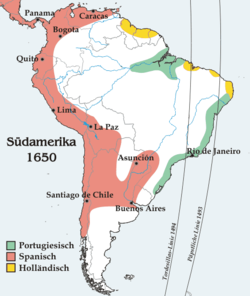
Pope Alexander VI decreed in the bull Inter caetera that all lands west of a pole-to-pole line 100 leagues west of any of the Azores or Cape Verde Islands should belong to Castile, though territory already under Christian rule as of Christmas 1492 remained untouched.
Image source: Inter caetera
Sep 25, 1493
% complete
The bull Dudum siquidem gave all mainlands and islands 'at one time or even still belonging to India' to Spain, even if east of the line drawn by Inter caetera, further inflaming the dispute with Portugal.
Image source: Dudum siquidem
Jun 7, 1494
% complete
Signed in Tordesillas, Spain, on 7 June 1494, the treaty divided newly discovered lands outside Europe between Portugal and Castile along a meridian 370 leagues (c. 2,100 km) west of the Cape Verde islands off the west coast of Africa.
Jul 2, 1494
% complete
Castile ratified the Treaty of Tordesillas on 2 July 1494, less than a month after the treaty was signed in the town of Tordesillas, moving forward with the agreed division of the Atlantic world with Portugal.
Sep 5, 1494
% complete
Portugal ratified the Treaty of Tordesillas on 5 September 1494 at Setúbal, completing the ratification process on both sides and formally binding the two kingdoms to the new line of demarcation.
Jan 24, 1506
% complete
On 24 January 1506 Pope Julius II sanctioned the treaty through the bull Ea quae pro bono pacis, completing ratification of the agreement; some sources call the resulting line the 'Papal Line of Demarcation.'
1514
% complete
Pope Leo X, who was friendly toward Portugal and its discoveries, issued the bull Praecelsae devotionis in 1514 granting Portugal favorable recognition of its conquests and explorations.
Image source: Treaty of Tordesillas
1495
% complete
The earliest Aragonese opinion on the location of the demarcation line was provided by Jaime Ferrer in 1495 at the request of Ferdinand and Isabella, part of ongoing efforts to determine exactly where the treaty's meridian fell.
Image source: Jaime Ferrer
1501 - 1502
% complete
The earliest surviving Portuguese opinion on the demarcation is found on the Cantino planisphere of 1501 or 1502, generally considered to represent the Portuguese standard map of its day.
Image source: Cantino planisphere
1518
% complete
In 1518, another Castilian opinion on the demarcation was provided by Martin Fernández de Enciso as Spain and Portugal continued to contest the precise placement of the treaty's dividing line.
1524
% complete
In 1524, the Castilian mathematician Tomás Durán and pilots Sebastian Cabot and Juan Vespucci gave their opinion to the conference at Badajoz, whose failure to resolve the dispute led to the Treaty of Zaragoza.
Image source: Badajoz massacre
1529
% complete
The 1529 Diogo Ribeiro map—generally considered to represent the now-lost Spanish standard map used to finalize the agreement at Zaragoza—placed its own delineation of the Tordesillas agreement much further west, around 49°45′ W.
Image source: Diogo Ribeiro
1585 - 1607
% complete
The treaty's Islas de las Velas (Islands of the Sails), likely the Marianas, appeared in a 1585 Spanish history of China, Plancius's 1594 world map, Linschoten's 1598 London edition, and Kærio's 1607 map, identified as a north–south chain in the northwest Pacific also called the Islas de los Ladrones.
Image source: Mariana Islands
1667
% complete
Spain changed the name of the Islas de los Ladrones (Islands of the Thieves) to 'Islas de las Marianas' (Mariana Islands) in 1667; the chain includes Guam at its southern end, whose longitude closely matched the treaty's 17° east of the Moluccas.
1512
% complete
Portugal's discovery of the highly valued Moluccas in 1512 caused Spain to argue in 1518 that the Treaty of Tordesillas divided the earth into two equal hemispheres, opening a new dispute over the far side of the world.
Image source: Maluku Islands
1521
% complete
After the surviving ships of Magellan's fleet visited the Moluccas in 1521, Spain claimed that those islands were within its western hemisphere under the Treaty of Tordesillas, intensifying the rivalry over the spice trade.
Image source: Magellan expedition
1522 - 1523
% complete
The Portuguese built Forte de São João Baptista de Ternate on the southwest coast of the principal Moluccan island during 1522–23. Under the Treaty of Zaragoza, the fort could only be repaired, not modified.
Image source: Fort Kastela
Feb 19, 1524
% complete
The Treaty of Vitoria, negotiated between Spain and Portugal on 19 February 1524, called for the Junta of Badajoz to meet in an attempt to reach an agreement on the antimeridian, which ultimately failed.
Apr 22, 1529
% complete
Signed on 22 April 1529 between Charles I of Spain and John III of Portugal, the Treaty of Zaragoza specified the antimeridian to the Tordesillas line, with Spain relinquishing claims to the Moluccas for payment of 350,000 ducats of gold by Portugal.
Image source: Treaty of Zaragoza
1542
% complete
By 1542, Charles V decided to colonize the Philippines, judging that Portugal would not protest because the archipelago had no spices, effectively pushing past the limits implied by the Iberian treaties.
Image source: History of the Philippines
1565
% complete
King Philip II succeeded in 1565 when he sent Miguel López de Legazpi and Andrés de Urdaneta, establishing the initial Spanish trading post at Cebu, extending Spain's Pacific empire despite the earlier division agreements.
Image source: Miguel López de Legazpi
1571
% complete
Following the establishment of Cebu, Spain founded Manila in 1571, consolidating its colonial presence in the Philippines and anchoring its trans-Pacific empire that stretched from the Americas across the antimeridian.
Image source: Manila
1580 - 1640
% complete
Even when Spain and Portugal were united under a single king between 1580 and 1640, the divided possessions sanctioned by the Treaty of Tordesillas continued to be observed by both empires.
Image source: Iberian Union
Jan 13, 1750
% complete
On January 13, 1750, Kings John V of Portugal and Ferdinand VI of Spain signed the Treaty of Madrid establishing borders between Brazil and Spanish America, admitting that the Treaty of Tordesillas had been superseded and was considered void.
Image source: Treaty of Madrid (13 January 1750)
1761
% complete
Following the Guarani War, the 1750 Treaty of Madrid was annulled by Spain and Portugal in the Treaty of El Pardo (1761), reviving older territorial arrangements in South America.
1777
% complete
The border between Spanish and Portuguese America was eventually settled in the First Treaty of San Ildefonso in 1777, with Spain acquiring territories east of the Uruguay River and Portugal gaining territories in the Amazon Basin.
Image source: First Treaty of San Ildefonso
1900 - 1999
% complete
The Treaty of Tordesillas was invoked by Chile in the 20th century to defend the principle of an Antarctic sector extending along a meridian to the South Pole, asserting that the treaty made Spanish or Portuguese all undiscovered land south to the Pole.
Image source: Territorial claims in Antarctica
Or browse the full history timeline directory, with more than 2,000 topics.
This Treaty of Tordesillas timeline was generated with the help of AI, using information found on the internet.
We work hard to keep these timelines accurate, but mistakes do get through. If you spot one, email us at [email protected] and we'll fix it for future visitors.
Generate yours with AI or build it from scratch, for free.
Export your timeline, add your own events, edit or remove AI-generated events, and much more
No credit card required.
Cancel anytime.
Cancel anytime.
You can create an unlimited number of timelines with up to 10 events on each one, customize how they look, export them to PDF, PNG, PowerPoint, CSV, and Excel, and share them with a link. Paid plans raise the event limit and add features like spreadsheet imports and collaborators.
Yes. You can cancel your subscription from your account page at any time, and you will not be charged again. Your subscription stays active for the rest of the period you already paid for.
Yes. We will email you a reminder before the annual renewal, and we will also email you a receipt.
Yes. You can email us within 15 days of any payment, and we will issue you a full refund.
Check out our pricing docs or send us an email anytime: [email protected].